
Valorant Rank Distribution: Percentages and Account Value
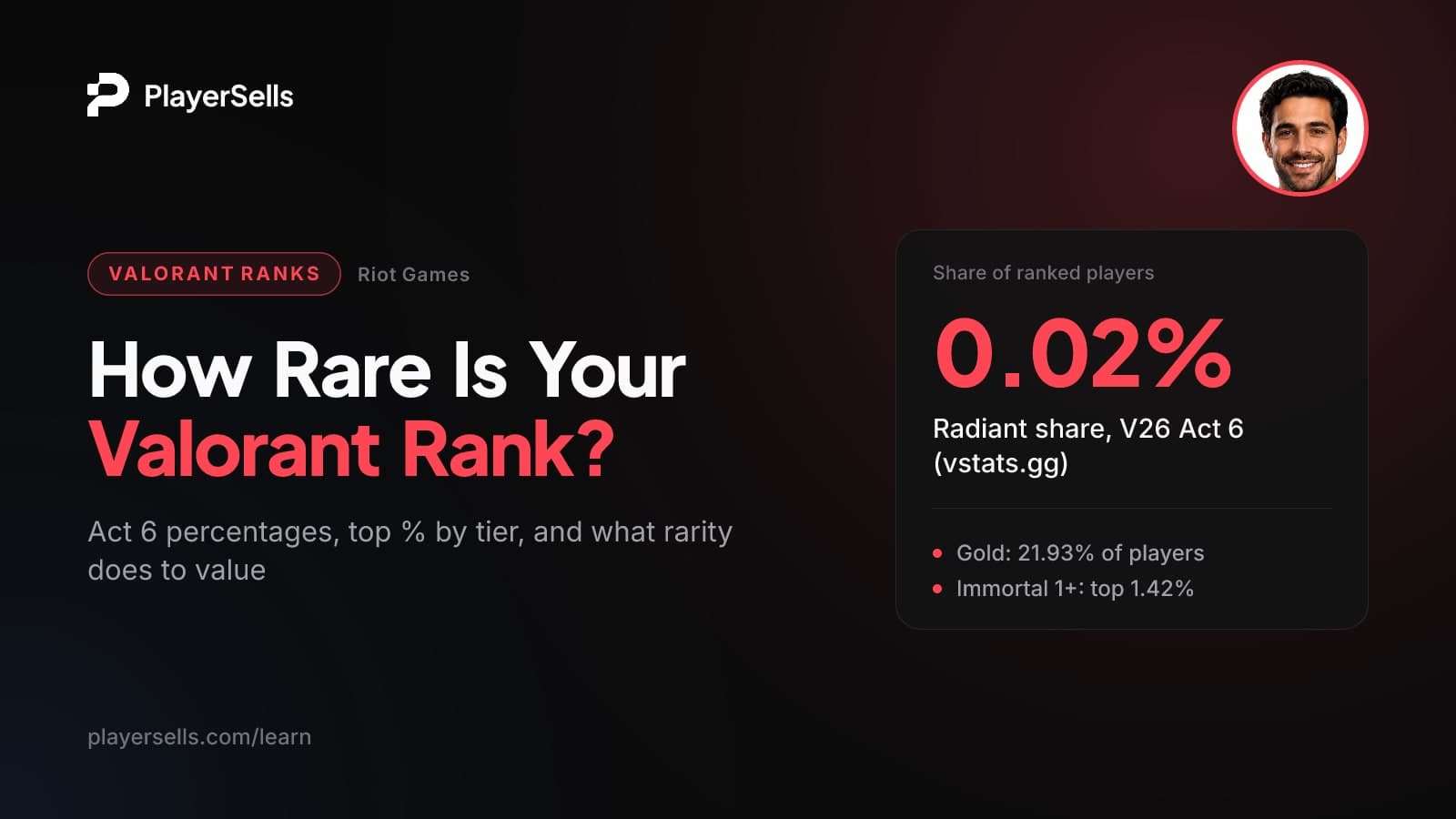
Valorant rank distribution for V26 Act 6: Gold is 21.93% of players, Immortal+ about the top 1-2%. See how rank rarity affects account value and ban risk.
The tracker vstats.gg published V26 Act 6 data in October 2026, taken early in the act and covering all regions. In it, Gold is the largest group at 21.93% of ranked players, and Gold 1 is the most common single rank at 8.63%. Immortal 1-3 together make up about 2.1%, and Radiant is just 0.02%. Rarity raises how much people think an account is worth, but Riot's terms prohibit buying and selling accounts.
This guide is for players who want to know how rare their rank really is, and for anyone wondering whether that rarity makes a Valorant account worth money. It covers the current distribution, a percentile table by tier, and why the numbers move during an act. It then explains how rank and skins feed into perceived value, why no reliable price index exists, and what Riot's rules mean for ban risk.
Key takeaways
- According to vstats.gg's V26 Act 6 snapshot (October 2026), Gold is the largest Valorant rank group at 21.93% of ranked players, and Gold 1 is the most common single rank at 8.63%.
- Immortal 1 and above covers roughly the top 1.4-2% of ranked players, depending on tracker and timing, and Radiant covers about 0.02-0.05%.
- Early-act data is volatile at the top. Immortal 1 was 1.82% days into Act 6 versus 0.98% in Act 5, while Radiant moved the other way (0.02% versus 0.05%), so recheck mid-act before quoting a percentile.
- A rank shown on an account listing is a snapshot, because placements at the start of each new ranked period cap at Ascendant 3 and Act Rank only reflects one act.
- Valorant skins are tied to the account they were bought on, so their value exists only inside that account and cannot be sold or moved separately.
- Riot's Community Pact says buying, selling or transferring accounts violates its Terms of Service, and Riot has banned sold accounts before, so every purchase carries enforcement risk.
What is the Valorant rank distribution right now?
As of October 2026, the middle of the ladder is crowded and the top is very thin. In vstats.gg's V26 Act 6 rank data, Gold holds 21.93% of ranked players, Silver 19.15% and Platinum 18.98%. Together those three tiers hold about 60% of the ranked players vstats.gg tracks.
One caveat before the numbers. None of these figures come from Riot. They are samples gathered by third-party trackers, and each tracker sees a slightly different slice of the player base. That is why we show two sources side by side: vstats.gg for the newest act and Esports Tales' Act 5 distribution from September 2026.
| Tier | V26 Act 6, by division 1 / 2 / 3 (vstats.gg, Oct 2026) | V26 Act 5 tier total (Esports Tales, Sep 2026) |
|---|---|---|
| Iron | 0.40% / 1.14% / 2.00% | 4.67% |
| Bronze | 4.40% / 4.87% / 4.13% | 15.72% |
| Silver | 19.15% (tier total) | 20.66% |
| Gold | 21.93% (tier total; Gold 1 is 8.63%) | 22.12% |
| Platinum | 18.98% (tier total) | 17.56% |
| Diamond | Not broken out in the data we used | 11.55% |
| Ascendant | 3.91% / 2.43% / 1.38% | 6.32% |
| Immortal | 1.82% / 0.21% / 0.07% | 1.37% |
| Radiant | 0.02% | 0.05% |
Both sources agree on the shape. In Act 5, Esports Tales also had Gold 1 as the single most common rank at 8.70%, ahead of Platinum 1 and Silver 1 at 7.62% each. The median player sits around Gold 1-2. Sources differ on the exact division, so treat "low Gold" as the honest answer.
What percentile is your rank?
Diamond 1 and above is roughly the top 19% of ranked players. Ascendant 1 and above is about the top 8%, and Immortal 1 and above is about the top 1.4%. Those cumulative figures come from Esports Tales' Act 5 "top %" table, which is the most recent full percentile table we found as of October 2026.
The right-hand column below describes, in general terms, how each band tends to be treated when accounts change hands. It does not give prices, because no neutral price data exists (more on that below).
| Rank threshold | Share of players at or above (Act 5) | Rarity band | How the market tends to treat it |
|---|---|---|---|
| Iron to Platinum | Roughly the bottom 80% | Common | Rank adds little. The appeal is mostly that the account can queue ranked at all. |
| Diamond 1+ | Top 19.29% | Above average | A modest signal. Plenty of supply exists at this level. |
| Ascendant 1+ | Top 7.74% | Uncommon | Starts to be advertised as a selling point in listings. |
| Immortal 1+ | Top 1.42% | Rare | The tier where sellers ask for a clear premium. |
| Immortal 3+ | Top 0.22% | Very rare | Small supply, wide and unpredictable asking prices. |
| Radiant | 0.05% (Act 5) / 0.02% (Act 6) | Extreme tail | Tiny supply. The rank depends almost entirely on the original player's own skill. |
Secondary sources often describe Radiant as the top 500 players per region. Riot's leaderboard rules can differ by region and change over time, so treat that as a rule of thumb rather than a fixed number.
Why do the percentages move during an act?
The top of the distribution is unstable early in an act, and it settles as more players finish placements. The clearest example is in the current data. Immortal 1 was 1.82% in vstats.gg's Act 6 pull, taken within days of the act starting, but only 0.98% in Esports Tales' Act 5 data. That is nearly double.
Other snapshots from earlier in 2026 give useful reference points. WIN.gg cited vstats.gg data from 29 March 2026 with Immortal at the top 1.45% and Radiant at 0.04%. PCGamesN, on an undated page from around mid-2026, listed Immortal at 1.44% and Radiant at 0.03%, with Gold the largest group at 22.32%. Between snapshots, the top tiers usually move by a few hundredths to a few tenths of a percentage point. If you need a precise percentile, check again mid-act.
How placements and RR shape the ladder
Placements are part of why early data looks odd. According to Riot's Rank Rating support page, every player plays 5 placement matches at the start of each new ranked period. Riot's page calls these the Season and Mid-Season. The highest possible starting placement is Ascendant 3.
From Iron to Ascendant, a newly placed player starts at 50 RR in their rank and needs 100 RR to promote. After a promotion they get a buffer of at least 10 RR in the new rank. Immortal and Radiant use a different RR system. Because placements cap at Ascendant 3, those ranks have to be won back through matches at the start of each new ranked period.
Current rank vs Act Rank
Act Rank is a separate thing from your current rank. It reflects the highest-ranked match you won during the act, and it decides your end-of-act rewards. A listing that shows an Immortal Act Rank badge is showing a peak, which may not match where the account plays today.
Does a rare rank make a Valorant account worth more?
Rarity raises perceived value, but it does not create legitimate resale value. Riot does not allow accounts to be sold. Where accounts trade anyway, prices follow the shape of the distribution. Gold and Silver accounts are plentiful, so rank adds almost nothing at that level. Immortal and Radiant accounts are scarce, and that scarcity is what sellers charge for.
The problem for a buyer is that the rank itself does not transfer cleanly. What you are paying for is a record of someone else's skill, and the ladder will re-test it.
Ranked-ready accounts: the Level 20 rule
A "ranked-ready" account is simply one that is allowed to queue Competitive. According to Riot's Competitive mode FAQ, an account has needed to be at least Account Level 20 to play Competitive since Episode 4 Act 1. There is one exception. Players below level 20 who played at least one ranked match before Episode 4 can still queue.
So a ranked-ready listing is mostly selling time saved on leveling, not skill. Unranked, level-20 accounts are often marketed this way. That overlaps with smurfing, which Riot penalizes when it detects it.
Immortal and Radiant: why the top tail is priced differently
At the top 1-2%, the account is basically a proof of skill. That is why asking prices jump at Immortal. Supply is tiny, and some buyers want the badge, a high-MMR lobby, or a profile that looks impressive.
Two facts cut against that premium. First, placements cap at Ascendant 3, so after the next reset an Immortal account has to win its way back. A buyer who cannot hold Immortal will fall. Second, Riot's Community Pact says rank manipulation, including boosting, queue boosting and smurfing, is penalized when detected. A high rank reached by boosting is a liability, not an asset.
The rank on a listing is a snapshot
Any rank you see on a listing belongs to one moment in one act. Before you weigh it, check whether it is the current rank or the Act Rank, which act it is from, and when the next ranked reset is due. Also remember that percentiles taken early in an act are volatile, so how rare a rank looks can shift by mid-act.
Skins vs rank: what actually holds value?
Below the very top ranks, skins are usually the more durable part of an account's perceived value. Skins stay on the account after a rank reset, while rank has to be re-earned through placements and matches. A Diamond rank can slip after the next reset, but a collection of premium or limited skins stays put.
There is a catch that most valuation pages leave out. Valorant skins cannot be sold or moved to another account. According to the skin-value site Valorant-Spind, the only official exception is gifting a skin or bundle bought fresh from the store. Riot support will not move skins between accounts, even between two accounts owned by the same person. So a skin's value only exists inside the account it sits on.
That makes skins a property of the account, not a separate asset. If the account is lost to a ban or a dispute, the skins go with it. The same split between what you paid and what you could get back shows up in our guide to Steam account list vs resale value, although Steam items can trade in ways Valorant skins cannot.
How much is my Valorant account worth?
There is no reliable answer in dollars, because there is no neutral price index for Valorant accounts. Every price figure we found came from a marketplace, a boosting site or a calculator run by one. Those sources benefit from the number they publish.
The spread shows the problem. In our research, one valuation page put Immortal and Radiant accounts at $100-$350+, and another put the same tier at $500-$2,000+. Neither gave a method or a date. Treat ranges like these as listing claims you cannot verify, not as market data.
What you can do is assess the factors that drive perceived value and compare like with like:
- Step 1: Record the current rank, the Act Rank and the act each one comes from. Then place them on the percentile table above.
- Step 2: Confirm the account is Level 20 or meets Riot's pre-Episode 4 exception, so it can actually queue Competitive.
- Step 3: List the skins, noting which are premium or limited. These stay through rank resets, so they usually carry more weight than rank.
- Step 4: Note the region, and only compare against listings from the same region.
- Step 5: Check for any history of penalties or restrictions. Riot says that if a player uses an alternate account while another of their accounts is restricted or suspended, the penalty may also be applied to the alt.
- Step 6: Compare against several current listings with a similar rank, skins and region, and discount for the enforcement risk described below.
Can you get banned for buying or selling a Valorant account?
Yes. Buying or selling breaks Riot's rules, and Riot has acted on it before.
Riot's Community Pact states that buying, selling, or transferring accounts violates Riot's Terms of Service. That means any account sale carries the risk of penalties, up to a ban of the account.
The full wording is in Riot's Community Pact. A third-party summary of Riot's Terms of Service from ConductAtlas adds that users get no ownership or property interest in virtual content, and that sharing, selling or transferring accounts in any form is prohibited. Back in VALORANT's 2020 closed beta, Inven Global reported that Riot was banning players who sold their accounts, some of which had been listed for hundreds of dollars.
The Community Pact also sets out a few related points:
- Owning more than one account is fine. Using an alternate account to gain or give a competitive advantage, dodge penalties or disrupt other players is not.
- If Riot detects a player using an alternate account while another account they own is restricted or suspended, the penalty may also be applied to the alt.
- Boosting, queue boosting and smurfing are penalized when detected.
We found no official ban-rate statistics for bought accounts, so be wary of anyone who quotes one. Another risk is commonly reported but not confirmed by Riot: the original owner may reclaim a sold account through support, or reverse the payment with a chargeback. This is a separate issue from Riot's own enforcement. Whether the rules are also a legal matter depends on the country. In practice the issue is Riot's contract terms, and this article does not give legal advice.
Buying or selling a Valorant account on PlayerSells
PlayerSells lists Valorant accounts, so here is plainly what it can and cannot do. Escrow protects the deal between buyer and seller. It cannot change Riot's Terms of Service or stop Riot from acting on an account. You should weigh the risk above before any purchase or sale.
What escrow does cover is the risk of paying and receiving nothing, or receiving something different from the listing. The buyer pays PlayerSells and the money is held. The seller is paid only after the buyer confirms the account was delivered as described. Every listing is reviewed by a person before it goes live. Every deal follows the same sequence: offer sent, accepted, payment pending, paid, delivered, buyer confirmed, completed.
Either side can open a dispute before completion. A human moderator reviews it, and the money stays held while the dispute is open. Sellers receive funds in an on-platform wallet and can withdraw after a clearing period. Fees are on the pricing page, and the full process is on how it works. For practical precautions, read the safety guide.
If you are comparing options, browse Valorant accounts for sale. If rank is what matters to you, look at ranked Valorant accounts. If you care more about cosmetics, see Valorant accounts with skins. Check every listing against the six steps above.
Frequently asked questions
What is the most common rank in Valorant?
Gold 1 is the most common single rank. It held 8.63% of ranked players in vstats.gg's V26 Act 6 data and 8.70% in Esports Tales' Act 5 data. Gold is also the largest tier overall, at about 22% of players in both snapshots.
How rare is Radiant in Valorant?
Radiant is extremely rare, at about 0.02-0.05% of ranked players depending on the tracker and the point in the act. vstats.gg showed 0.02% early in Act 6, and Esports Tales showed 0.05% in Act 5. That works out to roughly 2-5 players in every 10,000.
What rank is the top 1% in Valorant?
No rank lines up exactly with the top 1%. In Act 5 data the cutoff falls inside Immortal 1. Immortal 1 and above was the top 1.42%, and Immortal 2 and above was well under 1%, with Immortal 3 and above at the top 0.22%.
Is Diamond a good rank in Valorant?
Yes, Diamond is a strong rank. Diamond 1 and above was the top 19.29% of ranked players in Esports Tales' Act 5 data, so a Diamond player is ahead of roughly four in five competitors. It is not rare enough to add much to an account's perceived value, though.
Can you transfer Valorant skins to another account?
No. Skins stay on the account they were bought on, and Riot support will not move them, even between two accounts owned by the same person. The only official option is gifting a skin or bundle bought fresh from the store.
Does rank or skins matter more for Valorant account value?
Skins are usually the more durable factor, because they survive rank resets and rank does not. The exception is the extreme top of the ladder, Immortal 3 and Radiant, where scarcity is the main selling point. Even there, the rank depends on whoever plays the account next.
What happens to a bought account's rank at the next reset?
The account plays 5 placement matches like everyone else, and it cannot place higher than Ascendant 3. Any Immortal or Radiant rank has to be won back through matches. A buyer who cannot play at that level will see the rank drop.
Bottom line: is your rank worth anything?
If you only wanted to know where you stand, the answer is simple. Low Gold is the middle of the ladder, Diamond puts you in roughly the top fifth, and Immortal puts you in the top 1-2%. Recheck mid-act, because early-act figures run high at the top.
If you are thinking about money, start with this fact: Riot prohibits account sales, and no neutral price index exists. A rare rank raises perceived value but does not survive the next reset by itself. Skins are tied to the account and can be lost with it. If you still decide to go ahead, compare listings carefully and use escrow for the deal itself. Start from the Valorant marketplace overview.

Published by the PlayerSells editorial team. Data comes from PlayerSells marketplace records and our own crawlers. About PlayerSells · Editorial policy
Related Articles
Continue learning with these related guides.
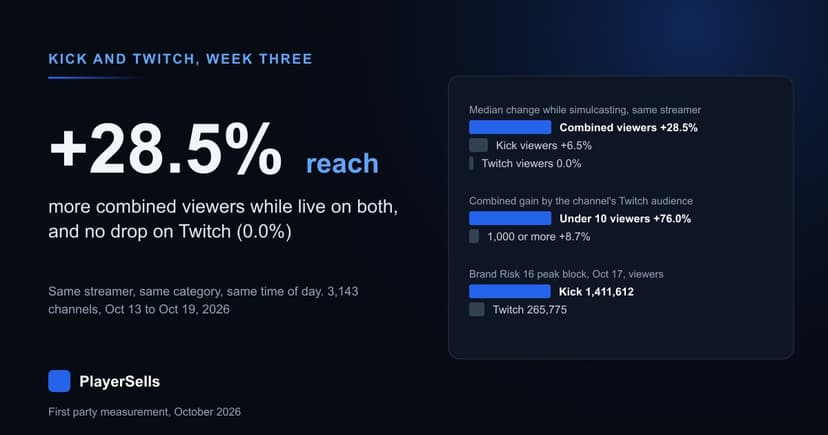
Does Simulcasting Cost Viewers? Kick and Twitch Measured
Compared with themselves, 3,143 simulcasters kept the same Twitch audience while also live on Kick, and Kick added a median 28.5% reach. Oct 13 to 19, 2026.
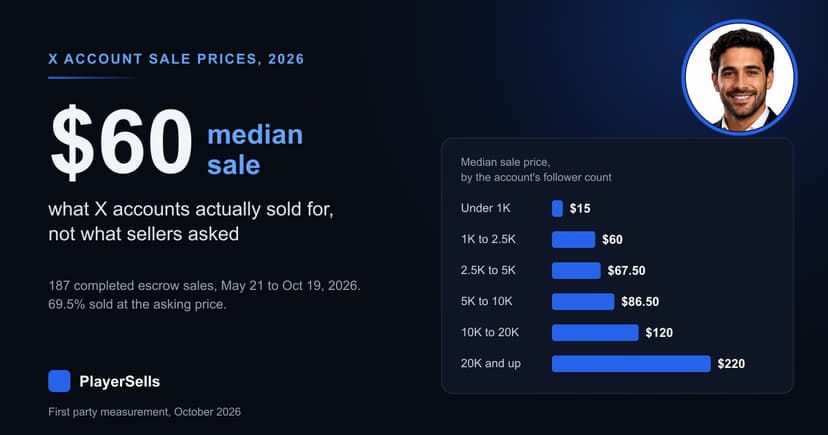
What X Accounts Actually Sell For: 187 Escrow Sales
187 completed escrow sales, May to Oct 2026: the median X account sold for $60, 7 in 10 at the asking price, and price per 1,000 followers fell from $35 to $7.
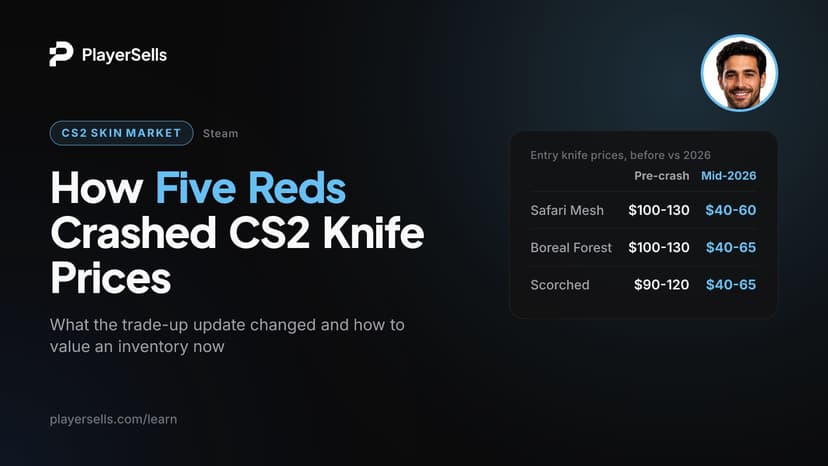
CS2 Skin Market Crash: What the Trade-Up Update Changed
The CS2 skin market crash explained: what Valve's knife trade-up changed, why loss figures differ, what recovered, and how to value your inventory now.