
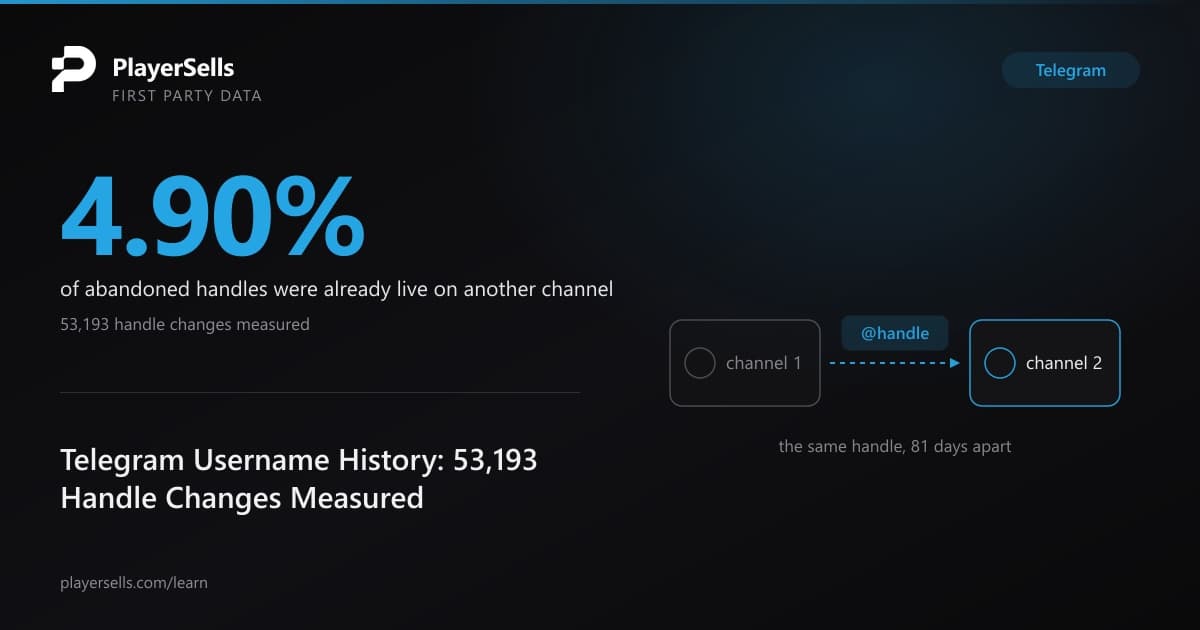
Telegram Username History: 53,193 Handle Changes Measured
We logged 3,086,956 telegram username history records over 81 days. 53,193 handles were abandoned and 4.90% already belong to another channel.
Our Telegram crawler recorded 53,196 handle changes across 3,033,760 channels between 2026-06-09 and 2026-08-29. Of the 53,193 handles those channels walked away from, 2,604 were already the current handle of a different channel in our index by the end of the window. One abandoned Telegram handle in twenty, 4.90 percent, had a new owner inside 81 days. That single number is the most useful thing a Telegram buyer can take from this dataset, because it means the handle printed on a listing is not a stable identifier for the thing being sold.
A bigger, rounder number sits in this dataset and we are not publishing it. Across all 3,033,760 channels in our username log, 35,056 carry more than one handle, which works out to 1.16 percent. That figure is worthless as a statement about Telegram, and the reason is in the next section: our crawler observed 2,725,388 of those channels, 89.84 percent, on exactly one calendar day. A channel we saw once cannot show a rename no matter how many times it renamed. The 1.16 percent measures our own revisit schedule, so it appears here only as the thing we rejected.
Buy-side due diligence on Telegram channels is the subject of this article, and telegram username history is the evidence rather than the headline. Telegram itself keeps no public log of handle changes, which is why every page on the subject correctly says the history cannot be recovered. Our engine has been keeping one anyway, keyed to permanent numeric channel IDs, and the sections below set out what those records establish, what they only suggest, and what no dataset can tell a buyer before money moves.
What is in our Telegram username history log?
Our telegram username history log holds 3,086,956 rows across 3,033,760 distinct channels, measured on 2026-08-29. Each row is a pair of a permanent numeric channel ID and a public handle, with the first and last timestamp at which our crawler saw that pair together. When a channel resolves under a handle we have not recorded for it before, a new row appears; the old row stays, frozen at the last date we confirmed it. The observation window runs from 2026-06-09 to 2026-08-29, which is 81 days.
Subtracting channels from records gives the count of handle changes we witnessed: 3,086,956 minus 3,033,760 leaves 53,196. A separate check against the current-handle column in our channel table returns the same figure from the other direction: of 3,086,766 username records, 53,193 no longer match the handle their channel uses today, which is 1.723 percent of every handle we have on file. The two methods agreeing to within three rows, which is the drift from writes landing between queries, is the sanity check that the log is doing what we think it is doing.
The distribution of handles per channel is not the smooth decay you would expect from a single population of occasional rebranders. Channels carrying exactly four recorded handles outnumber channels carrying three, which does not happen if every channel draws from the same rename hazard. That bump turns out to be a different kind of account entirely, and it is the subject of a later section.
| Handles recorded for the channel | Channels | Share of all channels |
|---|---|---|
| 1 | 2,998,259 | 98.8449% |
| 2 | 26,507 | 0.8739% |
| 3 | 2,890 | 0.0953% |
| 4 | 4,032 | 0.1329% |
| 5 | 786 | 0.0259% |
| 6 | 224 | 0.0074% |
| 7 | 175 | 0.0058% |
| 8 | 160 | 0.0053% |
| 9 to 12 | 249 | 0.0082% |
| 13 to 20 | 15 | 0.0005% |
Sample: n = 3,033,297 channels holding at least one public handle in our Telegram index, measured 2026-06-09 to 2026-08-29. Percentages are shares of that denominator. The 4-handle row being larger than the 3-handle row is the anomaly this article traces to a separate population.
Why we will not publish a Telegram rename rate
A rename rate calculated over every channel in our index measures our crawl schedule, not Telegram. Our engine observed 2,725,388 of 3,033,760 channels on exactly one calendar day, so 89.84 percent of the denominator had zero opportunity to display a handle change. When we split channels by how many days separate our first and last sighting of them, the apparent rename rate moves by a factor of nearly 600 across the bands, which is not a property of Telegram channels.
| Days between our first and last sighting | Channels | With 2 or more handles | Apparent rename rate | Median subscribers |
|---|---|---|---|---|
| Seen on one day | 2,724,992 | 849 | 0.031% | 34 |
| 1 to 7 days | 90,046 | 2,913 | 3.235% | 1,896 |
| 8 to 29 days | 86,470 | 11,680 | 13.508% | 4,650 |
| 30 to 59 days | 93,728 | 16,863 | 17.991% | 9,692 |
| 60 to 81 days | 38,091 | 2,735 | 7.180% | 32,165 |
Sample: n = 3,033,327 channels, joined between our channel table and our username log on 2026-08-29. Median subscribers is the per-band median of the participant count, computed with percentile_cont rather than an average.
Watch length in that table is almost a synonym for channel size. Median subscribers rises from 34 for channels we saw once to 32,165 for channels we watched across the full window, and the share sitting in our top two internal tiers rises from 0.11 percent to 95.56 percent over the same bands. Any rename rate built on the pooled denominator is therefore a weighted average of one enormous, barely-observed group and several small, heavily-observed groups. Publishing that as a Telegram statistic would be confidently wrong in a way no reader could detect.
The failure gets worse for small channels, and this is the finding we killed hardest. Among channels under 1,000 subscribers that we watched for at least eight days, 24,192 out of 26,190, or 92.37 percent, carry more than one handle. That number is not a rename rate. Our crawler mostly discovers a small channel when its handle surfaces somewhere public, so for a small channel, being rediscovered and having changed handle are close to the same event. Conditioning on a long observation window selects the cyclers directly. The cross-tabulation below is the proof.
| Channel size | Observation span | Channels | With 2 or more handles | Share |
|---|---|---|---|---|
| Under 1,000 subscribers | Seen on one day | 2,551,661 | 688 | 0.03% |
| Under 1,000 subscribers | 1 to 7 days | 4,592 | 2,463 | 53.64% |
| Under 1,000 subscribers | 8 days or more | 26,190 | 24,192 | 92.37% |
| 1,000 or more subscribers | Seen on one day | 173,349 | 161 | 0.09% |
| 1,000 or more subscribers | 1 to 7 days | 85,446 | 449 | 0.53% |
| 1,000 or more subscribers | 8 days or more | 192,111 | 7,091 | 3.69% |
Sample: n = 3,033,349 channels, cross-tabulated on 2026-08-29. The two small-channel rows with long observation spans appear here as a rejected finding, not as a measurement of Telegram behaviour.
Everything that follows is therefore restricted to channels with at least 1,000 subscribers that our crawler observed on at least two calendar days more than a week apart. That cohort holds 192,156 channels and 7,161,276 channel-days of observation, and its members enter our re-crawl queue on a schedule rather than through handle-triggered rediscovery. Restricting to it costs us 93 percent of the raw row count and buys back the ability to say anything at all.
How often does a Telegram channel actually change its handle?
Inside the properly conditioned cohort, a Telegram channel with 1,000 or more subscribers changes handle about once every two years. We recorded 9,382 handle changes over 7,161,276 channel-days of observation across 192,156 channels, which is 1.3101 changes per 1,000 channel-days, or 0.4782 changes per channel-year. Expressing the rate per unit of observation time rather than per channel is the only way to compare groups our crawler watched for different lengths of time, and it is the form every number in the rest of this article takes.
Rates by size band show the mid-market is the most stable part of Telegram. Channels between 10,000 and 99,999 subscribers change handle 0.231 times per channel-year, the lowest figure we measured. Channels above 100,000 subscribers run higher at 0.443, which is worth flagging rather than explaining away: very large channels include both established media brands that never rebrand and large grey-market operations that rotate handles deliberately, and our data cannot separate the two.
| Channel size | Channels | Channel-days observed | Handle changes | Implied changes per channel-year |
|---|---|---|---|---|
| Under 1,000 subscribers | 26,199 | 854,624 | 38,895 | 16.612 (rejected, see below) |
| 1,000 to 9,999 | 96,262 | 2,481,697 | 6,074 | 0.893 |
| 10,000 to 99,999 | 85,443 | 4,090,648 | 2,592 | 0.231 |
| 100,000 or more | 10,455 | 589,883 | 716 | 0.443 |
Sample: n = 218,359 channels observed on at least two calendar days at least eight days apart, 8,016,852 channel-days total, measured 2026-06-09 to 2026-08-29. The first row is printed so you can see the size of the artifact we excluded: for channels under 1,000 subscribers our crawler rediscovers the channel because the handle changed, so that rate is a measurement of our own discovery path.
Annualising an 81-day window carries an assumption worth stating plainly. Converting 1.3101 changes per 1,000 channel-days into 0.4782 changes per channel-year assumes the rate is roughly constant through the year, and we have no way to test that from a single summer window. Telegram handle changes may cluster around platform enforcement waves, seasonal campaigns or marketplace activity. Treat the annual figure as a scaled observation, not as a forecast, and treat the per-1,000-channel-day figure as the raw measurement.
Can you see a Telegram channel's old username?
You cannot retrieve a Telegram channel's old username from Telegram, and any service claiming a complete history is reconstructing it from third-party observation rather than reading it from the platform. The Telegram channel object in the MTProto API carries a main active username and a list of additional usernames, and it contains no historical field of any kind, as the published channel constructor reference shows. Changing a handle overwrites the current value and nothing is retained.
The workaround people are pointed to is a witness bot, most often SangMata, which records name and handle changes for accounts it happens to observe inside groups it already sits in. A witness bot knows only what passed in front of it. Coverage is a function of which chats the bot was in and when, which means an absent record proves nothing at all. Our own log has exactly the same epistemic shape and the same weakness, at a different scale: we know what our crawler resolved, and silence in our data is not evidence of stability.
What our log can do is answer the buyer's real question, which is narrower than "show me every handle this channel ever had". A buyer wants to know whether the channel in front of them has been stable recently, whether the handle they are paying for was recently released by someone else, and whether the channel profile matches the kind of account that keeps its handle. All three are answerable from an 81-day window keyed to permanent IDs, and none of them requires a complete history.
One practical consequence for anyone reading a listing: ask for the numeric channel ID, not the handle. Our records show 53,196 handle changes in 81 days against zero ID changes, because the numeric ID is the primary key of the channel and cannot be edited. A seller who will give you the handle but not the ID is withholding the only identifier that survives the sale, and every escrow step in our escrow and transfer process is keyed to something permanent for exactly that reason.
Why is the numeric channel ID the only permanent identifier?
The numeric channel ID is the only field in a Telegram channel that our crawler has never observed changing. Across 3,033,760 channels and 81 days we recorded 53,196 changes to the public handle, an unknown number of changes to titles and descriptions, and no change to a single numeric ID. Telegram exposes that ID through every client and bot interface, so it costs a buyer nothing to record it, and it is the only value that lets anyone check later whether the channel they received is the channel they inspected.
The ID carries a second, less obvious use. When we bucket every indexed channel by its numeric ID and look at four independent maturity signals, all four move in the same direction across the ID range. Verified status collapses from 1.157 percent of channels in the lowest ID block to 0.001 percent in the highest. Median subscriber count falls from 476 to 8. Description fill falls from 83.19 percent to 44.66 percent. Median posts per day rises from 0.27 to 6.07. Channels in the highest ID block behave in every measurable way like channels that were created very recently.
| ID block (lowest to highest) | Channels | Median subscribers | Verified | Verified share | Has a description | Median posts per day |
|---|---|---|---|---|---|---|
| 1 | 368,889 | 476 | 4,266 | 1.157% | 83.19% | 0.27 |
| 2 | 758,405 | 86 | 2,444 | 0.322% | 69.68% | 0.35 |
| 3 | 701,347 | 64 | 367 | 0.052% | 67.50% | 0.36 |
| 4 | 322,460 | 40 | 49 | 0.015% | 62.33% | 0.43 |
| 5 | 212,026 | 31 | 26 | 0.012% | 58.70% | 0.54 |
| 6 | 501,204 | 13 | 13 | 0.003% | 49.76% | 1.18 |
| 7 | 169,479 | 8 | 2 | 0.001% | 44.66% | 6.07 |
Sample: n = 3,033,810 channels, bucketed into seven equal ranges of the internal numeric channel ID, measured 2026-08-29. Medians use percentile_cont. Verified share is the count of verified channels divided by the channels in that block.
Calling the ID block an age proxy is an inference and we want to be precise about its limits. We can demonstrate that the ID is strongly ordered against every maturity signal we hold, which is what the table shows. We cannot demonstrate the mechanism from our own data, because the highest ID we observed sat at roughly the same ceiling in every week of the window, so we never watched allocation advance. Read the ID block as an empirically ordered maturity index that behaves the way an age proxy would behave, and note that a change in how Telegram allocates IDs would break it.
Does channel maturity predict handle stability?
Handle stability tracks the ID block harder than anything else we measured, by a factor of 34. Holding channel size and observation length roughly constant, channels in the lowest ID block change handle 0.159 times per channel-year and channels in the highest ID block change handle 5.482 times per channel-year. Every channel in this comparison has at least 1,000 subscribers and was observed on at least two calendar days more than a week apart, and the mean observation length falls only from 39.3 days in block 1 to 28.2 days in block 7.
The observation-length column is what makes the gradient trustworthy. Our crawler watched the newest channels for fewer days than the oldest ones, so any detection bias in this table works against the result: we had less opportunity to see a change in exactly the group where we saw the most changes. Median subscriber count also moves very little across the blocks in this cohort, from 11,277 down to 7,262, so the gradient is not a size effect wearing a disguise.
| ID block | Channels | Channel-days observed | Handle changes | Implied changes per channel-year | Mean days watched |
|---|---|---|---|---|---|
| 1 (lowest IDs) | 74,092 | 2,914,925 | 1,273 | 0.159 | 39.3 |
| 2 | 64,058 | 2,352,872 | 2,119 | 0.329 | 36.7 |
| 3 | 33,049 | 1,179,018 | 2,192 | 0.679 | 35.7 |
| 4 | 9,557 | 335,675 | 1,144 | 1.244 | 35.1 |
| 5 | 4,444 | 150,018 | 687 | 1.671 | 33.7 |
| 6 | 6,182 | 207,130 | 1,640 | 2.890 | 33.5 |
| 7 (highest IDs) | 774 | 21,772 | 327 | 5.482 | 28.2 |
Sample: n = 192,156 channels with 1,000 or more subscribers, observed on at least two calendar days more than a week apart, 9,382 handle changes over 7,161,410 channel-days as summed from the rows above, measured 2026-06-09 to 2026-08-29. The smallest cell holds 774 channels and 327 changes, which is above the threshold at which we would label a group underpowered.
For a buyer the practical reading is a single comparison. A channel in the lowest ID block is on a path where roughly one handle change every six years is normal. A channel in the highest ID block is on a path where more than five handle changes a year is normal. Both channels can show you the same subscriber count and the same recent post history, and only the numeric ID separates them. Correlation is not causation here, and the obvious confound is that newer channels are disproportionately built by operators who treat handles as disposable rather than as brand assets.
Who are the channels that change handles every day?
The channels carrying four or five recorded handles are not rebranding businesses, they are near-empty accounts that cycle handles at machine speed. Channels with exactly four recorded handles have a median of 3 subscribers, and 87.1 percent of them sit in the two highest ID blocks. Channels with two handles, by contrast, have a median of 185 subscribers and only 42.2 percent sit in those blocks. The bump at four handles that breaks the decay curve is a second population, not a tail of the first.
| Handles recorded | Channels | Median subscribers | Median days first to last handle | Share in the two highest ID blocks | Verified |
|---|---|---|---|---|---|
| 2 | 26,519 | 185 | 23 | 42.2% | 60 |
| 3 | 2,890 | 208 | 30 | 51.7% | 4 |
| 4 | 4,033 | 3 | 33 | 87.1% | 0 |
| 5 | 786 | 4 | 33 | 66.9% | 1 |
| 6 | 224 | 70.5 | 11 | 37.5% | 0 |
| 7 | 175 | 19 | 15 | 42.9% | 0 |
| 8 or more | 424 | 27 | 8 | 35.6% | 1 |
Sample: n = 35,051 channels carrying more than one recorded handle, measured 2026-06-09 to 2026-08-29. Medians use percentile_cont. Verified is a raw count, not a rate, because several cells hold zero.
Timing separates the two populations even more cleanly than size. Across 32,302 handle changes on channels with two or three handles, the median gap between consecutive handles is 21 days and 10.0 percent happen on the same day. Across 5,648 handle changes on channels with six or more handles, the median gap is 0 days and 74.3 percent happen on the same day. A business does not rebrand three times before lunch. Whatever the six-plus population is doing, it is scripted.
| Group | Handle changes | Median days between handles | 25th percentile | 75th percentile | Same-day changes | Within 7 days |
|---|---|---|---|---|---|---|
| Channels with 2 to 3 handles | 32,302 | 21 | 8 | 36 | 3,244 (10.0%) | 7,607 (23.5%) |
| Channels with 4 to 5 handles | 15,243 | 1 | 0 | 32 | 6,758 (44.3%) | 8,796 (57.7%) |
| Channels with 6 or more handles | 5,648 | 0 | 0 | 1 | 4,197 (74.3%) | 5,001 (88.5%) |
Sample: n = 53,193 handle changes across 35,051 channels carrying more than one handle, measured 2026-06-09 to 2026-08-29. A change is dated from the first time our crawler saw the new handle, so every interval here is an upper bound on the true interval.
The handles those channels cycle through are also systematically shorter than everyone else's. Across 2,998,477 username records belonging to single-handle channels, 9.107 percent are six characters or fewer and the median length is 10. Across 20,062 records belonging to four and five-handle channels, 41.805 percent are six characters or fewer and the median length is 8. Across 6,471 records belonging to six-plus-handle channels, 43.764 percent are six characters or fewer and the median length is 7. Short handles are the scarce inventory on Telegram, and the accounts holding a rotating supply of them have a median of 3 subscribers.
| Group | Username records | Median handle length | Handles of 6 characters or fewer | Share short |
|---|---|---|---|---|
| Single-handle channels | 2,998,477 | 10 | 273,068 | 9.107% |
| Channels with 2 to 3 handles | 61,710 | 10 | 7,828 | 12.685% |
| Channels with 4 to 5 handles | 20,062 | 8 | 8,387 | 41.805% |
| Channels with 6 or more handles | 6,471 | 7 | 2,832 | 43.764% |
Sample: n = 3,086,720 username records across 3,033,289 channels, measured 2026-06-09 to 2026-08-29. Length is the character count of the handle text as we recorded it.
Two readings of that pattern are available and our data does not choose between them. Handle harvesting, where an operator parks scarce short handles on disposable channels and moves them as they are sold or claimed, fits the median of 3 subscribers and the same-day changes. Automated account creation, where the channel is a byproduct of a script that is really registering handles, fits equally well. What matters for a buyer is that a channel showing this signature is a container for a handle, not an audience, and its subscriber count is not the asset being sold.
How often does an abandoned Telegram handle get taken by someone else?
Within 81 days, 2,604 of the 53,193 handles abandoned by channels in our index, or 4.90 percent, had already become the current handle of a different channel we index. Handle recycling is the part of telegram username history that costs buyers real money, because a dropped handle does not go dark: it goes back into the pool, and somebody else can take it. Every link, bookmark, bio mention and forwarded message pointing at the old handle now resolves to a channel the original owner does not control.
Counted the other way, 2,867 distinct handles in our log were held by more than one channel during the window, and 15 handles passed through three or more channels in 81 days. Recycled handles skew short: 15.45 percent are six characters or fewer against a 9.107 percent baseline for handles that never moved, which is what you would expect if the handles worth taking are the scarce ones. Median length of a recycled handle is 9 characters.
| Measurement | Value | Denominator |
|---|---|---|
| Handles abandoned by their channel | 53,193 | 3,086,766 username records |
| Abandoned handles now held by another indexed channel | 2,604 (4.90%) | 53,193 abandoned handles |
| Distinct handles seen on 2 or more channels | 2,867 | 3,083,660 distinct handles |
| Handles seen on 3 or more channels | 15 | 2,867 recycled handles |
| Recycled handles of 6 characters or fewer | 443 (15.45%) | 2,867 recycled handles |
| Median days between last sighting on one channel and first on the next | 33 | 2,882 handovers |
Sample: n = 3,086,766 username records across 3,033,760 channels, measured 2026-06-09 to 2026-08-29. The 4.90 percent takeover rate is a floor, because we can only detect a takeover when the receiving channel is also in our index.
The 33-day median gap needs a caveat that changes how you read it. A gap in our data is the interval between the last time our crawler confirmed the handle on the losing channel and the first time it confirmed the handle on the gaining channel, so it includes our own re-crawl latency. The true release-to-reclaim interval on Telegram is shorter than 33 days, possibly much shorter, and 36 of the 2,882 handovers we recorded show the handle on both channels within the same day. Treat 33 days as an upper bound on the window a buyer has to notice a handle has moved.
For anyone selling rather than buying, the same measurement is a reason to be careful about the order of operations in a transfer. Releasing a handle before the buyer is ready to claim it puts scarce inventory into an open pool where, by our measurement, roughly one handle in twenty gets claimed by a third party inside three months. Our guide to selling a Telegram channel safely covers the transfer sequence, and the platform-by-platform transfer rules cover the cooldowns that make the ordering matter.
What happens to subscribers after a channel is renamed?
A handle change is not associated with a subscriber collapse in our data. Across 1,759 channels with 1,000 or more subscribers that changed handle between 2026-06-24 and 2026-08-13 and had daily snapshots in both a 14-day window before and a 14-day window after, the median subscriber change was plus 0.11 percent. In a comparison group of 1,268 channels that kept a single handle throughout, measured the same way around a pivot date drawn from the same range, the median was minus 0.20 percent.
What does change is the spread. Renamed channels ran from minus 1.47 percent at the 25th percentile to plus 7.40 percent at the 75th, a band of 8.87 points. Single-handle channels ran from minus 0.77 percent to plus 0.35 percent, a band of 1.12 points. Renamed channels were also more likely to be growing at all: 911 of 1,759 gained subscribers, against 472 of 1,268 in the comparison group. A rename in our window looks like a marker of a channel in motion, in either direction, rather than a cost.
| Group | Channels measured | Median 14-day subscriber change | 25th percentile | 75th percentile | Lost subscribers | Gained subscribers |
|---|---|---|---|---|---|---|
| Changed handle | 1,759 | +0.11% | -1.47% | +7.40% | 847 | 911 |
| Single handle throughout | 1,268 | -0.20% | -0.77% | +0.35% | 794 | 472 |
Sample: n = 3,027 channels with 1,000 or more subscribers and daily snapshots present in both windows, measured against 14 days before and 14 days after the handle change or the assigned pivot date, drawn from our Telegram daily snapshot table over 2026-06-09 to 2026-08-28.
Two confounds sit on top of that comparison and neither can be removed with the data we hold. Channels that change handle are systematically newer, and newer channels grow faster from a smaller base, which pushes the treated group's numbers up independently of the rename. Detection also requires re-crawling, and channels we re-crawl frequently are channels doing things, so the treated group is tilted toward active operators. The honest claim is narrow: we found no evidence that renaming costs a channel its subscribers, and we did not run an experiment.
The often-repeated figure that a renamed Telegram channel loses roughly 44 percent of its followers comes from a different event entirely. The DarkGram measurement of 339 channels found that when a channel was taken down and its operators posted a link to a replacement, a median of 43.8 percent of followers moved to the new channel inside a week. That is a takedown-and-rebuild migration between two separate channels with two separate numeric IDs, not a handle change on one channel that keeps its subscriber list. A buyer confusing the two will price a rename as a disaster and a rebuild as a rename.
Do renamed channels reach fewer of their subscribers?
Channels that changed handle reach materially fewer of their own subscribers per post, and the gap survives every control we could apply. Across 6,542 channels with 1,000 or more subscribers that changed handle, the median channel gets 13.63 views per 100 subscribers. Across 367,653 channels of the same size that kept one handle, the median gets 23.16 views per 100 subscribers. Ratios are computed per channel and then medianed, so the comparison is not a ratio of two medians.
Because the renamed group is younger, we split both groups by ID block to see whether maturity explains the gap. It does not. In six of the seven ID blocks the renamed group's median reach sits between 36 and 53 percent below the single-handle group's median, including in the two lowest ID blocks where both groups are mature. Only in the highest ID block does the gap narrow, to 17.02 against 14.54, and that block holds the smallest sample.
| ID block | Single-handle channels | Median views per 100 subscribers | Renamed channels | Median views per 100 subscribers |
|---|---|---|---|---|
| 1 (lowest IDs) | 121,085 | 21.22 | 901 | 10.49 |
| 2 | 124,681 | 22.90 | 1,475 | 14.55 |
| 3 | 71,413 | 25.75 | 1,567 | 15.11 |
| 4 | 21,658 | 25.88 | 761 | 14.16 |
| 5 | 10,753 | 26.92 | 476 | 12.57 |
| 6 | 15,207 | 25.25 | 1,105 | 13.86 |
| 7 (highest IDs) | 2,857 | 17.02 | 257 | 14.54 |
Sample: n = 374,196 channels with 1,000 or more subscribers and a recorded average view figure, measured 2026-08-29. Views per 100 subscribers is computed for each channel and then medianed within each cell with percentile_cont.
Posting frequency is the confound we can see and cannot remove. Channels that changed handle post a median of 2.325 times per day; channels that kept one handle post a median of 0.97 times per day. Posting 2.4 times as often spreads the same audience across more posts and lowers the average view count per post mechanically, so part of the reach gap is arithmetic rather than audience quality. Channels that changed handle also tend to be less established in other ways: 66 of 7,702 are verified, against 6,800 of 443,213 in the single-handle group. For view-rate benchmarks that are not conditioned on handle history, our Telegram channel benchmarks covers size tiers and growth separately.
Is the verified badge a usable check on Telegram?
The verified badge is unavailable to 99.76 percent of the Telegram channels we index, which makes "look for the verified badge" the least actionable advice on the internet. We measured 7,167 verified channels across 3,033,758, or 0.2362 percent. An earlier academic count found 191 verified channels in a sample of 35,382, or 0.5 percent, and our figure across a sample 86 times larger comes in lower still. A check that returns "no" for 3,026,591 channels cannot separate good from bad.
Size raises the verified rate but never far enough to make it a filter. Even among channels with 100,000 or more subscribers, only 1,206 of 10,654, or 11.32 percent, carry the badge. In the 1,000 to 9,999 band where most marketplace listings sit, the rate is 0.6578 percent. A buyer looking at an unverified 20,000-subscriber channel has learned nothing, because 96.33 percent of channels that size are unverified.
| Channel size | Channels | Verified | Verified share | With 2 or more handles | Multi-handle share |
|---|---|---|---|---|---|
| Under 100 subscribers | 1,804,915 | 12 | 0.0007% | 15,433 | 0.855% |
| 100 to 999 | 777,724 | 289 | 0.0372% | 11,917 | 1.532% |
| 1,000 to 9,999 | 348,441 | 2,292 | 0.6578% | 5,231 | 1.501% |
| 10,000 to 99,999 | 91,834 | 3,368 | 3.6675% | 1,987 | 2.164% |
| 100,000 or more | 10,654 | 1,206 | 11.3197% | 486 | 4.562% |
Sample: n = 3,033,568 channels, measured 2026-08-29. The multi-handle column in this table is detection-limited and rises with size because larger channels are re-crawled more often, so read it as a coverage gradient rather than as a behaviour gradient. The exposure-adjusted rates earlier in this article are the ones to use.
Two flags a buyer might reasonably expect to help are not available from us at all. Our channel table carries an is_scam column and an is_fake column, and both are false for all 3,034,130 rows, which means our pipeline never populates them rather than that Telegram has no bad channels. Publishing a scam rate from those columns would have been the easiest mistake in this dataset to make, and we are naming them dead here so that nobody, including us, builds on them later. Our country column is empty for every row for the same reason.
How much of Telegram's public handle inventory sits on empty channels?
Most public Telegram handles in our index sit on channels that almost nobody is in. Of 3,033,381 channels holding a public handle, 1,804,811 have fewer than 100 subscribers, which is 59.50 percent, and 91,733 have zero. On a stricter test, 554,780 channels, or 18.29 percent, show no measurable output at all: no average view figure and no positive posts-per-day value. Only 2,429,572, or 80.09 percent, are measurably active by both signals.
| Subscribers | Channels holding a public handle | Share | With posts per day recorded as zero |
|---|---|---|---|
| 0 | 91,733 | 3.02% | 458 |
| 1 to 9 | 909,256 | 29.98% | 16,800 |
| 10 to 99 | 803,822 | 26.50% | 3,712 |
| 100 to 999 | 777,655 | 25.64% | 2,706 |
| 1,000 to 9,999 | 348,424 | 11.49% | 1,298 |
| 10,000 to 99,999 | 91,831 | 3.03% | 309 |
| 100,000 or more | 10,652 | 0.35% | 32 |
Sample: n = 3,033,381 channels holding a public Telegram handle, measured 2026-08-29. Eight channels with an unknown subscriber count are excluded from the bands and included in the denominator.
Telegram's founder described the same problem in August 2022, writing that 70 percent of all Telegram usernames had been reserved in inactive channels by cybersquatters, creating a graveyard of dead usernames, and that Telegram had withdrawn public addresses from channels that were empty or inactive for a year. Our measurement four years later is lower on any strict definition: 18.29 percent of the handles we index show no measurable output, not 70 percent. On the loose definition of a channel almost nobody reads, 59.50 percent under 100 subscribers is closer to the spirit of the original claim.
The gap between 18.29 percent and 59.50 percent is not a rounding question, it is a definition question, and it is why single-number claims about dead handles are hard to check. A channel with 40 subscribers that posts daily is active and worthless to a buyer. A channel with 200,000 subscribers that has not posted in a year is dormant and potentially valuable. Our data separates those cases and a headline percentage does not, which is the argument for reading the size distribution rather than the summary.
Does the language of a channel predict handle churn?
Chinese-language channels in our index carry a second handle about six times as often as Russian-language ones, and this is the weakest cut in this article. Among channels with 1,000 or more subscribers, 6.74 percent of the 12,303 we classify as zh-cn carry more than one handle, against 1.11 percent of 153,385 Russian-language channels and 0.68 percent of 6,729 Ukrainian-language ones. English sits at 2.33 percent across 65,787 channels, so the full spread from top to bottom of this table is close to tenfold.
| Language | Channels with 1,000+ subscribers | With 2 or more handles | Multi-handle share |
|---|---|---|---|
| Chinese (zh-cn) | 12,303 | 829 | 6.74% |
| Korean | 3,315 | 89 | 2.68% |
| English | 65,787 | 1,536 | 2.33% |
| Indonesian | 6,583 | 129 | 1.96% |
| German | 5,820 | 108 | 1.86% |
| Turkish | 3,919 | 65 | 1.66% |
| Persian | 52,929 | 825 | 1.56% |
| Arabic | 52,955 | 699 | 1.32% |
| Russian | 153,385 | 1,700 | 1.11% |
| Spanish | 4,504 | 38 | 0.84% |
| Ukrainian | 6,729 | 46 | 0.68% |
Sample: n = 450,915 channels with 1,000 or more subscribers, measured 2026-08-29, restricted to languages with at least 3,000 channels in that cohort. Language is a heuristic classification filled for 66.8 percent of our index, so channels we could not classify are excluded from every row.
Three problems keep this table out of the conclusions. Language classification is a heuristic applied to titles and descriptions, and it is missing for a third of our index. The multi-handle share here is not exposure-adjusted, so a language whose channels we happen to re-crawl more often will look churnier. Channel maturity is not controlled, and the language mix differs sharply by ID block. Read the table as a hypothesis generator for someone with better data, not as a fact about language communities.
What can a buyer verify before paying, and what can nobody verify?
A Telegram buyer can verify five things directly and cannot verify four others at any price. The verifiable set is the numeric channel ID, the current handle, the current subscriber count, recent per-post view counts, and the presence or absence of the verified badge. The unverifiable set is the channel's creation date, its complete handle history, its subscriber acquisition method, and whether the account credentials attached to it have been shared. Nothing in our index closes the second list, and a marketplace that claims otherwise is guessing.
| What a buyer wants to know | Verifiable before payment | How, and what our index adds |
|---|---|---|
| Permanent identity of the channel | Yes | The numeric channel ID, visible in any client. We recorded 53,196 handle changes and zero ID changes in 81 days. |
| Current public handle | Yes | Resolve it yourself. Confirm it matches the ID you were given, not just the title. |
| Approximate channel maturity | Partly | The ID block orders against verification, size, description fill and handle stability across 3,033,810 channels. |
| Exact creation date | No | Telegram exposes none, and our first_seen is the date our crawler found the channel, not the date it was made. |
| Complete handle history | No | Telegram retains nothing. Our log covers 81 days and only the channels we resolved. |
| Whether the handle was recently released by another channel | Partly | We measured 4.90 percent of abandoned handles taken over within the window, detectable only when both channels are indexed. |
| Subscriber authenticity | No | Telegram publishes no per-subscriber data. Views per subscriber is the closest available proxy. |
| Scam or fake status | No | Our is_scam and is_fake columns are false for all 3,034,130 rows and carry no signal. |
| Whether credentials were shared before the sale | No | No dataset can see this. Escrow and a controlled transfer sequence are the only defences. |
Sample: assessments are made against our Telegram index of 3,033,760 channels and 3,086,956 username records, measured 2026-06-09 to 2026-08-29. Rows marked partly mean our data narrows the question without settling it.
Turning that into a check that takes five minutes: get the numeric ID in writing before you discuss price, place the ID in its block to read maturity, compute views per 100 subscribers from the last ten posts and compare it against the 23.16 median for handle-stable channels of 1,000 or more subscribers, and search the handle to see whether anything older than the channel references it. A handle with a public trail that predates the channel's own posts is the signature of a takeover. Our Telegram channels directory and the Telegram channel rank tool both key on the numeric ID, so they will tell you whether the channel in front of you is the one we have been watching.
One correction worth carrying into any Telegram due-diligence conversation, because it is repeated constantly. The widely quoted claim that 56 percent of crypto Telegram channels are involved in manipulation misreads its source: the study that produced the figure found that more than 56 percent of the Twitter accounts sharing invite links to those channels were bots or suspended accounts. The channel-level figure in the same paper is 20 percent. Pricing a crypto channel off the wrong number by a factor of nearly three is an expensive way to be careless.
What this data cannot tell you
Our Telegram index is not a sample of Telegram, it is a record of what our crawler resolved, and that shapes every number above. We discover channels through public references, so channels that are never linked anywhere public are absent, and channels whose handles circulate widely are over-represented. Our index skews toward channels that are mentioned, which is a different population from channels that exist. Nothing here should be read as a census.
The window is 81 days and that is short for a question about lifetime behaviour. Every rate in this article is an observed-window rate, and the annualised versions assume a constant hazard we cannot test from one summer. A channel that changed handle five times in 2024 and none in 2026 appears in our data as a single-handle channel. Our log begins on 2026-06-09 and contains nothing before it, so telegram username history here means recent history, not history.
Several columns in this schema are structurally empty and we are naming all of them. Our is_scam and is_fake flags are false for all 3,034,130 rows. Our country column is null for every row. Our status column reads active for every row. Our linked-discussion column is populated for 71 rows out of 3,034,068. Our engagement-rate column is filled for 14.2 percent of rows, and our category column for 7.0 percent, which is why neither appears in any table above. Average views is never recorded as zero anywhere in the table, which tells us the pipeline writes that column only when it computes a positive value, so a missing view figure is not evidence of a silent channel.
Handle changes are also not perfectly separable from concurrent handles. Telegram lets a channel hold additional usernames alongside its main one, and our log records a pair per handle without marking which was primary. Among channels carrying exactly two handles, 9.76 percent have overlapping observation intervals, meaning we saw both handles live at times that overlap. For the other 90.24 percent the intervals are disjoint and sequential replacement is the natural reading, but roughly one in ten of the two-handle cases in this article may be a channel holding two handles rather than swapping one.
Timing resolution is bounded by our crawl cadence and always in the same direction. A handle change is dated from the first time we saw the new handle, which is on or after the moment it actually changed, so every interval we report is an upper bound and every rate is a floor. The same applies to handle takeovers: the true release-to-reclaim gap is shorter than the 33-day median we measured, and the 4.90 percent takeover rate would rise if our index covered more of Telegram.
Row counts in this article move by a few hundred between tables and that is expected. Our engine writes continuously, so a query run at 03:40 and a query run at 04:10 on 2026-08-29 return channel totals that differ by the channels discovered in between. Every table above states the denominator its own query returned rather than a single reconciled total, because reconciling them after the fact would mean reporting numbers no query produced.
Finally, none of the associations in this article are causal. Channels that change handles also tend to be newer, smaller, more prolific posters and less often verified, and those traits travel together. We can say that a channel showing a recent handle change tends to reach a smaller share of its subscribers, and we cannot say the rename did it. Anyone using these numbers to price a channel should treat them as base rates to argue from, not as effects to apply.
Questions buyers ask about Telegram username history
Can you see a Telegram channel's old username?
Not from Telegram. The Telegram channel object carries a main active username and a list of additional usernames, with no historical field, so changing a handle overwrites the old value and retains nothing. Any recovered history comes from a third party that happened to be watching, such as a witness bot inside a group or a crawler like ours. Our own log covers 3,086,956 handle records over 81 days, which is recent history for the channels we resolved, not a complete record.
How many Telegram channels change their handle?
We will not give you a single percentage, because any percentage over our whole index measures our crawl schedule. The defensible figure is an exposure rate: across 192,156 channels with 1,000 or more subscribers and 7,161,276 channel-days of observation, we recorded 1.3101 handle changes per 1,000 channel-days, which scales to about 0.478 changes per channel-year. Roughly one handle change every two years for a channel of that size.
Is a renamed Telegram channel a scam signal?
A single handle change is weak evidence on its own, and the pattern matters more than the event. Channels carrying four or more recorded handles have a median of 3 subscribers, change handles a median of 0 to 1 days apart, and hold short handles at four times the base rate, which is a machine signature rather than a rebrand. A channel with two handles 23 days apart and a real subscriber base looks like a rebrand. Our scam and fake flags carry no data, so treat the pattern as the evidence.
What happens to a channel's subscribers after a rename?
In our measurement, essentially nothing at the median. Across 1,759 channels with 1,000 or more subscribers that changed handle, the median subscriber change over 14 days before against 14 days after was plus 0.11 percent, against minus 0.20 percent for 1,268 comparison channels that kept one handle. Renamed channels were more volatile in both directions. The often-quoted 43.8 percent follower loss comes from channels being taken down and rebuilt elsewhere, which is a different event.
What is SangMata, and does it work for channels?
SangMata is a Telegram bot that logs name and username changes for accounts it observes inside groups it is already a member of. Coverage is the limitation: the bot knows only what passed in front of it, so an empty result proves nothing, and channels that never appear in a monitored group are invisible to it. Our crawler has the same shape of limitation on a different axis, which is why we publish observation windows and channel-days rather than bare percentages.
How do I check a Telegram channel's history before buying it?
Start with the numeric channel ID, ask for it in writing, and confirm it resolves to the handle you were shown. Place the ID in its block to read maturity, since we measured verified share falling from 1.157 percent to 0.001 percent and median subscribers from 476 to 8 across the ID range. Compute views per 100 subscribers from recent posts and compare against the 23.16 median for handle-stable channels above 1,000 subscribers. Then search the handle for references that predate the channel's own content.
Can I change a Telegram channel's name after I buy it?
Yes, and our data shows how routine that is: 53,196 handle changes across 3,033,760 channels in 81 days, with no platform-imposed limit that we observed. The risk runs the other way. Releasing your current handle puts it back in a pool where we measured 4.90 percent of abandoned handles taken over by another indexed channel within the window, so a handle you drop during a rebrand may not be available if you want it back.
Does Telegram delete inactive channels and free their handles?
Telegram has reclaimed handles from inactive channels before, and its founder described withdrawing public addresses from channels that were empty or inactive for a year in August 2022. We cannot observe reclamation directly from an 81-day window, and our status column reads active for every row, so we have no dormancy-to-deletion measurement. What we can say is that 18.29 percent of the 3,033,563 channels holding a public handle in our index show no measurable output at all.
Is the verified badge worth checking on Telegram?
Checking it is nearly free and almost never informative. We measured 7,167 verified channels across 3,033,758, which is 0.2362 percent, and an earlier academic count of 35,382 channels found 191 verified, or 0.5 percent. Even among channels with 100,000 or more subscribers, only 11.32 percent carry the badge. An unverified channel is the default state, so absence of the badge tells a buyer nothing.
What to check on your next Telegram listing
Take three numbers off any Telegram listing before you talk about price: the numeric channel ID, the subscriber count, and the average views on the last ten posts. The ID is the only permanent identifier and the only maturity signal available, the subscriber count is the claim being sold, and the ratio between views and subscribers is the fastest test of whether the audience is present. Across 367,653 handle-stable channels above 1,000 subscribers, we measured a median of 23.16 views per 100 subscribers.
Run the channel through the Telegram channel rank tool to see where it sits against our index, then check whether it appears in the Telegram channels directory under the ID you were given rather than the handle. For pricing, our Telegram channel valuation guide covers what actually moves the number, and the ten-metric due diligence checklist transfers cleanly to Telegram for everything except the platform-specific fields. Our other engine-backed calculators sit on the tools hub, and the wider measurement series lives in our insights reports.
When you are ready to transact, the sequence matters more than the checks. Hold the handle release until the numeric ID has moved, keep the conversation and the payment on one marketplace record, and read our safety guidance before you agree to any off-platform step. Handle history is evidence a buyer can gather; a controlled transfer is the only thing that protects the buyer once the evidence runs out.
Free tools for this topic

Published by the PlayerSells editorial team. Data comes from PlayerSells marketplace records and our own crawlers. About PlayerSells · Editorial policy
Related Articles
Continue learning with these related guides.

X algorithm, follower count and what a bought account gets
X open-sourced its ranking code. See what the X algorithm does with follower count and account age, and what reach a bought account really inherits.

Telegram Channel Benchmarks 2026: View Rates, Size, and Growth from 2.4 Million Channels
Telegram view rate benchmarks from 2.4 million indexed channels: 31.3% median at 1K-5K subscribers, 3.3% above 500K, plus 52-day growth by category.

Most Social Accounts Are Shrinking: What 6 Million Daily Snapshots Reveal About Follower Decay
We tracked 6.1 million daily snapshots for 52 days: 63.3% of X accounts and 62.2% of Telegram channels shrank. What follower decay does to price.