

X algorithm, follower count and what a bought account gets
X open-sourced its ranking code. See what the X algorithm does with follower count and account age, and what reach a bought account really inherits.
X's open-source ranking code names a parameter called ColdStartFollowerCap, and its published default value is 1000. The rule it gates hands cold-start eligibility to authors with a thousand followers or fewer, and only on original posts. So the published X algorithm does read follower count. One of the documented things it does with that number is decide whether a small account qualifies for extra reach that a large one does not get.
That single parameter is a problem for the way accounts are sold. Buyers pay for follower count and account age because the sales pitch says those two things buy reach. Our own marketplace already disagrees: the age premium peaks at 3-5 years, at a median $60.10 per 1,000 followers, and falls to $18.22 per 1,000 for accounts over ten years old (PlayerSells marketplace data, 68 X listings in the 10-year-plus band, March to August 2026).
This article reads X's published ranking repository as a buyer would, and it stays inside what the code actually says. No weights were published, so nobody can honestly tell you how much any signal is worth. What the release does support is a distinction that changes how you value an account: the system predicts what a viewer will do with a post, and viewer behaviour is the one thing that does not transfer when an account changes hands.
Key takeaways
- X's For You ranking code is public under the Apache License 2.0. The repository
xai-org/x-algorithmwas created on 19 January 2026 UTC, and it ships production code with no weights and no training data. - All 26 scored heads in the ranking scorer are predicted viewer actions: favourite, reply, repost, quote, share, clicks, dwell, follow author, and the negative set of not interested, mute, block and report.
- Follower count is a named input, not a scored target.
author_followers_countis hydrated in the pipeline around the model, while the model's own documented input list does not include it. ColdStartFollowerCapdefaults to 1000, so the one published rule that keys on follower count is aimed at authors with a thousand followers or fewer.- Account age appears in the code as a viewer-side parameter with a 1,800-second default, not as an author-quality score. Post age and account age are different fields and are constantly confused in secondary coverage.
- On our marketplace the age premium peaks at 3-5 years ($60.10 per 1K, N=40) and bottoms at 10-plus years ($18.22 per 1K, N=68), which is closer to the code than the folklore is.
- The median 10K-100K account posts 871.2 times a year, across a 357,360-account sample of our X directory that skews toward accounts with some public visibility. That is the behaviour the ranking system scores, and the workload a buyer inherits.
X published the For You ranking algorithm in January 2026 and kept the weights back
The release is real production source code, and it is not the whole system. The repository xai-org/x-algorithm was created at 2026-01-19T23:12:35Z according to the GitHub API, is licensed under the Apache License 2.0, and is described as the algorithm powering the For You feed on X. Its first commit carries a 20 January 2026 date, and the repository's commit history records further commits on 15 May 2026 and 13 August 2026, so this is a rolling release rather than a one-off dump.
What is inside, in X's own words, is the core code that determines which posts a viewer sees in the For You feed. The named components are Phoenix (retrieval and ranking), Thunder (an in-network candidate source), SimClusters (cluster-based retrieval) and VMRanker (a reranking service), plus visibility filtering, content labeling, configuration parameters and experimental frameworks.
What is deliberately missing
Phoenix ships what X describes as the production implementation itself: the real model code, the real training step and the real Rust serving engine, exported from the internal tree. X also runs cron scripts that keep the repository's default parameter values in sync with production defaults. That is unusually honest for a public release, and it is why the parameter numbers in this article are worth quoting at all.
But there is no checkpoint or corpus bundle to fetch: no weights, no training data. X also withholds xAI-specific infrastructure (production data feeds, cluster orchestration, internal telemetry), notes that the dense-optimizer slot ships as standard AdamW rather than production's tuned internal variant, and explicitly holds back the Grok prompt files and some botmaker rules to reduce the risk of gaming the systems.
| Part of the system | In the public release? | What it means for a buyer |
|---|---|---|
| Phoenix ranking model code and training step | Yes, exported from the internal tree | You can read what the system tries to predict |
| Thunder, SimClusters, VMRanker | Yes, named components | Candidate sourcing and reranking are visible |
| Configuration parameters and defaults | Yes, synced to production values by cron | Numbers like the cold-start cap are quotable |
| Visibility filtering and content labeling | Yes | Not the same as the full integrity stack |
| Model weights and training corpus | No | Nobody can tell you how much any signal is worth |
| Grok prompts, some botmaker rules | No, withheld to reduce gaming | The anti-abuse layer is partly invisible |
| xAI production infrastructure and telemetry | No | You cannot reproduce the live feed from this |
Read that table before you read anyone's viral thread about the release. Every confident claim about how much a like is worth relative to a reply is describing numbers that were not published. For a measured view instead, our analysis of how account reach changes across millions of daily snapshots answers a different question than the code does.
All 26 scored heads are viewer actions, and viewer behaviour does not transfer
The ranking scorer combines predicted probabilities of viewer actions into a weighted sum. The README groups the prediction targets into five families: Engagement (favourite, reply, repost, quote, share, share via DM, share via copy link), Clicks (post, profile, link, photo expand, video open, quoted post), Attention (video quality view, dwell, dwell time, click dwell time, active seconds), Author (follow author) and Negative (not interested, mute author, block author, report, not dwelled).
The definitive list is in the ranking scorer file, and it runs to 26 named scores: favorite_score, reply_score, retweet_score, photo_expand_score, video_open_score, click_score, open_link_score, profile_click_score, vqv_score, share_score, share_via_dm_score, share_via_copy_link_score, dwell_score, dwell_time, quote_score, quoted_click_score, quoted_vqv_score, click_dwell_time, active_secs_5m_residual_norm, follow_author_score, not_interested_score, block_author_score, mute_author_score, report_score, not_dwelled_score and post_unexplored_score. Two of those, quoted_vqv_score and post_unexplored_score, are not spelled out in the README's grouped taxonomy.
Every one of them requires a human to do something
None of the 26 prediction targets is a follower count, an account age or an author-reputation score. Each one is a bet on what a specific viewer will do next: tap, expand, watch, linger, follow, or reach for the mute button. Phoenix is documented as producing one logit per action in a shared taxonomy, trained as multi-label targets, plus regression heads for continuous signals such as dwell time.
That is the whole buyer's lesson in one line. You can buy a follower list. You cannot buy the probability that those followers reply to you, and that probability is what the system is actually estimating. The audience formed its habits around a previous owner's posting: their subjects, their voice, their cadence, their timing.
| Head family | Named targets | What has to happen for it to fire |
|---|---|---|
| Engagement | favourite, reply, repost, quote, share, share via DM, share via copy link | A viewer acts on the post |
| Clicks | post, profile, link, photo expand, video open, quoted post | A viewer opens something |
| Attention | video quality view, dwell, dwell time, click dwell time, active seconds | A viewer stays |
| Author | follow author | A viewer decides you are worth subscribing to |
| Negative | not interested, mute author, block author, report, not dwelled | A viewer rejects you |
If you are choosing between accounts, this reframes the shortlist. An account whose audience has a demonstrated habit of replying to its posts is a different asset from an account with the same follower number and a silent audience, and the tier you pick should follow from that. Our guide on which follower tier is actually worth buying takes that decision apart with sell-through data attached.
Follower count is an input the pipeline reads, not a score the model maximises
This is the distinction that most coverage of the release gets wrong in one direction or the other, and it matters because it is exactly what you are paying for. There are two layers. There is the Phoenix model, which consumes features and emits predicted action probabilities. And there is the home-mixer pipeline around it, which hydrates candidates with metadata, applies filters, and runs scorers.
Phoenix's own documented inputs are a user prefix consuming country, language, location, gender, age bracket and installed apps, plus candidate features covering semantic-ID embeddings and context features (timezone, local hour-of-day, product surface, post age) and hashed post and author IDs. Follower count is not in that list.
But the pipeline around the model names it explicitly
The candidate hydrator declares pub author_followers_count: Option<i32> and populates it from the user counts service. So the number exists, travels with the candidate, and is available to the rules that run around scoring. Anyone who tells you X's published algorithm has no follower-count feature has not read the hydrator, and anyone who tells you follower count is a ranking reward has not read the head list.
The honest formulation is that follower count is an eligibility and routing input. It helps decide which pipeline a post goes down. It is not a quantity the model is trying to grow on your behalf. That distinction is worth real money at purchase time, because the market prices follower count as though it were the output. Compare what an account's followers cost against what its engagement pattern justifies with the engagement rate calculator before you argue about price.
It also explains a pattern our sellers see constantly: two accounts with identical follower counts trade at very different prices once a buyer reads the recent posts. That instinct is pricing predicted behaviour, and the published head list says it is correct. If you want the numbers behind how unusual any given follower count actually is, the follower count benchmarks drawn from 17 million accounts put your candidate in its percentile.
X's own code aims its cold-start help at authors with 1,000 followers or fewer
Here is the finding that should unsettle anyone selling reach by the thousand. The cold-start scorer contains an eligibility function that returns true only when a candidate is not a reply, is not a repost, and the author's follower count is at or below a configured cap. The parameter is declared as ColdStartFollowerCap with a default of 1000.
Read literally, that is a published mechanism in X's ranking pipeline whose gate opens for small authors and closes for large ones. A 40,000-follower account you just bought is outside that gate by a factor of forty. An account with 900 followers is inside it.
What you may not conclude from it
You cannot say how much the cold-start path is worth, because the weights are not in the release. You cannot say it outweighs the advantages of a large audience, because that comparison needs numbers that were not published. And you cannot say X favours small accounts overall, because a single eligibility gate is not the whole system.
What you can say is that X's published code contains a follower-count rule, and the rule helps authors at or below a thousand followers rather than above it. That is the opposite shape from the one implied by a listing that charges a premium per thousand followers. It is also consistent with something our own marketplace shows: the median price per 1,000 followers collapses from $44.15 in the 1K-5K band to $3.43 in the 50K-100K band (PlayerSells marketplace, sold X listings, N=50 and N=3 respectively; treat the 50K-100K row as directional given three sales).
The practical read for a buyer on a budget: the only accounts that sit inside that published gate are sub-1,000-follower accounts, which are also the cheapest thing on the market. Browsing X accounts under $500 is not the compromise option it looks like. If you are still weighing whether to buy at all, the honest math on buying versus growing runs the comparison with hours and dollars on both sides.
Three account-age claims the published X algorithm does not support
Account age is where the secondary coverage falls apart, and where a buyer is most likely to overpay on a misreading. The repository does name account age, but not in the place people assume, and not pointed at the author.
Trap one: post age is not account age
The age filter in the repository measures how long ago a post was created and compares it against a maximum age. Phoenix's context feature called post age is likewise the age of the post. Neither is a measure of how long the account has existed. Anyone citing the age filter as proof that aged accounts rank better is reading a recency filter as a pedigree signal.
Trap two: age bracket is the viewer's human age
Phoenix's user prefix consumes country, language, location, gender, age bracket and installed apps. That is a description of the person scrolling, not of the account posting. Age bracket there is the viewer's demographic age. It has nothing to do with account tenure.
Trap three: the new-user filter targets the viewer, not the author
The parameter NewUserMinEngagementFilterMaxAccountAgeSecs is real, with a published default of 1800 seconds, and there is a companion NewUserAgeThresholdSecs. The filter computes duration since creation for the query user, which is the viewer, and gates on whether that age is below the maximum. Thirty minutes is a first-session window, not an account-quality judgement. The follower-count rule is the one that targets authors; the account-age parameter in this filter targets the person doing the scrolling.
| Claim you will read online | What the code actually names | Who or what it applies to |
|---|---|---|
| The algorithm rewards old accounts | An age filter measuring time since post creation | The post, not the account |
| Phoenix has an age feature, so tenure counts | Age bracket in the viewer prefix | The viewer's human age |
| New accounts are suppressed by an age gate | A new-user filter with a 1,800-second default | The viewer's first half hour |
| The model has no follower-count feature | author_followers_count in the hydrator | The author, as an input |
Our marketplace already prices age below the folklore, and the gap is large
If aged accounts carried the algorithmic advantage the flipping blogs claim, the price curve would rise with age. It does not. Across active and sold X listings on PlayerSells between March and August 2026, the premium per 1,000 followers peaks in the 3-5 year band and then reverses.
| Age band | N listings | Median $ per 1K followers | Median followers | Average age (years) |
|---|---|---|---|---|
| Under 1 yr | 51 | $24.59 | 3,316 | 0.4 |
| 1-3 yr | 58 | $36.51 | 3,395 | 2.1 |
| 3-5 yr | 40 | $60.10 | 2,535 | 3.9 |
| 5-10 yr | 49 | $31.91 | 3,136 | 7.2 |
| 10 yr+ | 68 | $18.22 | 7,124 | 14.3 |
Source: PlayerSells marketplace, X listings, active plus sold, followers of 100 or more, 2026-03-16 to 2026-08-13.
Two readings are available and neither is proven by this table. One is that very old accounts in this sample are simply larger (median 7,124 followers), and the rate per 1,000 falls with size regardless of age, so part of what looks like an age effect is a size effect. The other is that an account which is ten years old and still has a few thousand followers is signalling dormancy rather than pedigree. Both are hypotheses. What is not a hypothesis is the price.
The directory data says the same thing in a different currency
Across a 357,360-account sample of the 17.9 million X accounts in the PlayerSells directory (a set that skews toward accounts with some public visibility, not every account ever registered), a 10-year-plus account has a median 708 followers against 151 for an account under a year old.
| Age band | N accounts | Median followers | 90th pct followers | Share with 10K+ |
|---|---|---|---|---|
| Under 1 yr | 14,986 | 151 | 3,329 | 3.864% |
| 1-3 yr | 32,816 | 321 | 5,156 | 5.695% |
| 3-5 yr | 47,065 | 444 | 6,819 | 7.388% |
| 5-10 yr | 93,254 | 589 | 8,119 | 8.532% |
| 10 yr+ | 169,239 | 708 | 8,678 | 8.940% |
The median gap is 4.7x, but the odds of ever clearing 10,000 followers only move from 3.864% to 8.940%, a 2.3x gap. Age helps, and it helps far less than the sales copy says. That is a defensible reason to pay something for tenure and an indefensible reason to pay a multiple for it. If you want the counter-argument stated properly, read our older piece on why account age can beat follower count alongside this one. Then look at what aged X accounts actually list for, and notice how little of the price is explained by the birthday.
The negative heads are how a clumsy rebrand suppresses an account you just paid for
Five of the 26 scored heads are negative: not interested, mute author, block author, report and not dwelled. They are predictions of rejection, and they are in the same weighted sum as the positive ones. That is the mechanical answer to a question buyers ask constantly, which is whether changing an account's topic will hurt it.
The mechanism is straightforward without any need to speculate about weights. An audience that followed an account for football and starts seeing token presales is more likely to mute, more likely to tap not interested, and more likely to scroll past without dwelling. Each of those is something the system is explicitly trying to predict. A rebrand does not just fail to help, it produces exactly the signals the model is trained to read as rejection.
What that does not license you to claim
It does not license a number. There is no published figure for how far a mismatched account falls, because the weights are not in the release. Anyone quoting a percentage suppression figure from this repository is inventing it. Treat the mechanism as a reason to change slowly, not as a formula.
The practical consequence is a sequencing problem, and it is the single most common way a good purchase turns into a bad one in the first month. Keep posting the subject matter the audience followed, introduce the new subject as a minority of your output, and watch the reply rate rather than the follower number. Our week-by-week plan for the first 90 days after you buy an X account covers the ordering in detail, and it is deliberately slower than most new owners want.
There is a second-order point here that affects valuation. An account is only worth its follower count to a buyer whose content matches what that audience already accepts, and it is worth materially less to a buyer planning a hard pivot. That is why niche fit belongs in the price negotiation and not in the nice-to-have column.
The follow graph is named in the code, the follower number is just a count
Beyond author_followers_count, the repository names a set of author and graph-side components: a bidirectional follow hydrator, a mutual follow Jaccard hydrator, an author social-graph filter, and parameters including AuthorDiversityDecay, AuthorDiversityFloor, EnableAllAuthorFollowHydration and EnableBidirectionalFollowHydration.
What those names tell you is that the pipeline works with relationships, not only with totals. A mutual-follow overlap measure is a structural property of the graph you are inheriting. A follower count is one integer. Two accounts with 20,000 followers can sit in completely different positions in the graph, and only one of those facts is printed on a listing.
The due-diligence version of that idea
You cannot compute Jaccard overlap from a public profile, and this article will not pretend otherwise. What you can do is check the cheap proxies for a graph built by reciprocity rather than by interest. In our directory sample of accounts with 1,000 or more followers (N=138,122), the median follower-to-following ratio is 3.99, the 25th percentile is 1.27, and 16.73% of those accounts follow more people than follow them.
An account whose ratio sits near or below 1.0 built its audience through follow-back churn. That audience never chose the content, which means the predicted-action probabilities the ranking system cares about are likely to be weak no matter how the number looks. Run the profile through a follower quality audit before you make an offer, then sample follower join dates by hand: a cluster of followers who all joined in the same month is a purchase signal, and the join month is printed on every public profile. The difference between the two kinds of audience is exactly the difference described on our organic versus bought followers comparison.
Verification is a product X sells, not one of the 26 prediction heads
Buyers routinely pay a premium for a blue checkmark on the theory that it is an algorithmic advantage. Separate the two things it actually is. The checkmark, in X's own words, means the account has an active subscription to X Premium and meets the eligibility requirements, and it does not mean the account has been ID verified. Reply prioritisation is sold as a subscription feature: X lists the highest reply prioritisation among the things Premium+ adds at $40 a month, as published on X's Premium help page and checked in August 2026.
None of the 26 scored heads is an account attribute of any kind: every one of them is a predicted viewer action. So the accurate statement is that X sells a distribution product and separately runs a ranking model that predicts viewer actions. Buying a verified account buys you the subscription state and whatever the subscription includes, not a coefficient in the ranking model.
The transfer trap that costs the checkmark
X documents that changes to the profile photo, display name or username will result in a temporary loss of the blue checkmark until the account is validated as continuing to meet requirements, with no further changes to those elements allowed during the review period. A new owner's first instinct is to change all three at once. Platform policies change, so check the current verification requirements on X's help centre before you plan a handover rather than trusting a checklist you read months ago.
| Verified | Original email | N listings | Median $ per 1K | Median price |
|---|---|---|---|---|
| No | No | 85 | $45.25 | $125 |
| No | Yes | 109 | $16.46 | $100 |
| Yes | No | 22 | $41.76 | $500 |
| Yes | Yes | 50 | $59.05 | $125 |
Source: PlayerSells marketplace, X listings, 2026-03-16 to 2026-08-13. Read it carefully rather than as a causal claim. Verified plus original email carries the highest rate per 1,000 followers at $59.05, while verified without the original email carries the highest absolute median price at $500 because those are bigger accounts. The unverified-with-email group is the cheapest per follower at $16.46. Verification lifts the rate, and absolute price is driven mostly by size. If the credential set is what you are shopping for, compare verified X accounts against listings sold with the original email before deciding which premium you are actually paying.
Original Content Rewards pays on impressions the ranking system decides
The two systems connect at exactly one point, and it is worth understanding before you buy an account for monetization. As of August 2026, X stopped accepting new enrollments into Creator Revenue Sharing on 7 August 2026 and retires the program on 7 September 2026, replacing it with Original Content Rewards. Existing members can begin applying to the new program from 8 September 2026.
The new eligibility bar is 500,000 Home Timeline impressions from verified users in the last 90 days plus at least 500 verified followers, an active Premium subscription, an account in good standing, and 18-plus age in a supported country. Payouts are processed every two weeks with a $30 minimum. A qualified impression is a unique impression from a Premium user on the Home Timeline where at least 50% of the post is visible, and impressions on replies are excluded from the 500,000 requirement. Note the detail that trips people up: Premium Basic subscribers count toward qualified impressions even though Basic carries no checkmark.
Why that connects to everything above
The payout metric is Home Timeline impressions, and Home Timeline impressions are handed out by the ranking system whose targets are predicted viewer actions. So monetization eligibility is downstream of exactly the behaviour that does not transfer with an account. Buying a big follower number does not buy qualified impressions. Producing original posts that a Premium audience actually stops to read does.
There is a second, harder point. X's verification policy lists transfer of account ownership among the reasons it may request re-verification of identification, and monetization requires a verified Stripe account and completed identity verification tied to a real legal identity. X does not publish an outcome for what happens to monetization when an account changes hands, so nobody can tell you it survives or that it does not. Separately, X's Authenticity policy prohibits trading, buying, selling or soliciting access to accounts, and states that for severe violations accounts will be permanently suspended at first detection. This is general information about published policy, not legal advice, and you should read the current Authenticity policy yourself before assuming anything about your own position. Our sibling piece on what a bought account is worth now that revenue sharing has ended works the valuation side of the same change.
What the release cannot tell you, and the claims it quietly kills
A public repository is a gift to anyone writing about distribution, and it is also an invitation to overreach. Three claims circulating in 2026 do not survive contact with the code, and one of them was manufactured by the coverage of the code itself.
The link penalty story
X has never published a policy imposing a general reach penalty on posts that contain links. The only closely related published statement is about search filtering: X says it may filter accounts from search if they are degrading the search experience for other people, giving the example of posting lots of duplicate links. In July 2026, two X figures said in a reply thread that links in replies were no longer necessary and that this had been true for over a year. There was no formal announcement, no blog post and no help page. Independent analysis of the open-sourced code found no explicit URL penalty in it.
So there is no documented penalty and therefore no documented removal, which means any account priced on a "link reach has recovered" thesis is priced on a story with no measured figure behind it. Do not accept a percentage. None was ever published by X.
The claim that the model ignores link clicks
A January 2026 analysis argued the model omits external link clicks from its prediction framework, and that argument travelled widely. The README lists link explicitly among the Clicks heads, and the scorer file names open_link_score outright. The correction matters commercially: accounts bought as traffic sources for a newsletter or a product page are often valued on the assumption that X structurally hates outbound links. The published code does not support that assumption.
The integrity layer you cannot audit
X withholds the Grok prompt files and some botmaker rules specifically to reduce the risk of gaming. That means the part of the system most relevant to a bought account, which is how X classifies suspicious behaviour, is exactly the part you cannot read. Anyone who tells you the open-source release proves a bought account is safe from enforcement is claiming knowledge of code that was not published.
Posting cadence is the behaviour hiding behind the price tag
If the system scores predicted viewer actions, then the supply of chances for those actions to occur is posting. Our directory data puts a number on the workload attached to each follower tier.
| Follower tier | Median lifetime posts | Median posts per year of life |
|---|---|---|
| Under 1K | 934 | 130.3 |
| 1K-10K | 5,906 | 660.4 |
| 10K-100K | 8,150 | 871.2 |
| 100K+ | 14,884 | 1,301.3 |
Source: PlayerSells X directory, 357,360-account sample of 17.9 million tracked accounts, drawn 2026-08-14.
The median account in the 10K-100K band posts 871.2 times a year, which is about 2.4 posts a day, every day. That is not a description of what the previous owner did on their best week. It is the median across the whole band, and it is the rate at which the audience became accustomed to hearing from that handle.
Why cadence is a valuation input, not a lifestyle note
An account purchased at 10K-100K comes with an audience calibrated to roughly that frequency. Drop to two posts a week and you are not merely posting less. You are producing fewer opportunities for the favourite, reply, dwell and follow-author predictions to be tested, on an account whose graph position was earned at a much higher rate.
Price the cadence honestly before you buy. If you cannot sustain the tier's median rate, buy a smaller account and keep the difference, or buy in a niche where you can genuinely sustain that rate. Accounts bought for audience building in the creator niche fail most often on this exact point rather than on anything technical. A tool like the algorithm score check is a useful sanity read on how a candidate account currently presents before you commit.
How to test an account's distribution before you pay for it
The published code changes what evidence is worth asking a seller for. Since the system predicts viewer actions, ask for the artefacts that show viewer actions, not the artefacts that show size.
The evidence hierarchy
| Check | What it shows | The limit you must respect |
|---|---|---|
| X Analytics, screen-shared live | 28-day impressions, engagement rate, profile visits, follower growth, top posts | Owner-gated and behind Premium on desktop; a screenshot is a claim, not evidence |
| Engagement per follower on recent posts | The cheapest fake-audience signal available | An analyst heuristic; X defines engagement rate against impressions, not followers |
| Follower-to-following ratio | Whether the audience was earned or followed back | Heuristic only, and easy to game with follow churn |
| About this account panel | Join date, inferred country, count of username changes and the most recent one | Location is inferred from aggregated IP addresses; rollout is partial |
| Verified followers tab | How much of the audience pays for Premium | A spend proxy, not an authenticity proxy, and X shows no count |
| Third-party bot scores | Historically useful | Botometer holds no records for accounts created after 31 May 2023 |
The single highest-value request you can make is a live screen share of the seller's own X Analytics, because it is owner-authenticated and a still image is not. Ask for the 28-day view, then ask them to open the top posts and scroll. A seller who will not screen-share an analytics page they claim is excellent has told you something.
Why there is no cheap comprehensive audit
As of August 2026 the X API is priced pay-per-usage, and reads of follower and following records cost $0.010 per resource. Auditing every follower of a 100,000-follower account therefore costs roughly $1,000 at list price. Any free tool claiming a comprehensive follower audit in 2026 is sampling a small slice, scraping, or serving cached data from before the pricing change. Price your diligence accordingly: sample manually, and weight the behavioural evidence above the size evidence. Every deal run through our escrow process gives you an inspection window in which to do exactly that, and it is the cheapest hour of work in the whole purchase.
What this should change about the price you are willing to pay
Put the code findings and the market data next to each other and the pricing conclusion is not subtle. The published system rewards predicted viewer behaviour, contains one follower-count rule that helps small authors, and treats follower count elsewhere as an input. Our marketplace prices exactly the opposite way at the top end, and the top end does not clear.
| Tier | Listed | Sold | Sell-through | Median $ per 1K sold |
|---|---|---|---|---|
| Under 1K | 47 | 15 | 31.9% | $41.55 |
| 1K-5K | 130 | 50 | 38.5% | $44.15 |
| 5K-10K | 46 | 13 | 28.3% | $11.23 |
| 10K-50K | 72 | 14 | 19.4% | $13.22 |
| 50K-100K | 21 | 3 | 14.3% | $3.43 |
| 100K+ | 23 | 0 | 0.0% | No sales |
Source: PlayerSells marketplace, X listings with 100 or more followers, 2026-03-16 to 2026-08-13. The 50K-100K row rests on three sales and is directional only.
Twenty-three X accounts with 100,000 or more followers have been listed on our marketplace and not one has sold. Meanwhile the ask-to-clear gap in the middle of the market is enormous: in the 10K-50K band sellers ask a median $475 against a median clearing price of $150, and in the 50K-100K band the median ask is $1,050 against $200 cleared. The sticker price on a listing is not the market price.
Three moves that follow from the code
First, pay for demonstrated viewer behaviour rather than for a follower total, because behaviour is what the 26 heads predict and the total is only an input. Second, discount hard for a planned pivot, because the negative heads are the mechanism by which a mismatched audience punishes you. Third, negotiate. Across 99 completed X deals whose listing predates the deal, 72.7% closed at exactly the asking price, while the 50 deals that carried an offer opened at a median 83.3% of ask, with a 25th percentile of 60.6%. Not negotiating is the most expensive habit a buyer has.
When you are ready to compare live inventory against these bands, start on the X accounts for sale pages and read the listing against the price table above rather than against the seller's description. If you want the full buyer-side price picture, our sibling article on what you should actually pay for an X account builds it from closed transactions only.
Frequently asked questions
Does the X algorithm give bigger accounts more reach?
Not as a scored objective. All 26 prediction heads in X's published ranking scorer are predicted viewer actions, and none of them is a follower count. Follower count does appear as an input feature in the pipeline around the model, and the one published rule that keys on it, ColdStartFollowerCap, opens for authors with 1,000 followers or fewer. Because the weights were not released, nobody can quantify the net effect.
Is account age a ranking factor in X's open-source algorithm?
Account age is named in the code, but the parameter people cite applies to the viewer, not the author. NewUserMinEngagementFilterMaxAccountAgeSecs has a default of 1,800 seconds and gates on the age of the account doing the browsing. The separate age filter measures post age, which is recency. Neither is evidence that an older account ranks better.
Does buying an account reset its reach?
X does not publish an answer to that question, so treat any confident yes or no as invention. The useful answer is mechanical: the system predicts what viewers will do with your posts, so distribution follows the content the new owner publishes. An audience that stops replying, dwelling and following produces weaker predictions no matter what the follower number says.
What are the 26 prediction heads in X's algorithm?
They are grouped in the README as Engagement (favourite, reply, repost, quote, share, share via DM, share via copy link), Clicks (post, profile, link, photo expand, video open, quoted post), Attention (video quality view, dwell, dwell time, click dwell time, active seconds), Author (follow author) and Negative (not interested, mute author, block author, report, not dwelled). The scorer file lists 26 named scores in total.
Did X remove the link penalty in 2026?
X never published a general link reach penalty, so there was no documented policy to remove. In July 2026 two X figures said in a reply thread that links in replies were no longer needed and that this had been true for over a year, with no formal announcement. Independent analysis of the open-sourced code found no explicit URL penalty. Treat any percentage recovery figure as unsourced.
Does the open-source repository include the real model weights?
No. X ships the production model code, the training step and the Rust serving engine, but states there is no checkpoint or corpus bundle to fetch. It also excludes its own infrastructure, substitutes standard AdamW for the production optimizer variant, and withholds Grok prompt files and some botmaker rules. That is why weight-based claims about the algorithm are not verifiable.
Will a bought account still qualify for Original Content Rewards?
X does not publish an answer. It documents that a transfer of account ownership can trigger a request to re-verify identification, that monetization requires a verified Stripe account and completed identity verification, and that account trading is prohibited under its Authenticity policy. Anyone stating a definite outcome either way is going beyond X's documentation. Check the current help pages before you buy on a monetization thesis.
Does verification boost your posts in the ranking model?
Verification is a subscription product rather than one of the 26 prediction heads. X markets the highest reply prioritisation as a Premium+ feature at $40 a month, which is a purchased placement rather than a model coefficient. X also states that the blue checkmark means an active Premium subscription meeting eligibility requirements, and does not mean the account has been ID verified.
Will changing the handle and profile photo hurt a bought account?
X documents that changes to the profile photo, display name or username temporarily remove the blue checkmark until the account is re-validated, with no further changes permitted during the review period. Separately, the ranking model's negative heads predict mute, block, report and not-interested, which is the mechanism by which an audience reacts to a sudden identity change. Change one thing at a time.
Can I test an account's real reach before I buy it?
Partly. Ask for a live screen share of X Analytics, which shows 28-day impressions, engagement rate, profile visits, follower growth and top posts, and is owner-authenticated. Supplement it with engagement per follower on recent posts and the follower-to-following ratio, both of which are analyst heuristics rather than X metrics. A comprehensive API-based follower audit costs roughly $1,000 for a 100,000-follower account at list pricing.
Buy the behaviour, then check it before the money moves
The one action worth taking from this article is to change what you ask a seller for. Stop opening with the follower number and open with a live screen share of the account's own analytics, then read the last thirty posts and count replies rather than likes. That is the closest proxy available for what X's published system is actually predicting, and it is free.
When a candidate passes that test, compare its asking price against the clearing bands above, make an offer rather than paying sticker, and move the money through an escrow flow with an inspection window rather than paying a stranger directly. Start with live inventory on the PlayerSells marketplace, read the safety centre before you send anything, and buy the account whose audience already behaves the way your content needs it to.
Free tools for this topic

Published by the PlayerSells editorial team. Data comes from PlayerSells marketplace records and our own crawlers. About PlayerSells · Editorial policy
Related Articles
Continue learning with these related guides.

Buy an X account or grow one: the honest math on cost
Buy an X account or grow one? Only 8.118% of tracked accounts ever hit 10,000 followers. Real prices, real hours and the cases where buying loses.
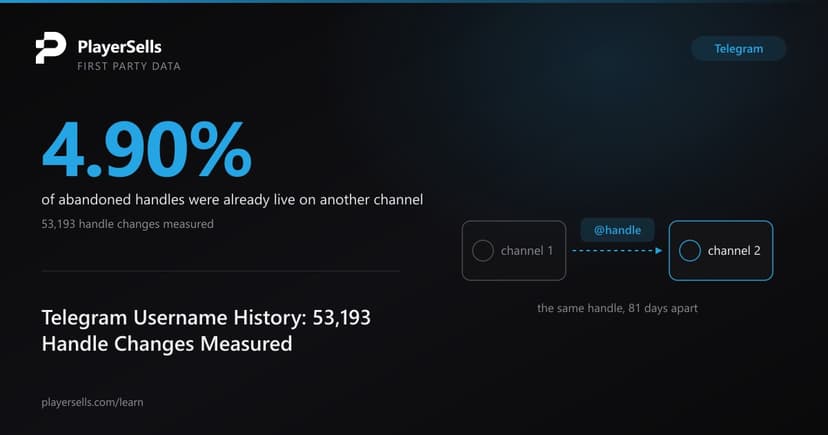
Telegram Username History: 53,193 Handle Changes Measured
We logged 3,086,956 telegram username history records over 81 days. 53,193 handles were abandoned and 4.90% already belong to another channel.
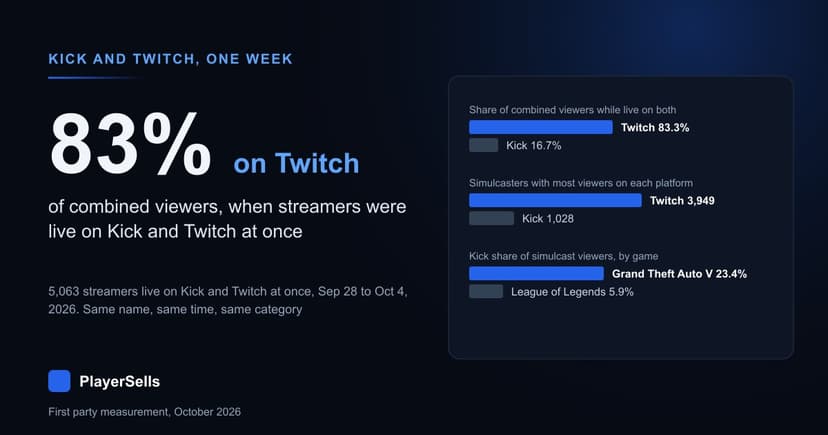
Kick and Twitch Simulcasts: 83% of Viewers Watch on Twitch
5,063 streamers went live on Kick and Twitch at once from Sep 28 to Oct 4, 2026. Twitch drew 83% of their combined viewers and Kick 17%.