

What to do after buying a Twitter account: the first 90 days
What to do after buying a Twitter account, week by week: a 90-day operating plan built on real escrow data so you do not break the audience you paid for.
The median escrow deal on PlayerSells closes in 23.1 hours from creation to completion, measured across 105 completed deals between March and August 2026. That is the whole window between "I want this account" and "this account is mine". Almost nobody uses it to write an operating plan, which is why the question of what to do after buying a Twitter account usually gets asked on day three, in a panic, after the new owner has already changed four things at once.
This is a week-by-week plan for the first 90 days. It is written for one buyer with one real asset, not for someone running a farm of throwaway accounts. That distinction decides everything. The pages currently ranking for this query are published by anti-detect browser vendors and bot-farm software companies, and their advice is built around one goal: not getting caught operating hundreds of accounts. Your risk is different and much more likely to happen. Your risk is that you take a working account with a real audience and break it yourself in the first fortnight.
What follows is the sequence, the numbers you should be measuring against, the platform limits that are actually documented (as opposed to the ones that circulate on outreach blogs), and the checkpoints at 30, 60 and 90 days. Where X publishes nothing, this article says so instead of inventing a figure.
Key takeaways
- The median PlayerSells escrow cycle runs 23.1 hours from deal creation to completion (N=105 completed deals, all platforms, March to August 2026), so the handover finishes long before most buyers have a plan. Write the plan before you fund.
- The median X account in the 10,000 to 100,000 follower band has posted 8,150 times in its life and posts 871.2 times a year, roughly 2.4 posts a day. That cadence is the job you just bought, not a bonus feature.
- 16.73% of accounts with 1,000 or more followers follow more people than follow them. If the account you bought is one of them, you inherited a follow-back audience and should plan for churn accordingly.
- X documents exactly one Direct Message limit, 500 messages sent per day, and publishes no separate DM figure for Premium or Premium+ accounts. The tiered numbers you have read elsewhere appear in no X document.
- Changing the profile photo, display name or username triggers a temporary loss of the blue checkmark until the account is re-validated, and X allows no further changes to those elements during the review.
- X has never published a general reach penalty for posts containing external links. The July 2026 "the penalty is gone" story is two individual posts in a reply thread, not a repealed policy.
- X publishes nothing about how it detects an ownership change. Any warm-up schedule that claims to know the detection signals is guessing, and following it will not make you safer.
Day zero is shorter than you think: the median escrow cycle closes in 23.1 hours
Plan the first week before you fund the deal, because the handover will be over before you finish rereading the listing. Across 105 completed PlayerSells escrow deals (all platforms, 2026-03-16 to 2026-08-13), the median time from deal creation to completion is 23.1 hours, with a 75th percentile of 55.5 hours and a 90th percentile of 127.8 hours. Finding the account takes far longer: the median X listing that sells takes 7.8 days from going live to a completed sale (N=99 chronologically consistent X deals).
So the shopping is slow and the transfer is fast. You spend a week comparing listings, and then the credentials arrive in an afternoon and you are suddenly operating an account you have never run.
The handover has to finish before anything else starts
The credential sequence itself, in what order to change the email, the password, the recovery phone and the two-factor method, is covered in the X account transfer ownership checklist, and this article does not repeat it. What matters for the next 90 days is that three of those mechanics have after-effects:
- A password change does not evict the seller's phone. X states that changing your password logs you out of all active sessions except the one you used to change it, but that "Changing an account's password does not automatically log the account out of X for iOS or X for Android applications." To remove those, sign in on the web, open Apps in settings, and revoke access.
- The seller's old inbox gets told. X sends a notification to the previously used email address every time the account email is updated. That is documented behaviour, and it means the seller knows the exact moment you took the email.
- Sessions and third-party apps are separate objects. The Apps and sessions screen lists active logins with location and time and lets you end all other sessions at once. X's caveat: logging out a session "may not delete data (e.g., Direct Messages) that was previously cached on the device while the session was active."
Two-factor authentication is where new owners lose accounts. X documents three methods: text message, authentication app, or security key. Text-message 2FA has been restricted to paying subscribers since March 20, 2023, so if the account has no active subscription, an authenticator app or a security key is your route. X issues a backup code at setup. Store it somewhere that is not the machine you log in from.
If you are still shopping, the listing attribute that makes this phase easier is the original email. Listings sold with the original email included hand you the recovery path rather than a promise about it. Our escrow process keeps the funds still while you confirm that path works.
You did not buy 40,000 followers, you bought a posting job of 871 posts a year
The number that should shape your first 90 days is not the follower count, it is the posting cadence the audience is used to. Across a 357,360-account sample of the 17.9 million X accounts in the PlayerSells directory (a set that skews toward accounts with some public visibility, not every account ever registered), posting volume scales hard with size.
| Follower tier | Median lifetime posts | Median posts per year of life |
|---|---|---|
| Under 1K | 934 | 130.3 |
| 1K-10K | 5,906 | 660.4 |
| 10K-100K | 8,150 | 871.2 |
| 100K+ | 14,884 | 1,301.3 |
Source: PlayerSells X directory, 357,360-account sample drawn 2026-08-14.
The median account in the 10,000 to 100,000 band posts about 871 times a year, which is roughly 2.4 posts a day, every day. That is the workload you skipped by buying, and it is also the workload you inherit. An audience that has received two or three posts a day for years does not quietly wait while you post twice a week. It stops seeing you, and then it stops recognising you.
Budget the labour before the purchase, not after
Buyers routinely price the account and forget to price the operation. If you cannot personally produce something near the account's historical cadence, you have three honest options: hire for it, buy a smaller account whose cadence you can sustain, or accept a decline and treat the purchase as a handle-and-history play rather than an audience play.
This is a strong argument for buying down a tier. A 3,000-follower account at 660 posts a year is a job you can do around other work. A 60,000-follower account at 871 posts a year is a part-time role, and the price gap between them is set out in what you should actually pay for an X account. If age rather than audience is what you were buying, aged X accounts are a different product with a different operating profile.
What to do after buying a Twitter account in week 1: read the account, do not write to it
Week one is an audit, not a launch. You now have owner-level access to information no buyer can see from outside, and it expires as a clean baseline the moment you start posting.
X's account analytics, available to the owner and gated behind a Premium subscription on desktop according to third-party documentation, exposes 28-day impressions, engagement rate, profile visits, follower growth, audience demographics and top posts. That is the highest-value evidence in this trade because it is owner-authenticated. A screenshot from a seller is a claim. The same screen, opened by you, is evidence.
| What to record in week 1 | Where it comes from | What it tells you later |
|---|---|---|
| 28-day impressions and engagement rate | Owner analytics | The baseline every later week is measured against |
| Top 10 posts by impressions, last 90 days | Owner analytics | What this audience actually rewards |
| Posting cadence, last 8 weeks | Public profile | The rhythm you must not break in month one |
| Follower and following counts, exact | Public profile | The churn baseline (record it daily for 30 days) |
| Reply patterns: who replies, how often | Public profile | Whether engagement is a community or a mailing list |
| Audience language and location mix | Owner analytics | Whether your content plan matches who is listening |
| Pinned post, bio, header, link | Public profile | The exact state to revert to if a change fails |
Screenshot everything, including the things you plan to change
Record the profile as it was on day one: bio text, avatar, header, pinned post, display name, handle, and the link in the bio. You are building the rollback point, and the only moment you can build it is before you start changing things. An owner who cannot describe what the account looked like when it worked has no way to tell, later, whether anything actually broke.
Do not trust the category label, because there usually is not one
In the same directory sample, 78.60% of accounts with 10,000 or more followers carry no category label at all. Niche is something you read off the content and the replies, not something the platform hands you. Among accounts with 10,000+ followers where a language is detectable (N=29,013), English accounts make up 45.82%, Japanese 9.10%, Spanish 7.48%, Arabic 4.39%, Portuguese 3.07% and Turkish 1.79%. If your new audience is not reading in the language you write in, week one is when you want to find that out. Our free follower audit tool is a reasonable second opinion on audience composition while you are still in read-only mode.
The follower-to-following ratio tells you what kind of audience you just inherited
Before you plan content, work out whether this audience chose the account or was traded for. Across accounts with 1,000 or more followers in the directory sample (N=138,122), the follower-to-following ratio spreads enormously.
| Percentile | Follower-to-following ratio |
|---|---|
| 10th | 0.80 |
| 25th | 1.27 |
| 50th (median) | 3.99 |
| 75th | 22.44 |
| 90th | 165.16 |
Source: PlayerSells X directory, accounts with 1,000+ followers, N=138,122.
16.73% of accounts with 1,000 or more followers follow more people than follow them. That is the follow-back signature. An account sitting near the 10th percentile at 0.80 built its audience by following people and hoping for reciprocation, which tells you three practical things about your first 90 days. The audience is weakly attached, so churn will be higher. The following list is enormous, so the account's own timeline is noise and you cannot use it to read the room. And the growth method that produced those followers is one X names as a lock trigger, so continuing it is not an option.
An account near the median at 3.99 is a normal, healthy shape. An account at the 90th percentile of 165.16 has an audience that actively sought it out, which is the best thing you can inherit and the thing most worth protecting by not rebranding immediately.
None of this replaces a proper pre-purchase audit of follower quality, which is covered in how to check if an X account has real followers. If you are reading this after the money moved, run the check anyway. Knowing you bought a follow-back audience changes what you should expect, and expectations are what make owners panic in week three.
The most expensive thing you can do after buying a Twitter account is rebrand it in 48 hours
Changing the bio, the avatar, the display name, the handle and the content niche in the same weekend is the single most common self-inflicted wound in this trade, and it is expensive in a way that is fully documented rather than speculative.
The checkmark drops the moment you touch the profile
X's verification page states that changes to your profile photo, display name, or username "will result in a temporary loss of the blue checkmark until your account is validated as continuing to meet requirements", and that no further changes to those elements are allowed during the review period. The eligibility criteria are documented on X's verified accounts help page: an active X Premium subscription, a display name and profile photo, activity in the past 30 days, a confirmed phone number, no recent changes to photo or name or handle, and no signs of being misleading or of platform manipulation. X does not publish a number for what counts as "recent".
If you change the avatar and the display name on day two, you can lose the checkmark and simultaneously lose the ability to change those elements back until X finishes reviewing. That is not a theoretical risk, it is what the policy says happens.
The audience reacts to identity changes faster than the algorithm does
Your followers recognise an avatar at thumbnail size. Replace it, rename the account and pivot the subject matter in one weekend, and the account becomes a stranger in their timeline. The mechanism is not mysterious: people who do not recognise a post are more likely to scroll past it, mute it or mark it as not interesting, and X's published ranking code scores posts as a weighted sum of predicted viewer actions including exactly those negative outcomes. That is worked through properly in what the open-source X algorithm means for a bought account. The operating conclusion here is simpler than the code: change one identity variable at a time and leave enough space between changes to see what happened.
The checkmark is a subscription, and it lapses with the seller's payment card
A "verified" account is an account with an active X Premium subscription, and that subscription is attached to the seller's payment method until you replace it. X states plainly that the blue checkmark "means that the account has an active subscription to X Premium and meets our eligibility requirements. It does not mean that the account has been ID verified."
| Tier | Monthly (USD) | Annual (USD) | Carries a checkmark |
|---|---|---|---|
| Basic | $3 | $32 | No |
| Premium | $8 | $84 | Yes |
| Premium+ | $40 | $395 | Yes |
Source: X Premium help page, checked 2026-08-14. X notes that prices may vary by location, applicable taxes, and payment method fees.
Premium adds the checkmark and reduced ads, plus eligibility for Original Content Rewards and Creator Subscriptions. Premium+ adds no ads anywhere on X, the highest reply prioritisation, Radar Search and Articles. Basic includes post editing and longer posts but no checkmark, which is worth checking before you pay a verification premium for an account that is only on Basic.
Negotiate the subscription gap before you close, not after
Three questions belong in the deal chat, before funds move:
- Which tier is the subscription on, and when does the billing period end?
- Will the seller leave it running through handover, or cancel on the day?
- Who pays for the overlap, and is that reflected in the price?
If the seller cancels on handover day and you subscribe a week later, the checkmark is gone for that week and its return is subject to the same review as any other change. That is avoidable friction. The cost of avoiding it is $8 or $40.
How rare is a checkmark, really
| Follower tier | N | Blue verified | Protected (private) |
|---|---|---|---|
| Under 1K | 217,802 | 5.60% | 10.15% |
| 1K-10K | 110,547 | 13.53% | 4.99% |
| 10K-100K | 25,750 | 24.90% | 3.34% |
| 100K+ | 3,261 | 49.86% | 1.78% |
Source: PlayerSells X directory sample, 2026-08-14.
Roughly a quarter of accounts in the 10,000 to 100,000 band carry a blue check, rising to about half above 100,000. It is a spend signal more than a status signal, which is why paying a large premium for it deserves scrutiny. If a checkmark is genuinely a requirement for your use case, browse verified X accounts for sale rather than buying an unverified account and hoping the review goes your way.
Weeks 2 and 3: post in the seller's voice before you post in yours
Your first posts should be indistinguishable in shape from the account's last hundred. Same format, same length, same posting hours, same subject matter. You are not being timid, you are running a control condition. Until you have posted in the old style, you have no way to tell whether a weak week is your content or the account.
Measure against the seller's numbers, not against your hopes
X defines engagement rate in its own analytics as engagements divided by impressions. Engagements divided by followers is an analyst construct, not an X metric, though it is the only version available to someone auditing from outside. Use the X definition now that you own the account, and our engagement rate calculator if you want a consistent way to compare posts week to week.
Three comparisons are worth running at the end of week 3:
- Impressions per post, your posts versus the trailing 90 days of the seller's. This is the honest measure of whether you are holding the account's distribution.
- Engagement rate on the X definition, same comparison. A drop here with impressions flat means your content reaches the right people and fails to move them.
- Profile visits per post. If impressions hold and profile visits collapse, the audience sees you and is not curious about you.
Posting hours matter more than new owners assume, because you inherited an audience with a timezone, not just a topic. Our best posting time tool gives you a starting hypothesis, and your owner analytics will settle it within a fortnight.
When reach drops in week 3, check the measurement before you change the strategy
A dip in week 3 is the most common panic point, and most of the time it is a measurement artefact rather than a platform event. Work through the causes in order of likelihood before you conclude anything about enforcement.
- You are comparing different windows. A seller's "last 28 days" screenshot may contain one outlier post that carried the whole period. Compare medians across comparable numbers of posts, not totals across unequal windows.
- You are posting below the account's cadence. If the account posted 871 times a year and you posted eleven times in three weeks, impressions per week fall even if impressions per post hold.
- The content moved and the audience did not. This is the real one. If you started introducing your own subject matter in week 2, week 3 is when it shows.
- Something changed on the profile. Check whether a checkmark lapsed, a subscription expired, or an element was edited during a review window.
- An actual visibility restriction. X's published enforcement options at post level include limiting post visibility (exclusion from search, trends and timelines, and downranking) and requiring removal of a post before the account can post again. At account level they include read-only mode and requiring ownership verification by phone or email.
Only the last of those five is a platform problem, and it is the least likely of the five. No public tool can see X's internal state, so treat any checker that claims to as selling certainty it does not have. What an external check can honestly tell you is what a logged-out viewer sees, which is a different question.
If the account did receive an enforcement action, what happens next is covered in bought an account and it got suspended. Note the underlying risk honestly: X's Authenticity policy, stamped Last Updated April 2025, prohibits "Trading, buying, selling (either through monetary or virtual compensation) or soliciting access of X accounts, including the temporary or permanent transfer or sales of accounts, username or X (e.g. 'pay for affiliation' schemes) products", and states that for severe violations, accounts are permanently suspended at first detection. That risk does not disappear because a transfer went smoothly. Our safety centre sets out how we structure deals around it.
X has never published a link penalty, and the July 2026 story was two posts in a reply thread
The advice that you must never post external links from a purchased account rests on a policy that does not appear to exist. There is one relevant published X statement about links and ordinary reach, and it is narrow: X says it may filter accounts from search "if they're degrading the search experience for other people (by posting lots of duplicate links, for example)". X separately documents blocking unsafe links, meaning phishing, spam and malware. No X document establishes a general reach penalty for posts that contain a link.
The widely repeated 2026 story that "X removed the link penalty" also needs care. According to the single outlet that reported it, Nikita Bier posted on July 28, 2026 that "you do not need to put the links in replies anymore", and Elon Musk replied on July 29, 2026 that "We haven't for over a year." The same report states that this arrived without a formal announcement and surfaced inside a reply thread. There is no blog post, no help page and no company statement. Separately, an independent analysis of X's open-sourced ranking code found no explicit URL penalties in the code.
So there was never a documented policy to remove, and the July 2026 statements were two individuals speaking in a reply thread rather than X announcing a change. Do not let anyone sell you a "link reach recovery multiple". No sourced figure for one exists.
What to actually do about links in the first 90 days
- Do not post links at all in weeks 1 and 2. You need a clean baseline more than you need clicks.
- Introduce them in week 3 at the account's historical rate. If the seller posted a link in roughly one post in ten, do that.
- Do not post the same URL repeatedly across many posts. That is the one behaviour X actually names, as a search-filtering trigger.
- Measure impressions on link posts against non-link posts on your own account over four weeks. Your account's data beats anyone's blog post.
X documents exactly one DM limit, 500 a day, and no tier buys you more
X's published limits page states "The limit is 500 messages sent per day." That is the only DM number X publishes. There is no documented Premium DM limit, no documented Premium+ limit and no documented hourly cap, despite all three circulating widely on outreach software blogs. If you are budgeting a campaign around a tiered figure, you are budgeting around a number that appears in no X document.
| Action | Documented limit | Note |
|---|---|---|
| Direct Messages sent | 500 per day | No per-tier figures published |
| Original posts, unverified accounts | 50 per day | Stated on the same page |
| Replies, unverified accounts | 200 per day | Stated on the same page |
| Posts, general line | 2,400 updates per day | Broken into semi-hourly intervals; X does not reconcile this with the 50/200 line |
| Follows | 400 per day, 5,000 total | Past 5,000, further follows are gated by your follower-to-following ratio |
| Email address changes | 4 per hour | Relevant on handover day |
Source: X's published limits page and X's follow limit page, fetched 2026-08-14. X states that limits count across devices and that it may lower them during periods of heavy site usage.
Why outbound DMs are the wrong first move
X documents real friction on cold messaging that has nothing to do with daily caps. Its Direct Message FAQ states that if you are sending Direct Messages to accounts that do not follow you, you may need to verify your phone number, and that sending duplicate Direct Messages to multiple accounts, including sending the same link to multiple accounts, may be reported as spam activity, after which you may need to wait at least 30 minutes without any attempt at sending before you can send again.
A newly transferred account firing identical outbound messages is producing exactly the pattern X names as spam, in the first week of a new operator's tenure. If outreach is the reason you bought the account, read buying an X account for cold outreach first, because the flat 500-per-day cap has a specific and unwelcome implication: a bigger account does not buy you more outreach volume.
What X publishes about logins, and what nobody can tell you about transfer detection
Start from what is documented. X states that "If we detect a suspicious login or when you log in to your X account from a new device for the first time, we will send you a push notification within the X app, or via email as an extra layer of security for your account." That notification goes to the account, which after handover means to you. If the seller still holds a notification channel, they see it too, which is one more reason the credential work must be complete before anything else.
X also documents what triggers a temporary lock: detection of "suspicious automated behavior that violates the X Rules", and named behaviours including "aggressive following or aggressive engagements (such as, like, repost, and quote)" and automated or scripted activity. To unlock, X asks you to confirm you are the valid account owner by phone, email or a recaptcha challenge. X says limits last "a specified time, which varies based on the nature of the violation" and publishes no fixed duration.
The honest answer about detection
X publishes nothing about how it detects an ownership change, which means every "warm-up schedule" promising to keep a transfer invisible is guessing. No X document names IP changes, device changes or login-country changes as transfer signals. The anti-detect vendors ranking for this query write as if one did, because their product is sold on that premise.
The useful reframe is this. The behaviours X does name as lock triggers, aggressive following, aggressive liking and reposting, scripted activity, are things a legitimate operator with one real account has no reason to do. You avoid them because they are the growth tactics of the previous era and now carry a documented penalty, not because you are hiding. Security hygiene is the same story: read the account security guidance, know that X only emails from @X.com or @e.X.com and never with attachments, and remember that X will never ask for your password by email, Direct Message or reply. Recovery phishing aimed at new owners is a real pattern.
Weeks 4 to 8: pivot one variable at a time
By week 4 you have a baseline and a rollback point, which is the minimum equipment for changing anything. Change in this order, and leave at least ten of your own posts between steps so you can attribute the effect.
| Order | Change | Why it goes here |
|---|---|---|
| 1 | Content angle, gradually | Fully reversible, and the audience response is the data you need |
| 2 | Pinned post | High signal, zero identity risk, easy to revert |
| 3 | Bio text and bio link | Not a checkmark trigger; carries most of your positioning |
| 4 | Header image | Cosmetic, low recognition cost |
| 5 | Profile photo | Checkmark review trigger; highest recognition cost |
| 6 | Display name | Checkmark review trigger |
| 7 | Handle | Checkmark review trigger, permanently counted, breaks external links |
Note where the line falls. Items 1 to 4 do not touch the three elements X names as verification-review triggers. Items 5 to 7 do. If you can achieve your goal without ever reaching step 7, do not reach step 7.
The following list is a legitimate cleanup target, carefully
If you inherited an account near the bottom of the ratio distribution, the following list is bloated and the account's own timeline is useless to you. X permits 400 follows per day and 5,000 total, with further follows gated by your follower-to-following ratio past that point. Unfollowing has no published daily cap, but "aggressive following" is a named lock trigger and mass unfollowing is the mirror image of it. Do it slowly over weeks, or leave it alone. It is cosmetic.
Niche pivots are the change that actually costs you
An identity change confuses people. A subject-matter change loses them. If you bought a creator or influencer account and intend to run it as a business feed, that is an audience swap, and you should model it as replacing the audience over time rather than converting it. Doing that deliberately over 90 days is a strategy. Doing it in week one is an accident.
Follower churn is real, and nobody has published an honest curve for it
Expect to lose followers after an ownership change, and do not let anyone quote you a percentage. There is no published dataset on post-transfer unfollow rates, ours included, and a figure invented for a blog post is worse than no figure at all. What you can do is measure your own curve properly and know what makes it worse.
Measure it correctly
- Record the exact follower count daily for the first 30 days. A weekly snapshot hides the shape.
- Separate gross unfollows from net change. An account still gaining followers can be shedding a chunk of its old audience underneath.
- Mark the date of every change you made on the same chart. This is the entire point of changing one variable at a time.
- Compare to the account's own history where you can see it, not to another account's.
Two structural factors predict a rougher curve. The first is the follower-to-following ratio: an account in the 16.73% that follows more people than follow it has a weakly attached audience by construction. The second is the general direction of social accounts, which our analysis of six million daily snapshots covers in most social accounts are shrinking. Some of what looks like transfer damage in your first month is the ordinary decay the account was already experiencing, and you will not be able to separate the two unless you recorded the baseline in week one.
Reversibility: three things you can undo, and three you cannot
| Change | Reversible? | What actually happens |
|---|---|---|
| Bio, header, pinned post | Yes | Restore from your week 1 record |
| Profile photo, display name | Yes, with a cost | Restoring is itself a change, and X blocks further changes during a verification review |
| Following list cleanup | Partly | You can re-follow, but you will not remember who |
| Handle change | No, in practice | The old handle becomes available to others, and the change is counted publicly |
| Deleted posts | No | The account's history is part of what you paid for |
| Deactivation | Only within 30 days | X deletes the account if you do not log in within the 30-day deactivation window |
The handle-change count is now public
Since November 2025, X has been rolling out an "About this account" panel on profiles. According to press coverage of the rollout, it displays the join date, an account location, how many times the account has changed its username and when the most recent change occurred, and how the app was downloaded. X's own help documentation confirms the location is inferred: "X infers this information based on your aggregated IP addresses", and the panel "is part of your account profile which is publicly available if your account is set to public."
Two limits are worth stating precisely. The documented feature is a count of username changes plus the date of the most recent one, not a browsable list of every handle the account has ever used, and the rollout has been reported as uneven rather than complete worldwide. The only documented user control is displaying region instead of country, reached by clicking the joined date and opening the settings gear. There is no documented way to hide the panel.
The practical consequence for a new owner is that every handle change you make raises a counter that the next buyer, and every sceptical reader, can see. That is a new cost as of late 2025 and it did not exist when most of the "how to rebrand your Twitter account" advice was written. How to read that panel on the other side of the trade, as a buyer assessing a seller's story, is covered in how to read an X account's real history before you buy.
The seller's data is still in the account, and that is your problem now
X's data archive contains, in its own words, profile information, posts, Direct Messages, media, a list of followers, a list of accounts followed, the address book, Lists, inferred interest and demographic information, and ad interaction history. The account therefore holds the previous owner's private correspondence with third parties who never agreed to share it with you. In the EU those messages, the follower list and the address book are personal data of those third parties, and the household-activity carve-out will not cover a commercial account or sale. Do not download the archive to read the seller's inbox, and do not treat the message history as an asset. This is general information, not legal advice. Consult a qualified professional about your own jurisdiction.
The 30, 60 and 90 day checkpoints, written down before you start
Decide the pass and fail conditions in week one, while you are still calm. Reviewing performance without pre-committed thresholds is how owners talk themselves into either panic or complacency.
| Checkpoint | Pass | Investigate |
|---|---|---|
| Day 30: access | You hold email, password, 2FA and backup codes; no unknown sessions or connected apps | Any session or app you cannot account for |
| Day 30: distribution | Median impressions per post within reach of the seller's trailing 90 days | A gap you cannot explain by cadence or content |
| Day 30: audience | Follower count stable or declining slowly against your daily record | A step change on a date you can tie to a specific edit |
| Day 60: voice | Your own posts perform in line with the account's history | Your posts consistently underperforming the seller's |
| Day 60: identity | Checkmark intact if you are paying for Premium | A checkmark that has not returned after a profile edit |
| Day 90: direction | Engagement rate on the X definition holding while content shifts | Rising mutes, blocks and not-interested signals after a pivot |
| Day 90: purpose | The account is doing the job you bought it for | Being unable to name that job in one sentence |
The 90-day window is also a monetization window
If monetization was part of the thesis, note that X's Original Content Rewards program requires at least 500,000 qualified impressions in the last 90 days plus at least 500 verified followers and an active Premium subscription. Qualified impressions are unique impressions from Premium users (including X Premium Basic subscribers, who carry no checkmark) on the Home Timeline feed, where at least 50% of the post is visible, and impressions on replies are excluded. Your first 90 days as owner are exactly the trailing window that gets assessed.
Be careful about what transfers. X's verification policy names transfer of account ownership as one of the reasons it "may request you to re-verify your identification", and monetization requires a verified Stripe account and identity verification tied to a real legal person. X does not document whether monetization survives a change of hands, and anyone telling you it definitely does or definitely does not is working from something other than X's documentation. That question, and what the end of Creator Revenue Sharing on September 7, 2026 does to account values, is covered in what a bought X account is worth now that revenue sharing ended.
The 90-day calendar in one table
| Period | Do | Do not |
|---|---|---|
| Day 0 | Finish the credential handover; revoke sessions and third-party apps; set 2FA and store the backup code | Change anything visible on the profile |
| Week 1 | Record the full baseline: analytics, top posts, cadence, ratio, audience mix, profile state | Post, DM, follow or unfollow at volume |
| Week 2 | Post in the account's existing voice, format and hours | Introduce links or new subject matter |
| Week 3 | Introduce links at the account's historical rate; run the first performance comparison | Panic at a dip before checking the measurement |
| Weeks 4 to 6 | Begin the content pivot; change the pinned post, then the bio | Touch the photo, display name or handle |
| Weeks 7 to 9 | Header and photo if needed, one at a time, with the checkmark consequence priced in | Stack two identity changes in one week |
| Weeks 10 to 12 | Display name if the strategy requires it; review the 90-day numbers against the day 1 record | Change the handle unless you have accepted the permanent count and the broken links |
If you follow only one line of this table, make it week 1: the baseline you record in the first seven days is the only evidence you will ever have about what this account was before you owned it.
Frequently asked questions
How long should I wait before posting on an X account I just bought?
Post within the first week, but post in the account's existing style rather than your own. Silence is its own risk: an audience used to roughly 2.4 posts a day in the 10,000 to 100,000 follower band (median 871.2 posts a year in our directory sample) notices absence quickly. Record the analytics baseline first, then post in the seller's format and hours.
What should I do after buying a Twitter account on day one?
Finish the credential handover and change nothing visible. Secure the email, password and two-factor method, revoke old sessions and third-party app access, then screenshot the whole profile as it stands. The median PlayerSells escrow deal completes in 23.1 hours (N=105), so day one arrives fast. Cosmetic changes belong in week four.
Will I lose the blue checkmark if I change the handle or profile picture?
Yes, temporarily, according to X's own verification page. Changes to your profile photo, display name or username cause a temporary loss of the blue checkmark until the account is validated as continuing to meet requirements, and X permits no further changes to those elements during the review. X publishes no number for how long that takes.
Why does my bought X account get no reach?
Check the measurement before you conclude anything. The common causes, in order: comparing unequal time windows, posting far below the account's historical cadence, changing the content angle faster than the audience adjusted, and a lapsed Premium subscription. Real visibility restrictions exist, and X documents downranking and exclusion from search and trends as enforcement options, but they are the least likely explanation in week three.
How many DMs can I send per day on X?
X documents one number: 500 messages sent per day. It publishes no separate DM limit for Premium or Premium+ and no hourly cap, despite those figures circulating widely. X does document related friction: messaging accounts that do not follow you may require phone verification, and duplicate messages or the same link sent to multiple accounts may be reported as spam.
Can X tell that an account changed owners?
X publishes nothing about how it detects an ownership change, so nobody outside X can answer this honestly. X does document that transfer of account ownership is one of the reasons it may request re-verification of identification, and that trading or selling accounts is prohibited under its Authenticity policy, with permanent suspension possible at first detection for severe violations.
How soon can I post links on a purchased X account?
There is no documented waiting period, because there is no documented link penalty to wait out. X has never published a general reach penalty for posts containing external links. The only related published statement is that accounts may be filtered from search for posting lots of duplicate links. Practically, hold off two weeks for a clean baseline, then post links at the rate the account historically did.
Do followers unfollow after an account changes hands?
Some do, and no honest source can give you a percentage. No published dataset measures post-transfer unfollow curves. What predicts a rougher curve is a weakly attached audience: 16.73% of accounts with 1,000 or more followers in our directory sample follow more people than follow them, which is the follow-back signature. Record your follower count daily for 30 days.
Do I need to keep paying for X Premium after buying the account?
If the account has a checkmark and you want to keep it, yes. The blue checkmark means the account holds an active X Premium subscription and meets X's eligibility criteria. Premium is $8 a month or $84 a year and Premium+ is $40 a month or $395 a year, per X's help page checked on 2026-08-14. Basic at $3 a month carries no checkmark.
Is it risky to log in from a different country than the seller?
X documents that it sends a push notification or an email when you log in from a new device for the first time or when it detects a suspicious login. It does not document login country as a signal it uses to detect account transfers, and nobody should tell you otherwise. Separately, the "About this account" panel infers a location from aggregated IP addresses, so your operating location eventually shows there.
Can I undo a handle change on X?
Not cleanly. You can set the handle back if nobody has claimed it, but the old handle becomes available to others the moment you release it, every external link to the old URL breaks, and X's "About this account" panel surfaces how many times the account has changed its username plus the date of the most recent change. Treat it as the last step in any rebrand.
Your next step: match the account to the operation you can actually run
The single most useful thing you can do after buying a Twitter account is to write the 90-day plan before the money moves, because the escrow cycle closes in a median 23.1 hours and there is no version of this where you get a quiet fortnight to think. Record the baseline in week one, change one variable at a time, and measure everything against the account's own history rather than someone else's benchmark.
If you are still choosing, choose for cadence rather than follower count. A 3,000-follower account you can post to daily is a better asset than a 60,000-follower account you post to weekly, and the price gap between them will fund a year of X Premium. Start with X accounts under $500 if this is your first purchase, or work through the full range of X accounts for sale and current listings by tier once you know what you can actually operate.
Free tools for this topic

Published by the PlayerSells editorial team. Data comes from PlayerSells marketplace records and our own crawlers. About PlayerSells · Editorial policy
Related Articles
Continue learning with these related guides.

Buy an X account for DM outreach? What 500 DMs a day means
X documents one DM limit: 500 a day, for every account. Here is what that means if you buy an X account for DM outreach, and what to buy instead.
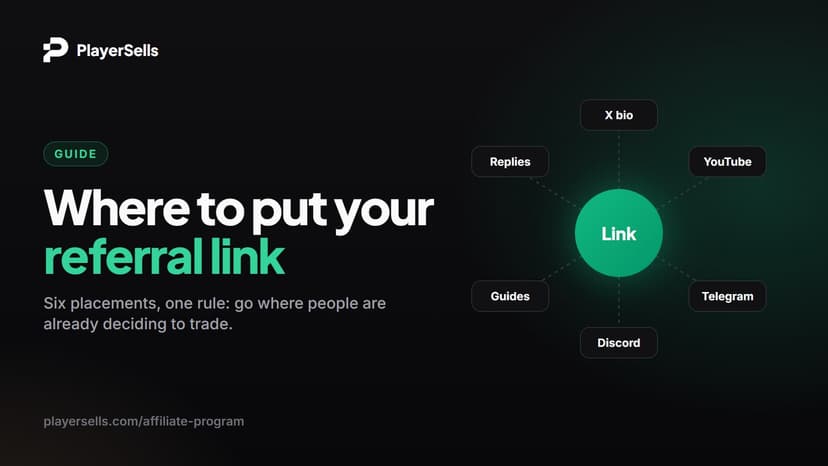
How to Make Money With Referral Links: Where to Put Yours
A referral link only earns when it reaches someone ready to trade. Six places to put yours, what to send each audience, and how to track results.
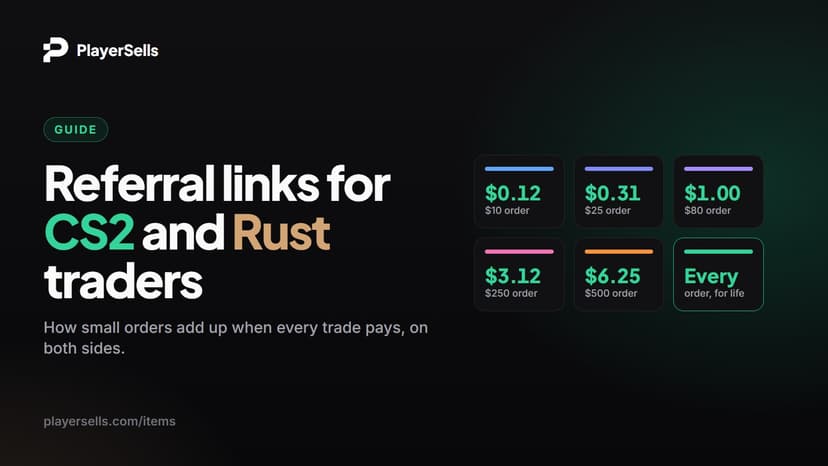
Referral Links for CS2 and Rust Traders: How Small Orders Add Up
A CS2 or Rust skin order pays a referrer cents to a few dollars, every time. See the numbers, where skin audiences gather and what to avoid.