

Buy an X account or grow one: the honest math on cost
Buy an X account or grow one? Only 8.118% of tracked accounts ever hit 10,000 followers. Real prices, real hours and the cases where buying loses.
Fewer than one X account in twelve ever reaches 10,000 followers. Across a 357,360-account sample of the 17.9 million X accounts in the PlayerSells directory (a set that skews toward accounts with some public visibility, not every account ever registered), 8.118% have 10,000 followers or more, and the median account sits at 576. On our own marketplace, an account in the 10,000 to 50,000 band sold for a median $150 across 14 completed sales between March and August 2026.
Buy an X account or grow one is usually treated as a budget question. It stops being one about ten minutes in. Growing to 10,000 followers is a thing more than 91% of tracked accounts never do at any age, and buying the same position cleared a median $150 in the band where our market is busiest. Cheapness is not the interesting part. The interesting part is that the two paths deliver different assets, and a large share of readers should buy neither. Anyone asking whether buying an X account is worth it has usually already answered the price question and is really asking a fit question.
This article prices three paths side by side: growing organically, buying followers (a different and partly unlawful product), and buying an account. Then it prices a fourth, X Ads, and a fifth, the hybrid. We run an escrow marketplace and we sell accounts, so read the arithmetic rather than our opinion. The cases where buying loses have their own section and they are not short.
Key takeaways
- Only 8.118% of a 357,360-account sample of the PlayerSells X directory has 10,000 followers or more, and 0.913% has 100,000 or more. That scarcity is the entire product.
- Age on its own does not deliver an audience. The median account older than ten years has 708 followers, against 151 for an account under a year old.
- The median account in the 10,000 to 100,000 band has posted 8,150 times in its life. At ten minutes a post that is roughly 1,358 hours, and the same position cleared a median $150 across 14 sales in our 10K-50K band.
- Buying does not end the work. The median 10K-100K account posts 871.2 times a year, and that cadence is what a buyer inherits on day one.
- Buying followers is not a cheap version of buying an account. Under 16 CFR 465.8, effective 21 October 2024, purchasing fake indicators of social media influence to misrepresent your influence for a commercial purpose is itself an unfair or deceptive act, carrying penalties of up to $53,088 per violation.
- Liquidity dies at the top. Twenty-three X accounts with 100,000 or more followers have been listed on our marketplace and not one has sold.
- If the audience you want would be following a person rather than a handle, the correct answer is almost always to buy nothing and post more.
Scarcity is the product: only 8.118% of tracked accounts ever clear 10,000 followers
Start with what an audience is actually worth by counting how few of them exist. The figures below come from a 357,360-account sample of the 17.9 million X accounts in the PlayerSells directory, drawn on 2026-08-14. The directory tracks accounts that surfaced through public discovery, so it skews toward accounts with some visibility. It is not a random sample of every account ever registered, which means the real-world rarity of a large account is probably worse than these numbers show, not better.
| Follower threshold | Share of the 357,360-account sample | One account in every |
|---|---|---|
| 1,000+ | 39.052% | 2.6 |
| 5,000+ | 13.893% | 7.2 |
| 10,000+ | 8.118% | 12.3 |
| 50,000+ | 1.860% | 53.8 |
| 100,000+ | 0.913% | 109.5 |
| 1,000,000+ | 0.0652% | 1,534 |
The median account in that sample has 576 followers. The 75th percentile has 2,137 and the 90th has 7,693. Nine out of ten accounts in a directory that already skews toward visible accounts never clear 7,693 followers. If you have been posting for two years and you are sitting at 900 followers, you are not failing. You are at the 60th percentile or so, which is exactly where the arithmetic says most people sit.
What that rarity does to price
Scarcity is why a follower is not priced linearly. The rarer bands cost more in absolute terms and less per follower, because the buyers who can pay for them are rare too. We break the full percentile picture down in our follower count benchmarks from 17 million accounts, and you can watch the same bands price themselves on any marketplace browse page.
The number that should reframe your plan
If your goal is 10,000 followers, you are not aiming at a milestone. You are aiming at the top 8.118% of a visibility-skewed sample. Most growth advice is written as if that outcome is a process you can run, and the distribution says otherwise. That is also why nobody can tell you honestly how long it takes to grow 10,000 Twitter followers. The median answer is never.
Time is not a growth strategy: the median ten-year-old account has 708 followers
The single most expensive belief in this market is that an old account is a grown account. It is not. Here is reach by age band from the same 357,360-account directory sample.
| Age band | N | Median followers | 90th pct followers | Share with 10K+ |
|---|---|---|---|---|
| Under 1 yr | 14,986 | 151 | 3,329 | 3.864% |
| 1-3 yr | 32,816 | 321 | 5,156 | 5.695% |
| 3-5 yr | 47,065 | 444 | 6,819 | 7.388% |
| 5-10 yr | 93,254 | 589 | 8,119 | 8.532% |
| 10 yr+ | 169,239 | 708 | 8,678 | 8.940% |
Ten years of existence moves the median account from 151 followers to 708. That is a 4.7x gap in medians. The odds of clearing 10,000 improve only from 3.864% to 8.940%, a 2.3x gap. A decade of being on the platform takes an account from a 96% chance of failing to reach 10,000 followers to a 91% chance of failing.
The comparison that should end the argument
The median account in the oldest band has 708 followers. On our marketplace, accounts in the 1,000 to 5,000 follower band sold at a median $100 across 50 completed sales, and by definition every one of them had at least 1,000 followers. A median ten-year run on X delivers less audience than a hundred dollars buys. That is not a statement about your ability. It is a statement about the shape of the distribution.
Two honest caveats. The directory median includes accounts that were never trying to grow, so it understates what a committed operator achieves. And an aged account still carries things a new one does not, which is why aged and new accounts price differently and why we wrote a separate piece on when account age beats follower count. Age is worth paying for. It is just not worth waiting for.
Growing is paid for in posts, and the median 10K-100K account has posted 8,150 times
Followers are bought with posts. Here is the posting volume behind each band, from the same directory sample, converted into hours. The conversion assumes ten minutes per post covering drafting, posting and replying in the thread. That ten minutes is our assumption for the arithmetic, not a measurement. Move it and every hours figure below moves with it.
| Tier | Median lifetime posts | Median posts per year of life | Lifetime hours at 10 min/post | Hours per year |
|---|---|---|---|---|
| Under 1K | 934 | 130.3 | 156 | 22 |
| 1K-10K | 5,906 | 660.4 | 984 | 110 |
| 10K-100K | 8,150 | 871.2 | 1,358 | 145 |
| 100K+ | 14,884 | 1,301.3 | 2,481 | 217 |
Put a price on the hours and the cost to grow an X account organically stops being abstract. At $20 an hour, a rate we picked to make the arithmetic legible rather than because we measured it, the median 10K-100K account represents roughly $27,200 of posting labour. At $50 an hour it is about $67,900. The same position cleared a median $150 across 14 completed sales in our 10K-50K band between 16 March and 13 August 2026.
Why that comparison is fair, and where it is not
It is fair in one direction: the posts really did happen, and nobody produced 8,150 posts by accident. It is unfair in another: much of that labour was not a cost, because the person enjoyed it, or was posting for reasons that had nothing to do with follower count, or would have written the same things anyway. Labour you would have spent regardless is not an expense you avoid by buying.
That is the honest boundary of the buy case. If posting is something you want to do, growing costs you very little that you were not already spending. If posting is a chore you are pricing as a chore, the hours column is a real bill and buying is a very cheap way to avoid part of it. Our growth simulator is the fastest way to see what your own cadence produces before you commit a year to it.
What the buy side actually costs, and why price per follower collapses as accounts get bigger
These are completed escrow sales on PlayerSells between 16 March and 13 August 2026, X listings only, accounts with 100 or more followers. Sold prices, not asking prices.
| Tier | N sold | Median price | 25th pct | 75th pct | Median $ per 1K followers |
|---|---|---|---|---|---|
| Under 1K | 15 | $15 | $12 | $29 | $41.55 |
| 1K-5K | 50 | $100 | $30 | $125 | $44.15 |
| 5K-10K | 13 | $85 | $70 | $95 | $11.23 |
| 10K-50K | 14 | $150 | $143 | $288 | $13.22 |
| 50K-100K | 3 | $200 | $140 | $350 | $3.43 |
| 100K+ | 0 sold | - | - | - | - |
Price per follower falls from $44.15 per 1,000 in the 1K-5K band to $3.43 per 1,000 in the 50K-100K band. The 50K-100K row rests on three sales, so treat it as directional rather than definitive. The mechanism behind the collapse is simple: small accounts carry a floor cost (listing effort, escrow minimums, the seller's time) that inflates their per-follower rate, and large accounts run out of buyers.
One thing to hold onto before you look at any live listing: asking prices and clearing prices are different markets. In the 10K-50K band sellers ask a median $475 across 34 active listings while sold accounts in the same band cleared a median $150. Our sibling article on what you should actually pay for an X account in 2026 takes that gap apart properly. For this article the point is narrower: when you compare buying against growing, compare against the clearing price, not the sticker.
What is actually in stock
Across 205 active X listings priced today, 50 sit under $50, 66 between $50 and $200, 45 between $200 and $1,000, 27 between $1,000 and $5,000 and 17 above $5,000. That is 56.6% of live inventory under $200. The market a first-time buyer meets is a two-figure and low-three-figure market, which is why accounts under $500 is the busiest browse page we run.
Buy an X account or grow one: what each path costs per 1,000 followers
Here are the two paths in the same unit. The buy column is our completed-sale medians. The grow column is derived from directory posting volumes, and it needs one explicit trick: the directory reports posting by band, not by exact follower count, so a band gives you a range. Anchoring at the band ceiling produces the fewest posts per 1,000 followers, which is the reading most generous to growing. Anchoring at the band floor produces the harshest. Both are shown.
| Zone | Buy: median $ per 1K (sold) | Grow: hours per 1K at band ceiling | Grow: hours per 1K at band floor | Grow: $ per 1K at $20/hr, ceiling anchor |
|---|---|---|---|---|
| 1,000 to 10,000 | $11.23 to $44.15 (N=63) | 98 | 984 | about $1,970 |
| 10,000 to 100,000 | $3.43 to $13.22 (N=17) | 14 | 136 | about $272 |
| 100,000+ | no completed sale (0 of 23 listed) | 25 | n/a | about $496 |
On the most growing-friendly assumptions in the table, growing a follower still costs somewhere between twenty and two hundred times what buying the same follower costs. Change the hourly rate to $10 and the gap halves. Change it to zero, because you would have posted anyway, and the gap vanishes entirely, which is the whole reason the last two sections of this article exist.
The unit is misleading and you should know how
Cost per 1,000 followers treats followers as interchangeable. They are not. A follower who found you through two years of your own posts has read your writing. A follower you acquired by buying the account they were already following has never heard of you. That is not a rounding error, it is the entire difference between the two assets, and it is why the next four sections are about what actually transfers.
Buying followers versus buying an account: one is a purchase, the other is a federal liability
These get conflated constantly and they are not adjacent products. Buying an account transfers a real account with real people following it. Buying followers attaches numbers to an account you already have. The second one has a rule pointed directly at it.
The FTC's Rule on the Use of Consumer Reviews and Testimonials, 16 CFR Part 465, took effect on 21 October 2024. Section 465.8 makes it an unfair or deceptive act for anyone to sell or distribute fake indicators of social media influence, and, in subsection (b), to "purchase or procure fake indicators of social media influence that they knew or should have known to be fake and that materially misrepresent their influence or importance for a commercial purpose". The rule defines indicators of influence to include followers, views, likes, shares, reposts and comments, and defines fake ones as those generated by bots, by accounts not associated with a real individual, by accounts created with someone's personal information without consent, or by hijacked accounts. You can read the text at Cornell's copy of 16 CFR 465.8.
Subsection (b) reaches the buyer, not just the seller, and the current civil penalty is up to $53,088 per violation under 16 CFR 1.98, the figure the FTC cited in its December 2025 warning letters. The FTC's first case over selling fake indicators of influence, announced in October 2019 against Devumi LLC, produced a $2.5 million judgment against the company's CEO, suspended on payment of $250,000, over allegations that included more than 58,000 orders for fake Twitter followers. New York's Attorney General, with Florida, announced a parallel settlement on 30 January 2019 described as the first in the country to find that selling fake followers and likes is illegal deception. In the EU, the Unfair Commercial Practices Directive blacklists misrepresenting social endorsements outright at Annex I point 23c, with no case-by-case unfairness test.
X has its own rule. The Authenticity policy (stamped Last Updated April 2025) prohibits "coordinating with and/or compensating others to conduct account metric inflation in any X features". So the padded-follower route breaks a federal rule, an EU per se prohibition and the platform's own policy at the same time. We laid out exactly what is and is not banned in our explainer on the FTC fake follower rule, and the practical comparison lives on organic versus bought followers.
How to spot an account that took the follower shortcut before you pay for it
Across 138,122 directory accounts with 1,000 or more followers, the median follower-to-following ratio is 3.99 and 16.73% follow more people than follow them. That inverted ratio is the follow-back growth signature: an account that gathered its audience by following thousands of strangers and keeping the ones who reciprocated. It is not proof of purchased followers, but it tells you the audience was assembled by churn rather than by content. Run any candidate through the engagement rate calculator before you talk price, and treat an inverted ratio as a question to ask rather than a verdict to deliver.
X Ads is the third path, and X charges an entry fee before you buy a single follower
Every guide in this niche quotes an X Ads cost per follower. We are not going to, because we could not verify one from a primary source, and printing an unverifiable unit cost is exactly how this niche got a reputation for making numbers up. What we can document is the gate you pass through before the meter starts.
X's published advertiser eligibility says your account "must be verified through one of the following programs": Verified Organizations for businesses and government entities, or X Premium for individuals. An advertiser cannot participate if the account is suspended, and cannot participate if it has been deactivated. Ads Quality requirements add that profile and header photos must not be GIFs, the bio must carry a functional, live, ungated URL that accurately represents the promoted product, and posts must be public. No minimum account age is documented on that page.
As of 2026-08-14, X Premium is listed at $8 a month or $84 a year, and Premium+ at $40 a month or $395 a year. Basic, at $3 a month, does not include a checkmark. So for an individual the ads path starts at a subscription, not at a bid, and the account you advertise from has to already be in good standing. X also says ads are submitted for approval automatically "based on an account's advertising status, its historical use of X, and other evolving factors", and publishes no turnaround time.
Why an ad-acquired follower behaves differently
An ads follower arrived because you paid to appear in front of them, and the acquisition stops the day the budget stops. A follower who came through your posting arrived because something you wrote was worth following, and that flow continues without spend. Neither is better in the abstract, but a cost-per-follower comparison across them compares a rental to a purchase.
One more distinction worth carrying: X documents that being offboarded from X Ads "is not the same as being suspended from X" and applies only to paid advertising. Advertising standing and account standing are separate objects, so an account with clean organic standing may still be a poor advertising vehicle, and you cannot check the latter from the outside before you buy.
What buying actually buys is a starting position, not an exemption from posting
Here is the part sellers under-explain and buyers under-plan for. The median 10K-100K account posts 871.2 times a year, which is about 2.4 posts a day, every day. That is not the history you are buying. That is the run rate the audience is used to and the workload transferring to you on the day the escrow closes.
Our escrow cycle has a median time from deal creation to completion of 23.1 hours across 105 completed deals on all platforms, with a 75th percentile of 55.5 hours. Day one arrives faster than most buyers plan for, and the account does not pause while you work out your content strategy. The sibling article on the first 90 days after you buy an X account is the operating plan for exactly that window.
| What you are paying for | Does it travel with the account? | What to know |
|---|---|---|
| Join date and account age | Yes | It is a property of the account, and X now surfaces it publicly. |
| Post history | Yes | Including anything the previous owner would rather you did not scroll back to. |
| Follow graph | Yes, subject to churn | People followed the previous operator. Some will leave when the output changes. |
| Impression history | Sits with the account | X re-checks monetization eligibility on an ongoing basis, so it is not a permanent credential. |
| Blue checkmark | No | It is a live X Premium subscription, and changes to display name, photo or handle cause temporary loss pending re-validation. |
| Payout identity | No | Monetization needs a verified Stripe account and completed identity verification tied to a real legal person. |
| The previous owner's voice and behaviour | No | This is the one that decides whether the purchase works. |
Everything in the "yes" column is real value and it is the honest case for buying. An aged X account hands you a join date, a body of posts and a live follow graph on the day you pay for it, and no amount of effort produces those in a quarter.
What buying cannot buy is the person the audience was following
The failure mode is not detection. It is dilution. You bought an audience assembled by somebody with a specific voice, posting about a specific thing, at a specific cadence, and the moment your output stops matching that, the audience stops behaving like the audience you priced.
The 2026 monetization rules make this concrete. X's Original Content Rewards program requires an active Premium, Premium+ or Premium Business subscription, at least 500 verified followers, at least 500,000 Home Timeline impressions from verified users in the last 90 days, and that you "actively post original content as defined in this policy". The published eligibility list is on X's Original Content Rewards help page. That impression bar is a rolling 90-day window, which is genuinely faster to buy than to build, and it is the strongest pro-buy argument available as of August 2026. It is also a window you have to keep re-earning, because X states it periodically reviews accounts in the program for ongoing compliance.
What X does document, and what nobody selling you an account will lead with, is that a transfer of ownership can itself trigger a request to re-verify identification. X's verification policy lists, among its re-verification triggers, "If the ownership of the account has been transferred to a different user". X does not publish an outcome for what happens to monetization when an account changes hands, and anyone who tells you it definitely survives or definitely dies is going past the documentation. The valuation consequences of the 2026 program change are handled in our sibling piece on what a bought X account is worth now that revenue sharing ended.
The break-even is not a payback period, it is a time-to-parity calculation
Payback needs revenue assumptions, and revenue assumptions are where account-flipping content goes to lie. A cleaner question: how long would it take you to reach the position you are about to buy, and what are the odds you get there at all? That is computable from the data.
| Target position | Share of tracked accounts that reach it | Median lifetime posts of accounts in that zone | Hours at 10 min/post | Median sold price to buy in |
|---|---|---|---|---|
| 1,000+ followers | 39.052% | 5,906 | 984 | $100 (1K-5K, N=50) |
| 10,000+ followers | 8.118% | 8,150 | 1,358 | $150 (10K-50K, N=14) |
| 50,000+ followers | 1.860% | 8,150 | 1,358 | $200 (50K-100K, N=3) |
| 100,000+ followers | 0.913% | 14,884 | 2,481 | no completed sale (0 of 23) |
Read the second column as the risk term. Buying converts a probabilistic outcome into a purchase: you are not paying to skip 1,358 hours, you are paying to skip a 91.882% chance of never getting there. That is the honest framing of the shortcut to Twitter growth, and it is a much better argument than the time saving on its own. The shortcut is real. It is also narrower than the people selling it admit, because it moves you past the odds and not past the work.
Three assumptions you should change before trusting any of this
- The ten minutes. If you write threads, it is higher. If you post one-liners, much lower. Every hours figure scales linearly with it.
- The $20 an hour. It is a placeholder we chose to make the numbers legible. Use your own rate, and use zero if you would post regardless.
- The band anchors. Posting volumes are reported per band, so per-follower figures are a range, not a point. We showed both ends rather than picking a flattering middle.
If you want the buy-side number for a specific account rather than a band median, the X account valuation calculator prices a single account against the same transaction data.
Three buyers, three different correct answers
| Buyer | Constraint | What we would do | Why |
|---|---|---|---|
| Founder shipping a product in ten weeks | A hard date, no audience | Buy in the 1K-5K or 5K-10K band, budget $85 to $125, keep posting from day one | 984 hours does not fit in ten weeks and 39.052% odds are not a launch plan |
| Consultant selling their own expertise | The audience would be following a person | Buy nothing. Post more. | The one asset that does not transfer is the person, and that is the entire product |
| Agency opening a second niche or market | Needs a credible base fast, may exit later | Buy two small accounts rather than one mid-sized one | The 1K-5K band has the market's best sell-through at 38.5%, so the position is exitable |
The founder
This is the cleanest buy case that exists. A launch date is a constraint that money can relieve and time cannot. The right purchase is small, cheap and in a matching niche, and the mistake is buying a bigger account than the launch needs because it feels more impressive. Note from the price table that the 1K-5K band is the most expensive band per follower at $44.15 per 1,000, and it is still the right band, because you are buying credibility at a threshold rather than reach at scale.
The consultant
Buying is close to pointless here and we would rather say so than sell you something. The people you want are going to follow a named human whose thinking they can evaluate. Handing that human a borrowed audience of strangers does not produce trust, it produces an unfollow curve. The median under-1K account posts 130.3 times a year, which is roughly two and a half posts a week. That is the bar you are competing against, and it is a low bar that most people never clear.
The agency
Two small accounts beat one medium account for a testable use case: you get two niches, two audiences and two independent outcomes for a similar budget, and if one fails you have not lost the whole position. Tier selection by goal is its own subject, and our sibling article on which follower tier you should actually buy covers it with the sell-through and liquidity data attached.
When buying is clearly wrong, and when it is clearly right
Most buy-versus-build content refuses to name the cases where its own product loses. Here are ours.
Clearly wrong
- Personal brand and thought leadership. The audience is following a person. You cannot buy a person.
- Any use where you will be asked to prove the account is yours. Speaking slots, media credentials and partnerships tend to involve a human checking history.
- When you have not yet proven you will post. Buying an audience you then leave silent is the most common way to waste this money. If you have not sustained the median under-1K cadence of 130.3 posts a year for a full year, buy nothing.
- When the account's niche does not match yours. A mismatched rebrand converts an inherited audience into an unfollow queue.
- When the price is inside the noise of your own labour cost. If your time is genuinely free, the arithmetic in this article stops favouring buying.
Clearly right
- A deadline you cannot move. Product launches, funding rounds, event marketing.
- A second brand account. You already have a working posting habit and need another surface.
- Entering a niche or language you have no presence in. Seeding from zero in an unfamiliar audience is the slowest possible start.
- A crossing threshold that gates something. 500 verified followers is a documented monetization eligibility bar, and thresholds are exactly what money is good at crossing.
- Aggregation. Running several niche accounts as a portfolio is a different business from growing one, and it is not reachable organically at any sensible speed.
If your case sits in the first list, the useful next step is not a listing page. It is a posting schedule and a year of keeping it. Whether it is better to buy an account or start fresh is decided by which list your case lands in, not by which one is cheaper.
The hybrid: buy in the liquid band, grow it, and know your exit before you enter
The third answer is buy small and grow it. This is the strategy most experienced operators actually run, and it has a specific data-backed shape.
| Tier | Listed | Sold | Sell-through |
|---|---|---|---|
| Under 1K | 47 | 15 | 31.9% |
| 1K-5K | 130 | 50 | 38.5% |
| 5K-10K | 46 | 13 | 28.3% |
| 10K-50K | 72 | 14 | 19.4% |
| 50K-100K | 21 | 3 | 14.3% |
| 100K+ | 23 | 0 | 0.0% |
Twenty-three X accounts with 100,000 or more followers have been listed on our marketplace and not one has sold. Liquidity peaks in the 1K-5K band at 38.5% and falls away above it. A tier you cannot exit is a different asset from one you can, and if any part of your plan involves selling later, that column is more important to you than the price column.
Speed matters too. The median time from a listing going live to a completed sale is 7.8 days across 99 chronologically sane X deals, with a 25th percentile of 3.7 days and a 90th percentile of 30.4 days. That is your realistic exit horizon in the liquid bands, and it collapses to nothing above 50,000 followers where there are barely any completed sales to measure.
Two things that decide whether the hybrid pays
First, negotiate. Across 99 completed X deals whose listing predates the deal, the median closing price is 100.0% of asking and 72.7% closed at exactly the asking price. Buyers who did open a negotiation opened at a median 83.3% of ask, and the 25th percentile opened at 60.6%. Not negotiating is the most expensive habit a buyer has, and the tactics belong in the tier article.
Second, plan for decay. Large accounts do not sit still, and an account bought today is not the same account a year from now. We measured that separately in what six million daily snapshots show about shrinking accounts, and a flip that assumes a flat follower count between purchase and resale is a flip with a hole in it.
Risk-adjusting the buy: the numbers that exist and the one that does not
You cannot compare paths honestly without pricing the downside, and this is where most marketplace content goes quiet. Start with the rule. X's Authenticity policy (stamped Last Updated April 2025) lists as prohibited behaviour "Trading, buying, selling (either through monetary or virtual compensation) or soliciting access of X accounts, including the temporary or permanent transfer or sales of accounts, username or X (e.g. 'pay for affiliation' schemes) products". The same policy states that "For severe violations, accounts will be permanently suspended at first detection." You can read it at X's authenticity policy page.
There is no published figure for how often X detects or acts on an account sale, and any article quoting one is inventing it. X publishes the rule and the maximum penalty and nothing about enforcement rates. Press coverage describes a wave of suspensions for inauthentic behaviour beginning around March 2026 that swept up legitimate accounts alongside automated ones, but that reporting is secondary and carries no verified numbers. Treat suspension as an unpriceable tail risk and size your purchase accordingly.
What we can price is our own side of the transaction. Of 414 X listings, 29 were suspended and 5 rejected, so 8.2% were removed by moderation before a buyer ever saw them close. Of the deals that reached funding or later, 10 out of 127 ended in dispute, a 7.87% dispute rate, or roughly one funded deal in thirteen. And the most common failure is not fraud at all: of 777 deals ever created, 448 were cancelled, and 238 of those cancellations (53.1%) were automatic 24-hour inactivity closures where one party simply stopped replying.
What escrow does and does not change
Escrow bounds the counterparty risk, not the platform risk. It means the seller does not hold your money while you check what you bought, and it gives you an inspection window before funds release. It does not make an account immune to enforcement and it is not insurance against X. Our escrow process explains the flow, and the complete buyer's guide covers the diligence that goes with it. Insist on the original email being included: accounts sold with the original email are materially harder for a seller to reclaim afterwards.
This is general information, not legal or tax advice. Consult a qualified professional about your own situation and jurisdiction, and check X's current policy pages before you act, because they change.
Buy an X account or grow one: the decision in five questions
Answer these in order and stop at the first one that decides it.
- Would the audience be following you personally? If yes, do not buy. No amount of inherited followers substitutes for the person they came for.
- Have you sustained a posting habit for twelve months? If no, do not buy yet. The median under-1K account manages 130.3 posts a year and buying does not lower that bar, it raises it to the 871.2 posts a year the 10K-100K band runs.
- Do you have a date you cannot move? If yes, buy. A deadline is the one constraint that money solves and time does not.
- Is there a threshold gating something you need? If yes, price the purchase against the threshold, not against the follower count. Crossing 500 verified followers is worth more than the 500 followers.
- Will you need to sell it later? If yes, buy inside the liquid bands. Sell-through peaks at 38.5% in the 1K-5K band and is 0.0% above 100,000 followers.
If you got to the end and the answer was buy, the practical starting point is a defined budget rather than a follower target. More than half of live X inventory sits under $200, so the first decision is niche fit and the second is whether the seller will show you live analytics. Browse X accounts for sale or narrow straight to a vertical such as 1K to 10K crypto and Web3 accounts.
Frequently asked questions
Is buying a Twitter account worth it?
It is worth it when you have a deadline, a matching niche and an existing posting habit, and it is not worth it when the audience you want would be following you personally. The arithmetic strongly favours buying on cost: the median 10K-50K account cleared $150 across 14 sales while the median 10K-100K account represents 8,150 lifetime posts. The cost is not the deciding factor. Fit is.
How long does it take to grow 10,000 Twitter followers?
There is no reliable timeline, because most accounts never get there. Only 8.118% of a 357,360-account directory sample has 10,000 followers or more, and the odds only improve from 3.864% for accounts under a year old to 8.940% for accounts over ten years old. What we can say is what it takes in output: the median account in the 10K-100K band has posted 8,150 times, roughly 1,358 hours at ten minutes a post.
Is it better to buy an account or start fresh?
Start fresh if you are building a personal brand, have not yet proven you will post consistently, or have no deadline. Buy if you are launching against a date, entering a niche you have no presence in, or need to cross a documented threshold like 500 verified followers. The two paths produce different assets, so match the asset to the job rather than comparing prices.
What does it cost to grow an X account organically?
In cash, close to nothing. In hours, the median 1K-10K account has posted 5,906 times and the median 10K-100K account 8,150 times, which is roughly 984 and 1,358 hours at ten minutes a post. Priced at $20 an hour, a placeholder rate we chose for legibility, that is about $19,700 and $27,200 of labour. If you would have posted anyway, none of it is an incremental cost.
What is the cost per follower on X Ads?
We do not publish an X Ads cost per follower because we could not verify one from a primary source. What is documented is the entry requirement: X states an advertiser account must be verified through Verified Organizations or X Premium, cannot be suspended or deactivated, and must have a live ungated URL in the bio and non-GIF profile images. X Premium is listed at $8 a month or $84 a year as of 2026-08-14.
Is buying followers cheaper than buying an account?
It is cheaper and it is a different product with legal exposure attached. Under 16 CFR 465.8, effective 21 October 2024, purchasing fake indicators of social media influence that you knew or should have known were fake, in order to materially misrepresent your influence for a commercial purpose, is an unfair or deceptive act, with penalties up to $53,088 per violation. X's Authenticity policy separately prohibits compensating others for account metric inflation.
Can I buy a small account and grow it instead?
Yes, and it is the most common experienced play. Buy inside the liquid bands, because sell-through peaks at 38.5% in the 1K-5K band and falls to 0.0% above 100,000 followers where 23 listings have produced zero completed sales. Median time from listing to sale is 7.8 days across 99 X deals, so an exit in the liquid bands is realistic if you keep the account clean.
Does buying an X account break X's rules?
Yes. X's Authenticity policy, stamped Last Updated April 2025, lists trading, buying, selling or soliciting access to accounts as prohibited behaviour, and states that severe violations lead to permanent suspension at first detection. X publishes no data on how often it detects transfers. That is a risk you price and bound rather than one you can eliminate, and it is why escrow with an inspection window matters.
Will the account's monetization come with it?
X does not document an outcome either way. What it does document is that a transfer of ownership can trigger a request to re-verify identification, that creator payouts require a verified Stripe account and completed identity verification tied to a real legal person, and that eligibility for Original Content Rewards is reviewed periodically rather than granted once. Anyone stating a definite outcome is going past X's own documentation.
How fast does a purchase actually complete?
The median time from deal creation to completion is 23.1 hours across 105 completed escrow deals on all platforms, with a 75th percentile of 55.5 hours. Finding the right listing takes longer than closing it. The failure mode to watch is silence: 238 of 448 cancelled deals died on an automatic 24-hour inactivity timeout because one party stopped replying.
The one thing to do next
Answer question two from the decision tree honestly. If you have not sustained a posting habit for a year, close this tab and post for a quarter, because buying an audience you will not feed is the most expensive mistake in this market and it is entirely avoidable. If you have, set a budget before you set a follower target, remember that 56.6% of our live X inventory sits under $200, and start on the live marketplace with a niche filter rather than a size filter. Then negotiate, because nearly three quarters of buyers do not.
Free tools for this topic

Published by the PlayerSells editorial team. Data comes from PlayerSells marketplace records and our own crawlers. About PlayerSells · Editorial policy
Related Articles
Continue learning with these related guides.

X algorithm, follower count and what a bought account gets
X open-sourced its ranking code. See what the X algorithm does with follower count and account age, and what reach a bought account really inherits.
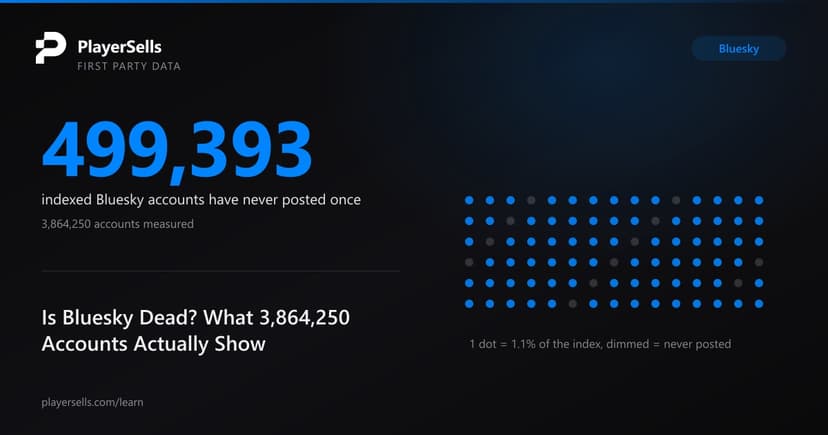
Is Bluesky Dead? What 3,864,250 Accounts Actually Show
Is Bluesky dead? We measured 3,864,250 indexed accounts: 12.9 percent have never posted, and the 29,114 we track daily grew 1.18 percent in 79 days.

Who Legally Owns a Social Media Account? What Courts Have Actually Ruled
Platforms say you own nothing. A federal appeals court says the account is property. Both are true. What JLM Couture v. Gutman and PhoneDog actually held.