
CS2 Skin Market Crash: What the Trade-Up Update Changed
The CS2 skin market crash explained: what Valve's knife trade-up changed, why loss figures differ, what recovered, and how to value your inventory now.
The CS2 skin market crash began on October 22-23, 2025, depending on time zone, when Valve let players trade five Covert (red) skins for a knife or gloves. Before that, knives and gloves came only from cases or other players. The new supply route pushed many knives down 20-50% within 48 hours, while cheap Coverts jumped in price because they had become ingredients.
This guide is for CS2 players, traders and anyone holding an inventory who wants to know what it is worth now. It covers what the update changed, why the loss figures in the headlines disagree, what has recovered since and what hasn't, and a step-by-step method for valuing knives, gloves and Coverts today.
Key takeaways
- Since October 22-23, 2025, five Covert skins can be traded up into one knife or pair of gloves from the collection of one of the skins used.
- Five StatTrak Coverts produce a StatTrak knife only, because the patch notes list a knife, not gloves, as the StatTrak result.
- Trackers cited by the press showed CS2's tracked market value falling roughly $1.75-2 billion, or about 28-30%, within about a day of the update.
- For knives that can be made through trade-ups, the cost of five eligible Coverts from the right collection now acts as the main price floor.
- By 2026 the knife market had split: common finishes follow the price of red inputs, while rare patterns, low floats and popular models still trade on collector demand.
- The biggest lesson of the crash is platform risk: Valve can change how items are created overnight, and skin values move with those decisions.
What did the October 2025 trade-up update change?
It gave knives and gloves a second source. The Trade Up Contract already let players exchange lower-rarity skins for a skin one tier higher, but knives and gloves sat outside that system. According to the patch notes as reproduced by HLTV, the update extended the contract so that Covert items, the highest regular tier, could be traded up into the special items above them.
The same patch brought back Retakes as an official mode on matchmaking servers, which is why many early recaps led with game changes. For the economy, only the trade-up change mattered.
How does the CS2 knife trade-up work?
You put five Coverts into a contract and receive one knife or one pair of gloves from the collection of one of the items you used. The StatTrak version works the same way, with one important limit: the patch notes name only a knife as the StatTrak result.
| Inputs | Possible result | Notes |
|---|---|---|
| 5 regular Covert skins | 1 regular knife or 1 regular pair of gloves | Comes from the collection of one of the inputs |
| 5 StatTrak Covert skins | 1 StatTrak knife | Patch notes mention a knife only, not gloves |
| Knives, gloves, Contraband skins | Not accepted | Cannot be used as inputs |
| Mixed collections | Weighted toward the collection with more inputs | Exact odds are not officially published |
Two details matter for pricing. First, collection matters most. A red from a collection whose knife pool includes a popular model is worth more as an input than a red from a weak collection. Second, the community-maintained Counter-Strike Wiki notes that when collections are mixed, more inputs from one collection make that collection's result more likely, but the exact ratio is not known. Treat any precise "odds calculator" figure for mixed contracts as an estimate.
Why did knife prices fall while Covert skins rose?
Knife and glove supply was no longer capped by case openings, and Coverts became the raw material. Those two effects hit at the same moment, so prices moved in opposite directions within hours.
The knife side: a new production line
Before the update, the only ways to get a knife were to open cases (expensive and rare) or buy one from another player. Afterwards, anyone holding five reds from the right collection could make one. Knife prices had been built on scarcity, and that scarcity ended overnight. Secondary coverage from Space Coast Daily put typical knife drops at 20-50% within 48 hours. The widely quoted "70%" figure applies to specific high-end items at their worst point, such as some Butterfly Fade and Karambit Doppler listings, not to the whole market.
The Covert side: reds became ingredients
When a knife can be built from five reds, each red is suddenly worth about a fifth of a knife, minus some risk. Critical Hit reported that some Covert skins costing under $5 the day before rose to over $40.
The rise was not even. It was strongest for reds from collections with desirable knife results. Inven Global's example is the MP9 | Starlight Protector, which went from around $3 to $65 as players chased Butterfly Knife results from the Dreams & Nightmares collection. Reds from collections with less popular knife pools rose far less.
Why StatTrak and gloves moved differently
Because StatTrak Coverts yield only StatTrak knives, StatTrak reds are tied to knife prices alone. Regular reds can produce either knives or gloves, so their value depends on the whole knife and glove pool of their collection. Anyone comparing StatTrak and regular input prices should keep that asymmetry in mind.
How much did the CS2 market really lose?
Roughly $1.75-2 billion, or about 28-30% of tracked market value within about a day, according to trackers cited by the press. No single number is "correct", because each headline measured something slightly different.
| Reported figure | Where it appeared | What it actually measures |
|---|---|---|
| About $1 billion ($6B to $5B) | Early social-media estimate quoted by SQ Magazine | An early estimate, well below later figures |
| About $1.75 billion | Inven Global | Fall "within days", a longer window |
| $1.784 billion, bottom $4.27B (about 28%) | Critical Hit | A different snapshot within the same report |
| $6B to $4.1B in one day (about 30%) | Critical Hit, citing PriceEmpire | 24-hour move to the low point |
| $5.9B to about $4.2B (28-30%) | TalkEsport | Similar window, different starting value |
| "Almost $2 billion" | Screen Rant | Rounded overnight loss |
| "14 billion" | PANews headline | Yuan, not dollars: about $2 billion |
Four things explain the spread:
- Different trackers. Each tool samples different marketplaces and items, so their starting values ($5.9B vs $6B) already differ.
- Different time windows. A 24-hour drop, a 30-hour drop and a "within days" drop are not the same number.
- Intraday lows vs. later prices. Figures taken at the bottom look worse than figures taken after the first bounce.
- Currency. As PANews explained, the "lost 14 billion overnight" headline refers to roughly RMB 14.2 billion, which is about $2 billion.
Also remember that "market cap" here is an estimate: tracked prices multiplied by estimated item counts. Nobody lost $2 billion in cash. Holders saw the paper value of their inventories fall, and those who sold at the bottom locked it in.
What has recovered since the crash, and what hasn't?
Recovery has been uneven. Entry-level knives now trade close to the cost of five eligible Coverts, while rare patterns, low floats and the most popular models behave more like collectibles. We are not quoting a current total market value: figures circulating in late 2026 contradict each other widely, so check a named tracker on the day you need one.
Common knives now track input costs
According to Inven Global's 2026 analysis, for knives that can be made through trade-ups, the cost of five eligible Coverts became the main price floor. Listings rarely stay below that cost while the inputs cost more. By spring 2026, common and mid-tier knives were following red prices, while rare pattern and float combinations still depended on collector demand.
Where does the entry knife floor sit in 2026?
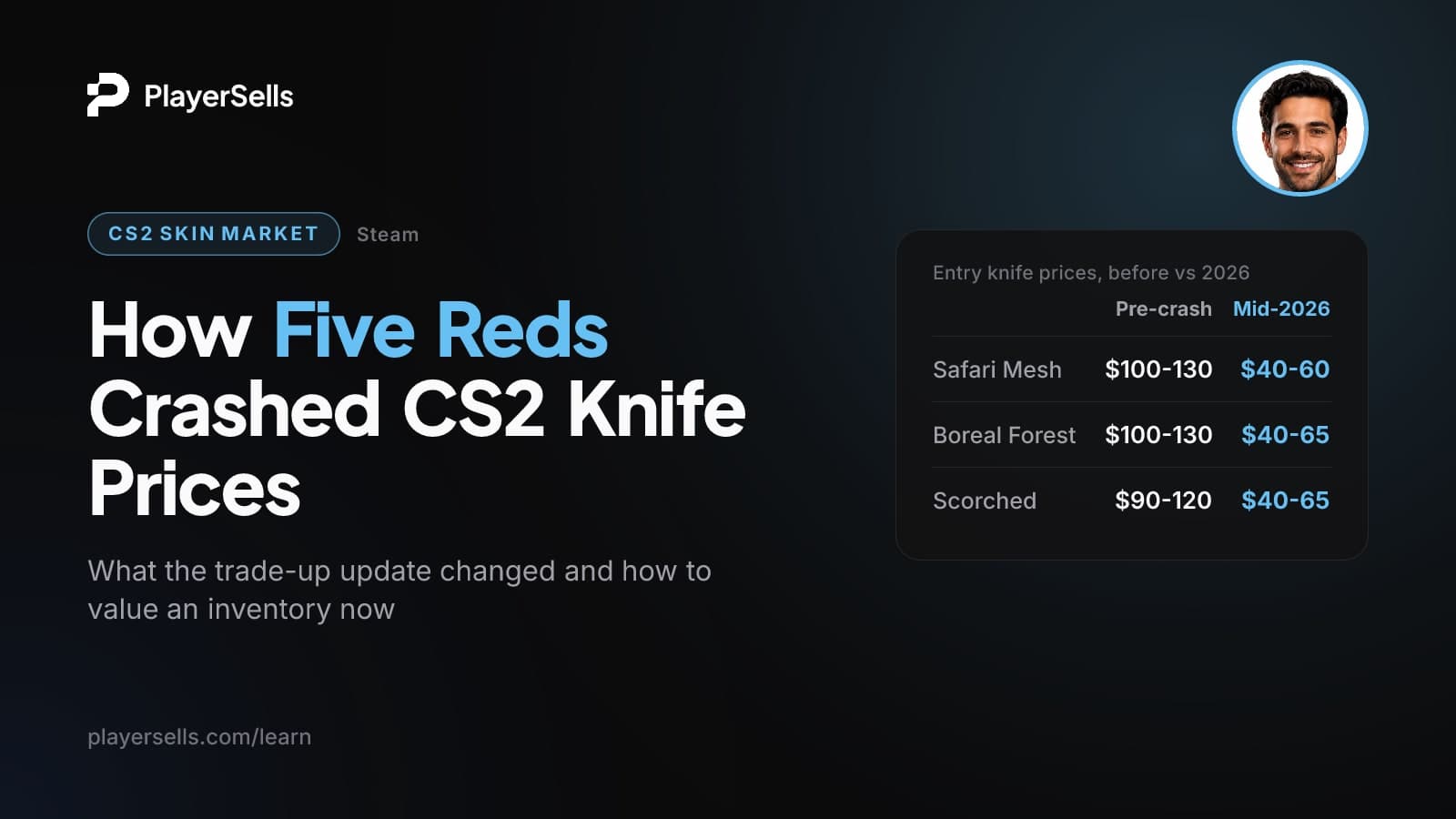
Low-demand finishes on cheaper knife models now sell far below their pre-crash prices. Inven Global's mid-2026 snapshot:
| Finish (cheaper knife models) | Before the crash | 2026 (as of July 2026) |
|---|---|---|
| Safari Mesh | About $100-130 | About $40-60 |
| Boreal Forest | About $100-130 | About $40-65 |
| Scorched | About $90-120 | About $40-65 |
Treat these as dated, approximate ranges. They vary by marketplace and region, and they move with input prices. Always confirm against recent completed sales.
Popular models and the knife vs. glove split
Secondary coverage from Space Coast Daily reports that Butterfly Knives and Karambits recovered faster than other models because demand for them stayed strongest. The same piece notes that the Dead Hand Terminal release added 22 new gloves while leaving the knife pool unchanged. According to that coverage, the unchanged knife pool helped support prices of existing knife models.
How do you value a CS2 inventory now?
Start by asking whether an item can be manufactured, then price it from real sales, then adjust for the details collectors pay for. Asking prices and pre-crash memories are the two most common sources of overvaluation.
- Step 1: Check whether the item can be made by trade-up. For each knife or pair of gloves, find which collections can produce it. If eligible Coverts exist for that collection, the item has a manufactured supply and a cost-based ceiling on how scarce it can be.
- Step 2: Find the input floor. Add up the recent sale prices of the five cheapest eligible Coverts from that collection (StatTrak Coverts for StatTrak knives). For common finishes, the market price usually sits near this number.
- Step 3: Price from completed sales, not listings. Look at what actually sold over the last few weeks. A wall of high asking prices tells you what sellers hope for, not what buyers pay.
- Step 4: Adjust for pattern, float and model. Rare patterns, low floats and models like Butterfly and Karambit can trade well above the input floor. If you are unsure how much float range a skin actually allows, our guide to CS2 skin float ranges shows which skins use the full scale.
- Step 5: Value your Coverts as inputs. A red from a collection with a strong knife pool is priced partly on knife demand. If knife prices in that collection fall, its reds usually follow.
- Step 6: Subtract costs and cash-out limits. Deduct the fees of wherever you plan to sell, and remember that Steam Wallet funds cannot be withdrawn as cash. A $500 inventory value on the Steam Market is not $500 in your bank account.
- Step 7: Date your valuation. Write down the date and source of every price you use. One patch changed the market in a day, so a valuation from last month may already be stale.
A knife's old price is not its value. If five reds can make it, the cost of those five reds is the number buyers compare against.
Are CS2 skins a good investment after the crash?
They are a risky place to store money, and the crash showed why. Valve changed how knives are created with no market-wide warning, and roughly a quarter or more of tracked value disappeared in about a day. That is platform risk, and no amount of chart reading removes it.
A few points worth weighing honestly, none of which is financial advice:
- Rules are set by one company. Valve can add new items, change trade-up rules or alter trading restrictions at any time. Holders have no say.
- Liquidity is not cash. Steam Wallet balances cannot be cashed out, and third-party selling is treated differently from country to country, as is case opening.
- Some segments are more exposed than others. Common knife finishes now move with input prices. Rare patterns depend on a smaller pool of collectors, so buyers can be hard to find and prices can swing sharply.
If you enjoy the items and can absorb a sudden drop, holding skins you like is reasonable. Buying them purely as an asset expecting prices to return to pre-October 2025 levels is a bet on Valve's future decisions, not on the market.
Buying or selling CS2 skins safely on PlayerSells
When prices move fast, the riskiest part of a trade is often the handover, not the price. On PlayerSells you can browse Steam items such as CS2 and Rust skins or list your own skins for sale, and every listing is reviewed by a person before it goes live.
Payment runs through escrow: the buyer pays PlayerSells, the money is held, and the seller is paid only after the buyer confirms the item arrived as described. Each deal follows the same sequence (offer sent, accepted, payment pending, paid, delivered, buyer confirmed, completed), and either side can open a dispute before completion. A human moderator reviews disputes while the money stays held. Sellers receive funds in an on-platform wallet and can withdraw after a clearing period. The full flow is on how it works, and fees are listed on the pricing page so you can include them in Step 6 above.
If you trade CS2 or Rust items regularly, our piece on referral links for CS2 and Rust traders covers another way small trades can add up.
Frequently asked questions
Did Valve reverse the knife trade-up update?
No neutral source we reviewed, as of October 2026, shows Valve reversing or changing the five-Covert knife and glove trade-up. Valve can change rules without notice, as this update showed, so check the latest official CS2 release notes before relying on the rule for a large trade.
Can you trade or sell a knife you got from a trade-up contract?
Reports conflict, so verify in-game before you plan around it. Shortly after release, CS2News reported community observations that knives and gloves from the new contracts appeared not to be tradable or listable on the Steam Market, and it described this as observed behaviour rather than official Valve policy. Check the item's trade status in your own inventory.
Will CS2 knife prices recover to pre-crash levels?
Common knives are unlikely to return to pre-crash prices while the trade-up rule exists, because their price is anchored to the cost of five eligible Coverts. Rare patterns and low floats are priced on collector demand rather than input cost. Secondary coverage also reports that Butterfly Knives and Karambits recovered faster than other models because demand for them stayed strongest.
What is the cheapest knife in CS2 now?
Among the cheapest are low-demand finishes such as Safari Mesh, Boreal Forest and Scorched on cheaper knife models. Inven Global put them at roughly $40-65 as of July 2026, down from about $90-130 before the crash. Prices vary by marketplace and region, so check recent completed sales.
Why did some Covert skins go up so much more than others?
Because each red's value depends on its collection's knife and glove pool. Reds from collections that can produce popular knives, such as Dreams & Nightmares with its Butterfly Knife results, rose the most. Reds from collections with less desirable knife or glove results rose far less.
How do mixed-collection trade-ups decide which knife you get?
The result comes from the collection of one of the inputs, and using more inputs from one collection makes that collection more likely. Valve has not officially published the exact weighting, so treat calculator odds for mixed contracts as estimates rather than guarantees.
Can StatTrak Covert skins be traded up into gloves?
No. According to the patch notes as reproduced by HLTV, five StatTrak Coverts produce a StatTrak knife only. Gloves are listed only as a result of five regular Coverts, so StatTrak gloves cannot be made this way.
Bottom line: price what can be made, not what used to be
The trade-up update permanently changed how most knives are priced. For common finishes, start from the cost of five eligible Coverts, check real sales, then add a premium only for patterns, floats and models that collectors actually chase. Treat the whole inventory as exposed to Valve's next decision.
Once you have a dated, sales-based number you trust, you can sell through escrow on PlayerSells and get paid only after the buyer confirms delivery.

Published by the PlayerSells editorial team. Data comes from PlayerSells marketplace records and our own crawlers. About PlayerSells · Editorial policy
Related Articles
Continue learning with these related guides.
Valorant Rank Distribution: Percentages and Account Value
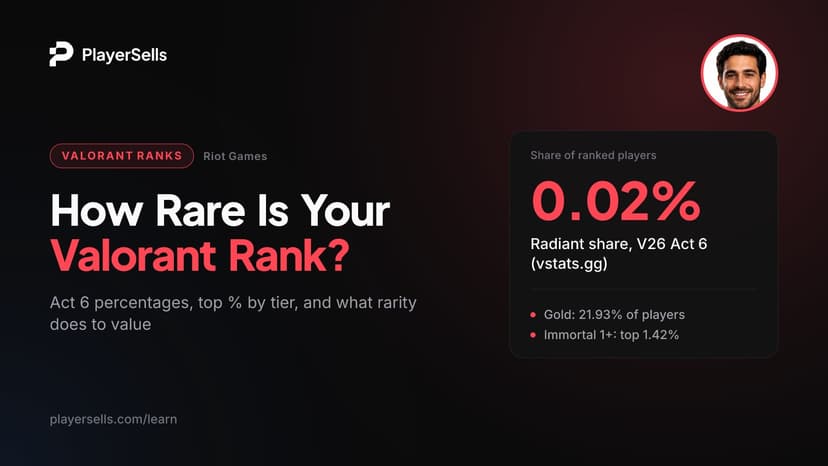
Valorant rank distribution for V26 Act 6: Gold is 21.93% of players, Immortal+ about the top 1-2%. See how rank rarity affects account value and ban risk.
Does Simulcasting Cost Viewers? Kick and Twitch Measured
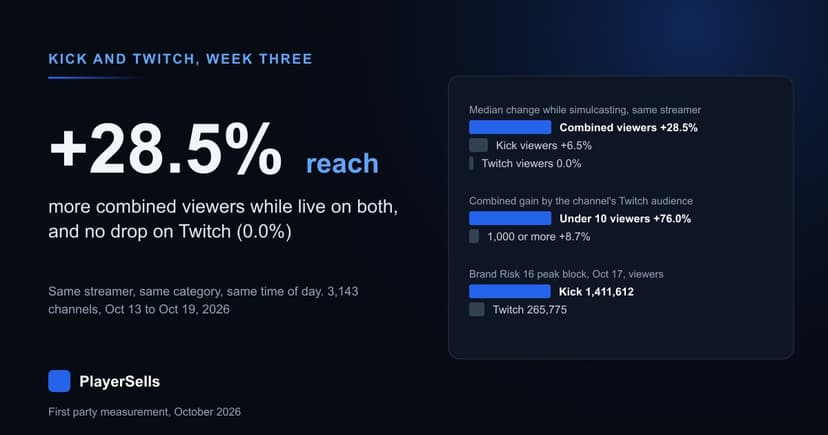
Compared with themselves, 3,143 simulcasters kept the same Twitch audience while also live on Kick, and Kick added a median 28.5% reach. Oct 13 to 19, 2026.
What X Accounts Actually Sell For: 187 Escrow Sales
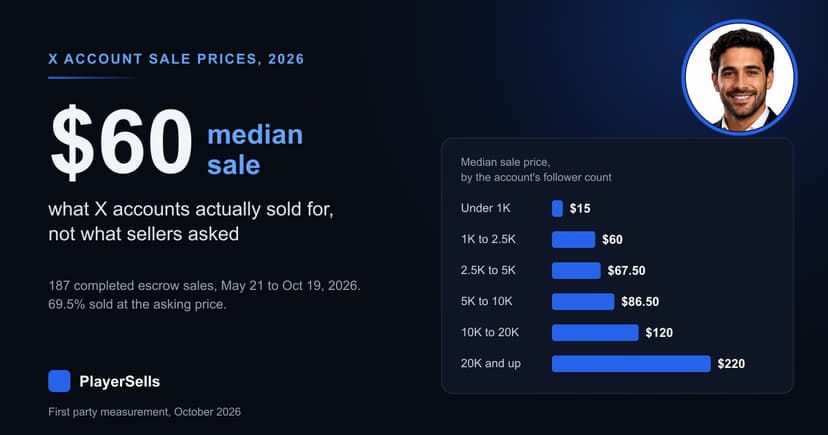
187 completed escrow sales, May to Oct 2026: the median X account sold for $60, 7 in 10 at the asking price, and price per 1,000 followers fell from $35 to $7.