
CS2 Skin Float Ranges: Only 423 of 1,954 Use Full Scale
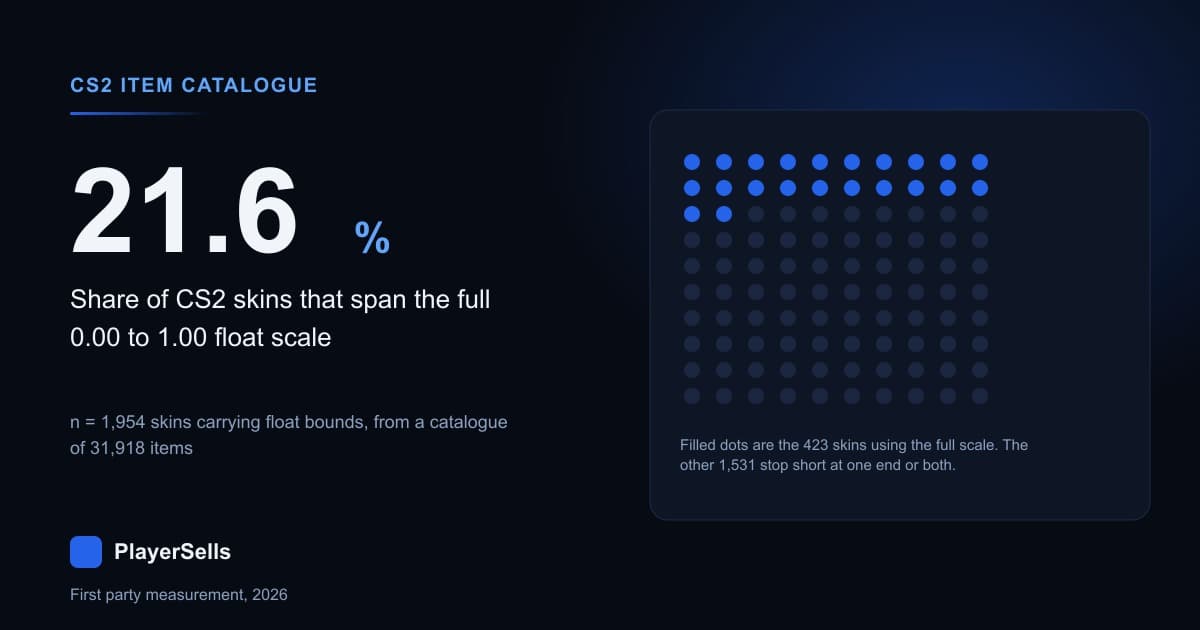
Only 423 of 1,954 CS2 skins in our catalogue span the full 0.00 to 1.00 float scale the published wear ladder assumes. Here are the real per-item bounds.
Only 423 of the 1,954 Counter-Strike 2 skins that carry float bounds in our item catalogue span the full 0.00 to 1.00 range the published wear ladder assumes. That is 21.6 percent, measured on 2026-09-08 across a catalogue of 31,918 game items synced from Steam between 2026-09-05 and 2026-09-07. The other 1,531 skins are capped somewhere. Sixty-one of them can never exist in Factory New, 308 can never reach Battle-Scarred, and 1,194 of the 1,646 skins that do have a Battle-Scarred version stop short of float 1.00. A wear label tells you which bucket the float landed in. It does not tell you the range.
The ladder itself is quoted everywhere as a fixed property of the game: Factory New 0.00 to 0.07, Minimal Wear 0.07 to 0.15, Field-Tested 0.15 to 0.38, Well-Worn 0.38 to 0.45, Battle-Scarred 0.45 to 1.00. Those cut points are correct. We reproduced all four of them against every one of the 1,954 skins and found zero disagreements. What is wrong is the assumption sitting behind them: that each skin uses the whole ladder. Battle-Scarred Karambit | Lore tops out at 0.65. Factory New Sport Gloves | Vice starts at 0.06, not 0.00. Same labels, different numbers.
What does the wear ladder actually get wrong?
The ladder describes the buckets, not the item. Every CS2 skin ships with its own paint wear minimum and maximum, and the wear name is just the bucket that a rolled float falls into. Where a skin's own bounds sit inside a bucket decides how much of that bucket is reachable. We computed the reachable band for every skin and tier pair in the catalogue on 2026-09-08 by intersecting each skin's bounds with each tier's fixed cut points.
Battle-Scarred is where the ladder breaks worst. Of the 1,646 skins with a Battle-Scarred version, 1,194 (72.5 percent) cannot reach the top of that band, and the median reachable Battle-Scarred width is 0.35 rather than the nominal 0.55. Factory New is second: 492 of 1,893 skins with a Factory New version get a narrower window than 0.00 to 0.07. The three middle tiers are nearly intact, which is why nobody notices.
The table below is the whole finding in one shape. Skins are counted once each, at skin level, not once per market entry, because a skin that ships with more variants would otherwise get more votes. Nominal width is what the ladder promises. Median reachable width is what the catalogue actually allows across the skins that have that tier.
| Wear tier | Nominal band | Nominal width | Skins with this tier | Narrower than nominal | Share narrower | Median reachable width |
|---|---|---|---|---|---|---|
| Factory New | 0.00 to 0.07 | 0.07 | 1,893 | 492 | 26.0% | 0.07 |
| Minimal Wear | 0.07 to 0.15 | 0.08 | 1,922 | 168 | 8.7% | 0.08 |
| Field-Tested | 0.15 to 0.38 | 0.23 | 1,796 | 109 | 6.1% | 0.23 |
| Well-Worn | 0.38 to 0.45 | 0.07 | 1,712 | 68 | 4.0% | 0.07 |
| Battle-Scarred | 0.45 to 1.00 | 0.55 | 1,646 | 1,194 | 72.5% | 0.35 |
How the catalogue stores a skin, and what min_float means
Our catalogue holds 31,918 rows across two games: 31,816 for Counter-Strike 2 and 102 for Rust. Each row is a tradable market entry, so one skin produces up to fifteen rows, five wear names across the plain, StatTrak and Souvenir variants. Float bounds live on 20,735 rows and are identical on every row sharing a base item. Of the 1,954 distinct base items with bounds, all 1,954 carry exactly one minimum and one maximum.
That is why skin-level counting matters. Quoting a percentage over the 20,735 rows would weight a skin by how many variants it has, and knives and Souvenir-flagged rifles carry more variants than gloves do. Every headline number in this article is counted once per skin. We re-ran each of them a second time keyed on the weapon and pattern name instead of the internal base identifier, and got the same answers.
| Item kind | Rows | Rows with float bounds | Distinct base items with bounds |
|---|---|---|---|
| weapon_skin (CS2) | 16,917 | 16,877 | 1,452 |
| sticker (CS2) | 10,433 | 0 | 0 |
| knife (CS2) | 3,388 | 3,388 | 408 |
| gloves (CS2) | 470 | 470 | 94 |
| case (CS2) | 467 | 0 | 0 |
| charm (CS2) | 78 | 0 | 0 |
| agent (CS2) | 63 | 0 | 0 |
| rust_skin (Rust) | 102 | 0 | 0 |
The forty weapon_skin rows without bounds are not a gap. They are the vanilla knives: twenty knife models in plain and StatTrak form, which have no paint kit and therefore no wear at all. They are filed under weapon_skin rather than knife, which is a labelling quirk in our sync, and we mention it so nobody tries to reconcile 16,917 against 16,877 and assume data loss.
Which CS2 skins cannot be Factory New?
Sixty-one skins of 1,954 have a minimum above 0.07, so no Factory New version of them exists at all. The largest single group is Rust Coat, which sits at 0.40 to 1.00 and appears on eighteen knife models including Karambit, M9 Bayonet, Butterfly Knife and Talon Knife. A Rust Coat knife has exactly two wear tiers, Well-Worn and Battle-Scarred, and no amount of searching will surface a Factory New one.
The famous cases sit just below that. AWP | Asiimov and M4A4 | Asiimov both run 0.18 to 1.00, which removes Factory New and Minimal Wear and leaves three tiers. AK-47 | Redline is 0.10 to 0.70, so the lowest wear it reaches is Minimal Wear. Galil AR | Chatterbox starts at 0.35 and only has Field-Tested, Well-Worn and Battle-Scarred.
More common than a missing Factory New is a shortened one. Across all 1,954 skins we measured, 442 start at exactly 0.06, leaving a Factory New band one hundredth of a point wide instead of seven. All 94 glove skins sit in that group, uniformly 0.06 to 0.80, along with 158 knife finishes and 171 weapon skins.
| Factory New window | Skins | Share of 1,954 | Example |
|---|---|---|---|
| Full 0.00 to 0.07 | 1,401 | 71.7% | AK-47 | Case Hardened |
| Only 0.06 to 0.07 | 442 | 22.6% | Sport Gloves | Vice |
| No Factory New at all | 61 | 3.1% | AWP | Asiimov |
| Other shortened window | 50 | 2.6% | SSG 08 | Acid Fade |
Which skins never reach Battle-Scarred?
Three hundred and eight skins of 1,954 have a maximum at or below 0.45, so Battle-Scarred is impossible for them. One design pattern dominates that group: skins capped at 0.08, which produce exactly two tiers. AWP | Fade, AWP | Lightning Strike, Desert Eagle | Blaze, Glock-18 | Fade and M4A1-S | Blue Phosphor all sit at 0.00 to 0.08, as does every Doppler, Fade, Marble Fade, Tiger Tooth and Gamma Doppler knife, 84 finishes between them.
The wider point is that reaching Battle-Scarred is not the same as reaching 1.00. Only 452 skins of 1,954 have a maximum of exactly 1.00. The median maximum across all 1,954 skins is 0.80, and the mean is 0.694. When a listing says Battle-Scarred, the float behind it is somewhere in a window that is usually much shorter than 0.45 to 1.00, and how short depends entirely on the item.
| Maximum float band | Skins | Share of 1,954 | What Battle-Scarred means there |
|---|---|---|---|
| Reaches 1.00 | 452 | 23.1% | The full 0.45 to 1.00 window |
| Capped 0.80 to 0.99 | 569 | 29.1% | At most 0.45 to 0.99 |
| Capped 0.60 to 0.79 | 365 | 18.7% | At most 0.45 to 0.79 |
| Capped above 0.45, under 0.60 | 260 | 13.3% | A band 0.15 wide or less |
| At or below 0.45 | 308 | 15.8% | No Battle-Scarred version exists |
M4A4 | Howl is the clean illustration. It runs 0.00 to 0.40, which gives it Factory New through Well-Worn and no Battle-Scarred at all. It is also the only Contraband item in the catalogue, and its span of 0.40 is well under the 0.74 median span we measured across all 1,954 skins.
Are the published cut points right, or is 0.37 the boundary?
Half the guides on the internet put the Field-Tested ceiling at 0.37 and half put it at 0.38. Our catalogue settles it, because the presence or absence of a Well-Worn entry for a given skin is a direct test. If the boundary were 0.37, every skin with a maximum of 0.38 would have a Well-Worn version. Two do not: AUG | Copperhead at 0.12 to 0.38 and USP-S | Guardian at 0.00 to 0.38 both stop at Field-Tested. UMP-45 | Minotaur's Labyrinth, at 0.00 to 0.39, does have a Well-Worn version. The boundary therefore sits at 0.38 or fractionally above it, and cannot be 0.37.
Applying 0.07, 0.15, 0.38 and 0.45 predicts the exact set of wear tiers for all 1,954 skins with zero mismatches. Substituting 0.37 produces two wrong predictions and 0.39 produces one. The limit of that test is worth naming: the wear entries and the bounds arrive in the same catalogue sync, so this is an internal consistency check, not independent confirmation from the game binaries. It still rules out 0.37.
How many skins are missing a wear tier entirely?
Three hundred and fifty-six skins of 1,954, or 18.2 percent, do not have all five wear tiers. Four have only one, and they are the sharpest version of the correction: SSG 08 | Acid Fade at 0.00 to 0.03, Galil AR | Blue Titanium and Tec-9 | Blue Titanium at 0.00 to 0.04 exist only as Factory New, and UMP-45 | Grand Prix at 0.25 to 0.35 exists only as Field-Tested. On those four the wear label carries no information at all.
| Wear tiers available | Skins | Weapon skins | Knives | Gloves |
|---|---|---|---|---|
| All five | 1,598 | 1,218 | 286 | 94 |
| Four | 85 | 85 | 0 | 0 |
| Three | 101 | 81 | 20 | 0 |
| Two | 166 | 64 | 102 | 0 |
| One | 4 | 4 | 0 | 0 |
Knives split hardest. Of 408 knife finishes, 102 have exactly two tiers, in two families: the 0.00 to 0.08 finishes that only exist low, and the Rust Coat family at 0.40 to 1.00 that only exists high. Gloves are the opposite. All 94 have five tiers and all 94 share 0.06 to 0.80 bounds, so glove float is the one corner of CS2 where a single rule fits every item.
Does the rarity label mean the same thing across item types?
No, and pooling rarity across item kinds produces a number that reads as meaningful and is not. Counted over all 31,918 rows, Covert comes out at 4,823, which sounds like a large population of high-rarity weapon skins. It is not: 3,388 of those rows are knives, which are all Covert by definition, and only 1,435 are weapon skins. Extraordinary looks like 2,698 rows until you split it, at which point it is 2,216 stickers, 470 gloves and 12 charms.
Cut by item kind and counted once per skin, the picture is stable and much smaller. There are 107 Covert weapon skins in our catalogue, not 4,823 Covert anything. The share of skins that use the full ladder also moves with rarity, and the direction is mild rather than dramatic.
| Rarity (weapon skins only) | Skins | Full 0.00 to 1.00 range | Share full range | Median float span |
|---|---|---|---|---|
| Mil-Spec Grade | 446 | 125 | 28.0% | 0.70 |
| Restricted | 311 | 89 | 28.6% | 0.70 |
| Industrial Grade | 204 | 30 | 14.7% | 0.675 |
| Consumer Grade | 200 | 7 | 3.5% | 0.74 |
| Classified | 183 | 62 | 33.9% | 0.75 |
| Covert | 107 | 37 | 34.6% | 0.80 |
| Contraband | 1 | 0 | 0.0% | 0.40 |
Consumer Grade is the outlier: only 7 of 200 use the full range, against roughly a third of Classified and Covert skins. Knives and gloves are excluded from that table because they collapse to a single rarity each, Covert for all 408 knife finishes and Extraordinary for all 94 glove skins, which makes a rarity cut on them meaningless.
Do StatTrak and Souvenir change the float range?
They do not. Float bounds are a property of the paint kit, and every variant of a skin in our catalogue carries the identical minimum and maximum. A StatTrak AK-47 | Redline is 0.10 to 0.70 exactly like the plain one. What the variants change is how many market entries a skin generates, and one of those counts is easy to misread.
Both flags hold up against the market name, which is the check that matters. StatTrak is set on 4,984 rows and every one of them carries StatTrak in its market hash name, covering 1,106 of 1,954 skins, including all 408 knife finishes and none of the 94 glove skins. Souvenir is set on 6,805 rows and all 6,805 begin with the word Souvenir. Neither flag disagrees with the name Steam itself uses.
The crate column cannot be used to audit them, and we checked before assuming it could. Souvenir AK-47 | Redline lists Operation Phoenix Weapon Case, which looks wrong until you notice the plain rows carry exactly the same crate: 1,482 Souvenir rows and 1,482 non-Souvenir rows name a Souvenir Package, and 2,081 Souvenir rows name no crate at all. The column describes where the base skin comes from, not where the Souvenir copy comes from. We also confirmed the copy is real rather than a catalogue artefact: we tested it against Steam's own price endpoint on 2026-09-09 and got a live lowest price of 219.96 dollars for Souvenir AK-47 | Redline (Field-Tested).
What the Rust side of the catalogue is missing
Rust contributes 102 rows and 102 distinct item names, and that is all it contributes. We checked every other column: rarity, image URL, float bounds, weapon, pattern, category, collections and crates are empty on all 102 rows. Names like Abyss Armored Door and Apotheosis of War Chestplate are present, and nothing else is.
Two of those gaps are permanent and one is not. Rust has no rarity tier system, so a null rarity column is correct rather than missing, and Rust skins carry no float or wear, so those columns stay empty by design. The absent images are a real gap on our side: all 31,816 CS2 rows have an image URL and none of the 102 Rust rows does. Our item marketplace also opens on CS2 by default, with Rust behind a game filter.
What to check before you pay for a skin
The practical version of all this is short. A wear label is a bucket, and the bucket is only useful once you know the item's own bounds. A 0.01 float is an elite Factory New on a 0.00 to 1.00 skin and cannot exist at all on a glove, where the floor is 0.06. A 0.79 float is a middling Battle-Scarred on a skin that reaches 1.00 and the worst one obtainable on a skin capped at 0.80. Ask for the number, then ask what the number is a fraction of.
On our own side the discipline is not there yet. Our item listings table carries float_value, paint_seed, inspect_link and a float_source field, so the schema supports verified float. As of 2026-09-08 there are 15 active CS2 item listings, none carries a recorded float value, and all 15 have float_source set to unverified. That is a small inventory and an unfinished feature, and we would rather say so than imply a check that is not running. The current inventory sits on our CS2 and Rust item marketplace, a separate surface from the social account marketplace.
The habit that transfers between the two sides of the site is identical: check the attribute, do not trust the label. On the account side the equivalent of a float bound is a follower history, and the same failure mode applies, a headline number quoted without the denominator that makes it mean anything. Our free measurement tools exist for that, and the follower audit tool is the closest analogue to a float check.
Buying a skin through a middleman raises the same two questions as buying an account through one: what the middle step costs, and what it actually checks. Our escrow fee comparison answers the first with real numbers, and the ten-metric due diligence checklist is the account-side version of the discipline in this article. If you came for skins and want the account inventory, the aged X account listings state age and history up front for the same reason we publish float bounds.
Questions about CS2 float ranges
Every answer below comes from the same measurement described above: 1,954 distinct CS2 skins carrying float bounds, taken from a 31,918 row item catalogue synced between 2026-09-05 and 2026-09-07 and queried on 2026-09-08. Counts are per skin, not per market entry, and none of them involves a price.
Is Factory New always 0.00 to 0.07?
No. The Factory New bucket is defined as 0.00 to 0.07, but only 1,401 of 1,954 skins in our catalogue can actually produce a float across that whole band. Another 442 start at 0.06, giving them a Factory New window one hundredth wide, 50 have some other shortened window, and 61 have no Factory New at all. So on 28.3 percent of skins, Factory New does not mean 0.00 to 0.07.
Which CS2 skins have no Factory New version?
Sixty-one skins of the 1,954 we measured. The biggest family is Rust Coat, which runs 0.40 to 1.00 and covers eighteen knife models. AWP | Asiimov and M4A4 | Asiimov at 0.18 to 1.00, AK-47 | Redline at 0.10 to 0.70 and Galil AR | Chatterbox at 0.35 to 0.85 are the best-known others. Each of those has a hard minimum above the 0.07 Factory New ceiling.
Do all gloves have the same float range?
Yes, and they are the only category where that is true. All 94 glove skins in our catalogue run 0.06 to 0.80 with no exceptions, so a Factory New glove is always a float between 0.06 and 0.07, and a Battle-Scarred glove never exceeds 0.80. That uniformity is why glove float comparisons are simpler than weapon skin ones.
Is the Field-Tested ceiling 0.37 or 0.38?
0.38. Two skins in our catalogue have a maximum of exactly 0.38, AUG | Copperhead and USP-S | Guardian, and neither has a Well-Worn version, which could not happen if the boundary were 0.37. UMP-45 | Minotaur's Labyrinth at 0.00 to 0.39 does have one. Applying 0.07, 0.15, 0.38 and 0.45 predicts the wear tiers of all 1,954 skins with no mismatches.
Does StatTrak change a skin's float range?
No. Float bounds come from the paint kit, and across all 20,735 float-bearing rows in our catalogue every variant of a given skin carries an identical minimum and maximum. StatTrak is present on 1,106 of 1,954 skins, including all 408 knife finishes and none of the 94 glove skins, but it changes the kill counter and the market entry, not the wear range.
How many CS2 skins can reach float 1.00?
452 of 1,954, or 23.1 percent. A further 569 stop between 0.80 and 0.99, 365 stop between 0.60 and 0.79, 260 stop above 0.45 but under 0.60, and 308 never reach Battle-Scarred at all. The median maximum float across the catalogue is 0.80, which is why a Battle-Scarred item is usually nowhere near 1.00.
Can I check a skin's float before I buy it?
The float value is readable from a Steam inspect link without a bot, and the bounds published here tell you where a given number sits for that specific item. On our own marketplace the plumbing exists but the data does not yet: all 15 active CS2 listings as of 2026-09-08 carry float_source unverified and no recorded float, so ask the seller for the inspect link and read it yourself.

Published by the PlayerSells editorial team. Data comes from PlayerSells marketplace records and our own crawlers. About PlayerSells · Editorial policy
Related Articles
Continue learning with these related guides.
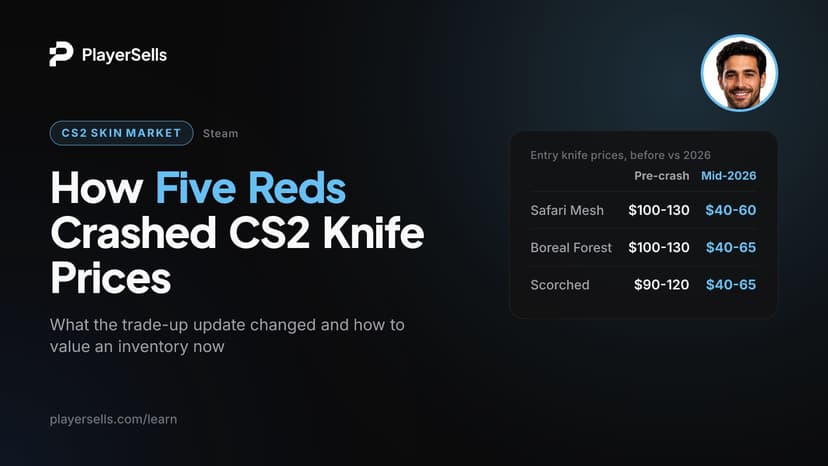
CS2 Skin Market Crash: What the Trade-Up Update Changed
The CS2 skin market crash explained: what Valve's knife trade-up changed, why loss figures differ, what recovered, and how to value your inventory now.
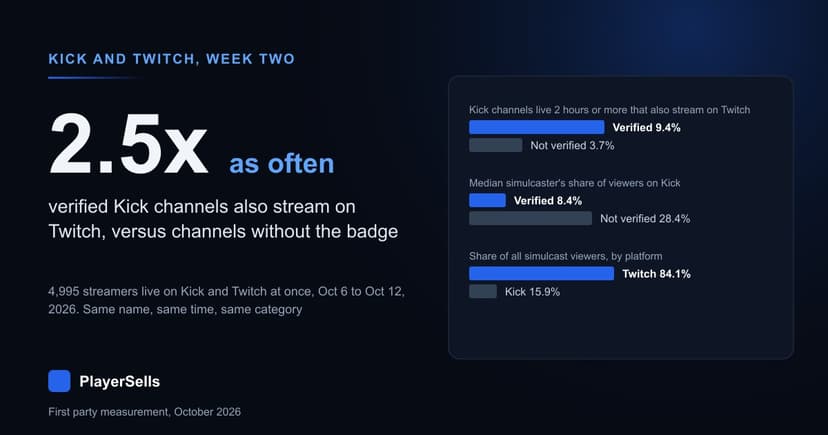
Verified Kick Channels Simulcast 2.5x as Often as Others
4,995 streamers were live on Kick and Twitch at once, Oct 6 to 12, 2026. 9.4% of verified Kick channels simulcast, against 3.7% of others.
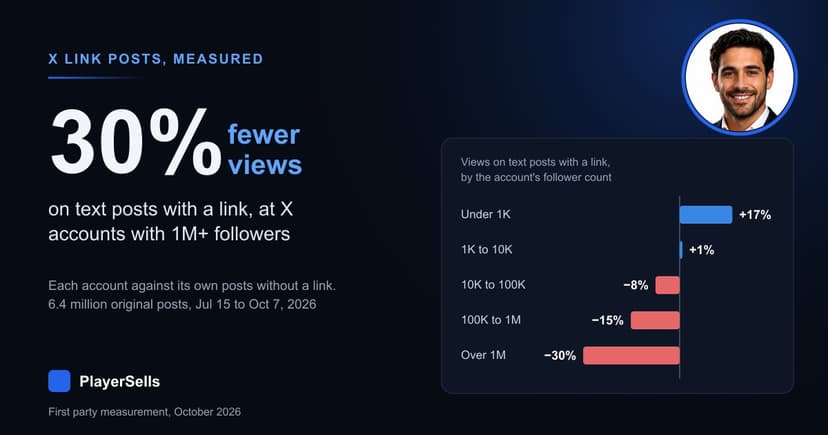
Does X Still Penalize Links? 6.4 Million Posts Measured
Across 6.4 million X posts, text posts with a link drew 10% fewer views than the same account's posts without one, and 30% fewer at 1M+ followers.