
How Much Do Twitch Streamers Make? Subs, Bits and Ads
How much do Twitch streamers make? See 2026 payouts per sub, Bit and ad, worked examples from 10 to 2,000 viewers, and how Kick's 95/5 split compares.
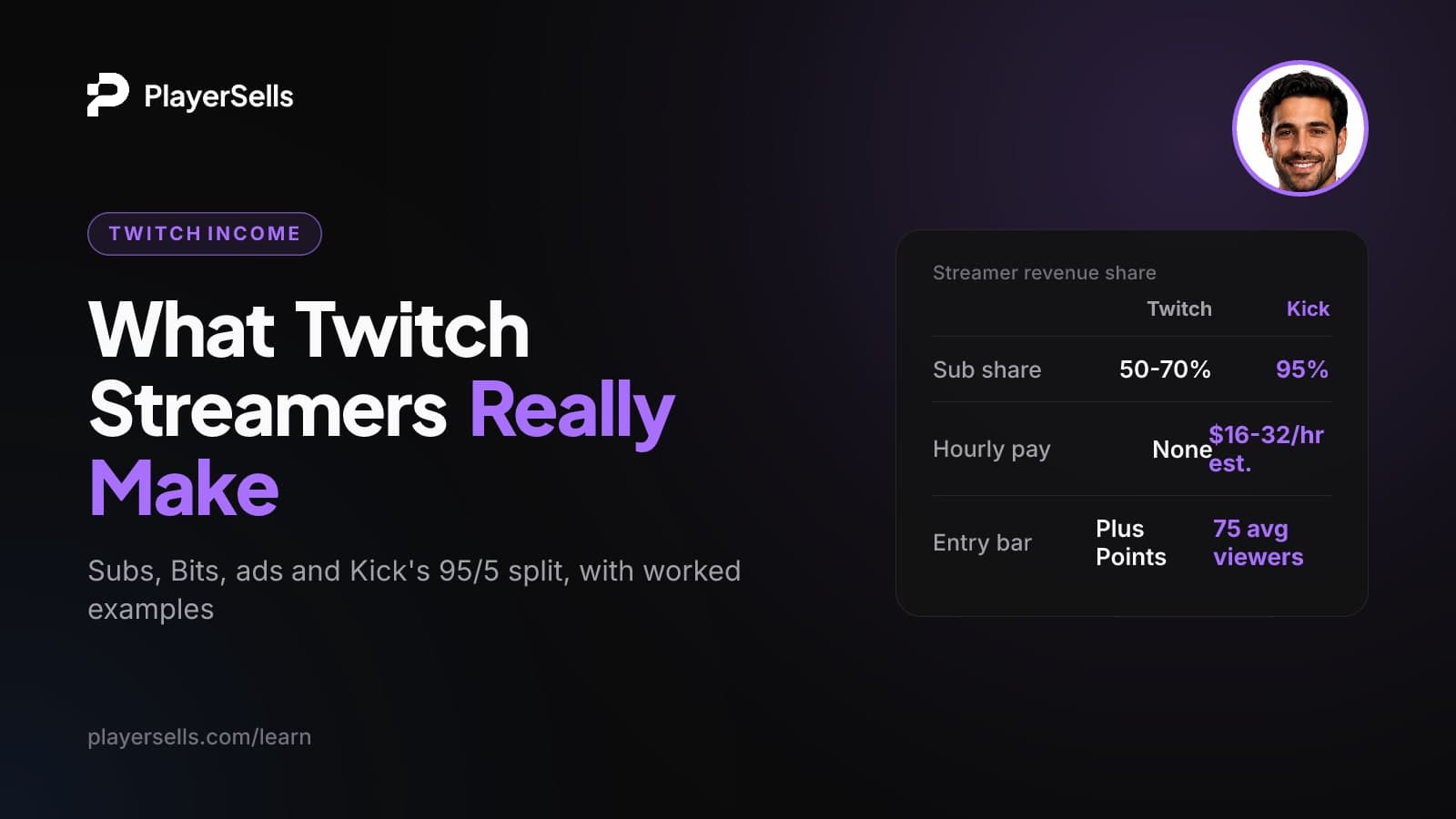
Twitch doesn't pay streamers a salary or a fixed rate per view. Streamers keep a share of what their channel earns: 50% of subscription revenue by default (60% or 70% through the Plus Program), $0.01 per Bit cheered, and 55% of net ad revenue if they run enough ads. Most small channels earn tens to a few hundred dollars a month, and big channels can reach five figures.
This guide is for streamers estimating their own income and for buyers who want to sanity-check a channel's earnings before paying for it. It covers what each sub tier pays, how the Plus Program and Plus Points work, Bits and ad math, sponsorships, worked examples from 10 to 2,000 average viewers, and how Kick's payouts compare. Figures reflect published rules and reported prices as of October 2026. Platform terms change, so confirm current numbers in your own dashboard.
Key takeaways
- Twitch pays streamers a share of their own channel's revenue, not a salary or a per-view rate.
- As of 2026, a US Tier 1 sub costs $5.99, which works out to about $3.00 per sub at the default 50/50 split, $3.59 at 60/40 and $4.19 at 70/30, before fees and taxes.
- Streamers earn a flat $0.01 per Bit cheered, so 1,000 Bits pays $10 no matter what the viewer paid for them.
- Twitch pays 55% of net ad revenue only to channels that run the minimum ads per hour (it started at 3 minutes), and Partners who run fewer ads get 30%.
- Kick advertises a 95/5 subscription split and pays some eligible streamers an hourly rate, but it has not published an official rate card.
- A channel's value depends on steady net monthly income, so buyers should verify payouts rather than estimate them from viewer counts.
How does Twitch pay streamers?
Twitch pays streamers through revenue shares on money their own channel brings in. There is no base salary, no payment per hour streamed and no flat rate per view. If nobody subscribes, cheers or watches ads, the channel earns nothing from Twitch.
The three Twitch income streams are subscriptions, Bits and ads. On top of that, many streamers earn from sponsors, affiliate codes and other platforms, which Twitch doesn't touch. At the platform level the money is large: Twitch said creators earned more than $1 billion in 2021 from ads, Bits and subs combined, up more than 50% from 2020. That total is spread very unevenly, which is why individual income ranges so widely.
One detail most income guides skip: Twitch's percentages are applied to net revenue. That means the share is calculated after things like billing costs, fees, taxes, refunds and chargebacks are taken out. A "50% split" on a $5.99 sub pays the streamer less than $3.00 in practice.
How much does Twitch pay per sub?
On a US Tier 1 sub ($5.99), a streamer gets about $3.00 at the default 50/50 split, $3.59 at 60/40 and $4.19 at 70/30, before fees and taxes. Many older pages still quote $4.99 and $2.50 per sub. That price is out of date for the US.
US prices as of 2026 are $5.99 for Tier 1, $11.99 for Tier 2 and $24.99 for Tier 3, according to third-party price trackers. Other countries pay local prices under Twitch's regional pricing, and lower local prices mean lower payouts per sub. Check the price on the subscribe button in your region before relying on these numbers.
| Sub tier | US price (2026) | 50/50 (default) | 60/40 (Plus Level 1) | 70/30 (Plus Level 2) |
|---|---|---|---|---|
| Tier 1 | $5.99 | $3.00 | $3.59 | $4.19 |
| Tier 2 | $11.99 | $6.00 | $7.19 | $8.39 |
| Tier 3 | $24.99 | $12.50 | $14.99 | $17.49 |
Treat the table as a ceiling. Because the split is applied to net revenue, real deposits per sub come in lower once fees and taxes are removed.
How does the Plus Program get you 60/40 or 70/30?
You reach a better split by earning Plus Points from paid monthly subscriptions. As of February 2026, according to Sportskeeda's summary of Twitch's support page, Level 1 (60/40) needs at least 100 Plus Points and Level 2 (70/30) needs at least 300 Plus Points, in both cases for three months in a row.
Not every sub is worth the same number of points. Twitch said it would publish the point values and update them every year, so check Twitch's current published point values rather than assuming one sub equals one point.
This replaced the original Partner Plus program, which paid 70% of the first $100,000 of net sub revenue each year and 50% after that. Twitch said it would remove the $100,000 annual cap and open the Plus Program to both Affiliates and Partners.
What happened to the old 70/30 contracts?
It is disputed. On February 13, 2026, several streamers said Twitch had emailed them about payout changes, and some said their old 70/30 contracts were being removed. Twitch's position, as reported by inkl, is that existing historical contracts stay as they are. If a channel's income depends on a legacy 70/30 deal, confirm its current status in writing before counting on it.
How much do Bits and ads pay?
Bits pay a flat $0.01 each, and ads pay 55% of net ad revenue to channels that meet Twitch's ads-per-hour minimum. Bits are easy to calculate. Ads are not, because Twitch doesn't publish what advertisers pay.
Bits: a cent each, whatever the viewer paid
Streamers earn $0.01 for every Bit cheered, regardless of which Bits bundle the viewer bought. Viewers pay more than that. In one example, a viewer pays about $14.00 for 1,000 Bits while the streamer receives $10.00. Viewer prices vary by bundle, by platform (web versus iOS or Android) and by region, so there is no single "viewer price" for Bits.
| Bits cheered | Streamer receives |
|---|---|
| 100 | $1 |
| 1,000 | $10 |
| 10,000 | $100 |
| 100,000 | $1,000 |
Ads: 55% net, if you run enough of them
Twitch moved from a fixed-CPM model to a percentage model that pays creators 55% of revenue from each ad on their stream, calculated on a net basis after billing costs, fees, taxes, refunds and chargebacks, per Twitch's June 2022 announcement. Twitch also said the switch would raise ad pay rates by 50% to 150% for most creators, as reported by Engadget. Qualifying Affiliates have been able to earn the 55% share since August 2022 by setting Ads Manager to 3 or more minutes of ads per hour.
The 55% share is conditional. Channels must run at least the minimum ads per hour, which started at 3 minutes and can vary by country and audience size. Partners who run fewer ads than the minimum get a 30% net share instead.
That rule comes from Twitch's ads incentive update. Any per-1,000-impression (CPM) figure you see online is an estimate. Twitch does not publish CPMs, and what an ad earns depends on advertiser demand, viewer country and how many ads actually get filled.
How much do Twitch streamers make from sponsorships?
Sponsorship income varies too much to give honest averages, but the pricing models are consistent. Many streamers treat Twitch payouts as the base layer and sponsor income as extra that has to be negotiated deal by deal.
- Flat fee per stream or segment: a set price for a mention, an overlay or a dedicated segment.
- Rate per average viewer or per 1,000 views: the brand pays based on audience size, often checked against stream analytics.
- Affiliate codes and revenue share: the streamer earns a commission on sales from a personal link or code.
Affiliate codes are the easiest to start with because they don't need a brand deal. Placement matters a lot here: panels, chat commands and pinned links all perform differently. Our guide on where to put referral links covers it.
How much do Twitch streamers make at different viewer counts?
Using the assumptions below, a 10-viewer channel earns about $43 a month from Twitch, a 100-viewer channel about $428 and a 2,000-viewer channel about $8,560, before sponsors, fees and taxes. Change any assumption and the result changes, which is why a vague "dollars per viewer" rule is not much use.
These are illustrative assumptions, not Twitch figures:
- 80 hours streamed per month (about 20 hours a week).
- One paid Tier 1 sub per average concurrent viewer, at the US price and the default 50/50 split ($3.00 each).
- One Bit cheered per average viewer per hour ($0.01 each).
- 3 minutes of ads per hour (about six 30-second ads), with half of possible impressions actually filled, and the creator receiving an assumed $2 per 1,000 filled impressions after Twitch's share.
| Average viewers | Subs | Bits | Ads | Monthly total |
|---|---|---|---|---|
| 10 | $30 | $8 | $5 | ~$43 |
| 50 | $150 | $40 | $24 | ~$214 |
| 100 | $300 | $80 | $48 | ~$428 |
| 500 | $1,500 | $400 | $240 | ~$2,140 |
| 2,000 | $6,000 | $1,600 | $960 | ~$8,560 |
Two things stand out. First, subs are the biggest line at every size, so the revenue split matters more than anything else. Moving the 2,000-viewer channel from 50/50 to 70/30 adds about $1.19 per sub, or roughly $2,380 a month. Second, in this model the path to five figures runs through a better split and sponsors, not ads.
If you want to know where a given viewer count sits against other channels, our Twitch average-viewer benchmarks show how few channels reach 100 or more.
How to estimate your own Twitch income
- Step 1: Pull your real numbers from your Creator Dashboard analytics: active paid subs by tier, Bits cheered and ad revenue for the last three months.
- Step 2: Multiply subs in each tier by the payout for your split from the table above (use your local price if you're outside the US).
- Step 3: Divide total Bits by 100 to get dollars.
- Step 4: Add actual ad revenue rather than estimating it, and check whether you met the ads-per-hour minimum for the 55% share.
- Step 5: Subtract an allowance for fees, taxes and refunds, since payouts are on net revenue.
For a quick estimate without the spreadsheet, the Twitch money calculator runs the same math from viewers, subs and Bits.
What cuts into the numbers?
Four things lower real income compared with headline math: net-revenue calculation (fees, taxes, refunds and chargebacks come out before your share), regional sub pricing, missing the ads-per-hour minimum, and payout thresholds. Secondary sources report a $50 minimum balance before Twitch pays out, so a very small channel may wait more than a month to see any money. Confirm the threshold in your payout settings.
How much do Kick streamers make?
Kick streamers keep 95% of subscription revenue, according to Kick's streamer page, and some eligible streamers also earn an hourly rate through the Kick Creator Incentive Program (KCIP). As of October 2026, Kick says its Partner Program, launched in 2024, has paid out more than $400 million to creators.
Kick launched on December 5, 2022. Its co-founders, Bijan Tehrani and Ed Craven, also co-founded the online casino Stake.com, and Kick allows gambling streams under specific rules (covered below). Our one-week measurement of gambling on Kick puts numbers on that.
The 95/5 split in plain math
Kick's sub price isn't confirmed on its official page, so think in shares: a Kick streamer keeps $0.95 of every subscription dollar, while a Twitch streamer on the default split keeps $0.50 (before net deductions on either side). On a hypothetical $5 sub, that is $4.75 on Kick versus $2.50 on Twitch at 50/50 or $3.50 at 70/30.
KCIP hourly pay: reported, not published
KCIP pays eligible streamers for time spent live, but Kick has not published an official rate card. Third-party estimates (as of October 2026) run from about $16 an hour at 50 average viewers to about $100 an hour at 1,000 average viewers. Streams Charts lists 2026 Partner eligibility as 75 average viewers and 250 followers, with an hourly rate of $16 to $32 and chat activity used as a pay multiplier.
Gambling content is allowed only from sites with visible 18+ ID verification (a rule in place since February 1, 2025), and it does not count toward KCIP. A gambling-heavy channel may earn far less incentive pay than its viewer count suggests.
| Income source | Twitch | Kick |
|---|---|---|
| Subscription share | 50% default, 60% or 70% via Plus Program | 95% (advertised) |
| Better split requirement | 100 or 300 Plus Points, three months in a row | No points system advertised for 95/5 |
| Hourly pay | None | KCIP, reported $16-32/hour for eligible Partners |
| Ads | 55% net with ads-per-hour minimum, 30% for Partners below it | Not covered in our sources |
| Bits or tips | $0.01 per Bit | Not covered in our sources |
| Rates published? | Splits published, CPMs not | Sub split published, KCIP rates not |
Here is how that plays out for the 100-viewer example. On Twitch it earns about $428 a month. On Kick, if it qualified for KCIP at the reported $16-32 an hour across 80 hours, incentive pay alone would be $1,280-$2,560, plus a larger cut of every sub. Those hourly rates are third-party estimates, so treat this as a scenario, not a forecast. The catch is audience: the same streamer may pull far fewer viewers on Kick, which our Kick vs Twitch viewer comparison measures. The Kick money calculator lets you test your own numbers.
From income to channel value: buying or selling on PlayerSells
Income is the input that drives what a channel is worth. A buyer is paying for future earnings, so three months of verified, steady net income counts for far more than one spike month or an estimate built from viewer counts. Keep in mind that Plus Program levels are earned on recent sub performance, and a legacy contract may be personal to the original streamer, so a buyer should not assume a 70/30 split carries over. Our article on what a Twitch or Kick channel is worth walks through valuation multiples, and the Twitch channel value tool gives a starting estimate.
Twitch's terms may restrict selling or transferring accounts, so understand that risk before you buy. If you go ahead, PlayerSells reduces the payment risk. Every listing is reviewed by a person before it goes live. The buyer pays PlayerSells, the money is held in escrow, and the seller is paid only after the buyer confirms the channel was delivered as described. Deals move through a fixed sequence (offer sent, accepted, payment pending, paid, delivered, buyer confirmed, completed), and either side can open a dispute before completion. A human moderator reviews it while the money stays held. Fees are listed on the pricing page, and you can browse Twitch channels for sale to see how sellers present their income.
Frequently asked questions
Does Twitch pay streamers per view?
No, Twitch pays nothing per view or per hour streamed. Streamers earn only from revenue shares on subs, Bits and ads on their own channel, plus whatever they earn off-platform. Views matter indirectly because more viewers usually mean more subs, cheers and ad impressions.
How much does Twitch pay per 1,000 ad views?
Twitch doesn't publish a CPM, so there is no official per-1,000 figure. Creators who meet the ads-per-hour minimum receive 55% of the net revenue from each ad, and what an ad earns depends on advertiser demand, viewer country and fill rate. Your Creator Dashboard shows actual ad revenue, which is the only reliable number.
Do Twitch Affiliates get paid for ads?
Yes, qualifying Affiliates have been able to earn the 55% ad share since August 2022. To get it, set Ads Manager to run at least 3 minutes of ads per hour, or whatever minimum Twitch currently shows for your country and audience size.
What is the minimum payout on Twitch?
Secondary sources report a $50 minimum balance before Twitch sends a payout, so a small channel may wait more than one payout period to get paid. Confirm the current threshold and payment methods in your payout settings, as Twitch can change them.
Is Kick's 95/5 split better than Twitch's?
Per sub, yes: 95% is well above Twitch's 50% default and 70% maximum. Total income depends on how many viewers and subs you actually get on each platform, and the same streamer can draw a very different audience on each. Compare real numbers from both before committing.
Do viewers pay more for Bits than streamers receive?
Yes, there is a markup. In one reported example a viewer pays about $14.00 for 1,000 Bits while the streamer receives $10.00. The viewer price varies by bundle, platform and region, but the streamer's $0.01 per Bit stays the same.
Bottom line
Twitch income is a revenue share, and subscriptions do most of the work. Use current prices ($5.99 for US Tier 1, not $4.99), apply the split you actually qualify for, remember payouts are on net revenue, and treat any ad CPM or Kick hourly rate as an estimate until you see real deposits.
If you're streaming, pull three months of dashboard data and run it through the Twitch money calculator. If you're buying, ask the seller for that same verified history before you price the channel.
Free tools for this topic

Published by the PlayerSells editorial team. Data comes from PlayerSells marketplace records and our own crawlers. About PlayerSells · Editorial policy
Related Articles
Continue learning with these related guides.
Most Expensive Rust Skins in 2026 and Why They Hold Value
The most expensive Rust skins by Steam Market price in October 2026, why each is scarce, how Rust differs from CS2, and how to check your inventory value.
How Much Does TikTok Pay for 1 Million Views? Real RPM Data
TikTok pays about $400-$1,000 per 1M qualified views, per creator-reported payouts. See which views count, real examples and why public views pay less.
How Much Does YouTube Pay for 1 Million Views? RPM by Niche
YouTube pays by RPM, not per view. See what 1M long-form vs Shorts views earns by niche and country, the 2027 Shorts rule, and how RPM sets channel value.