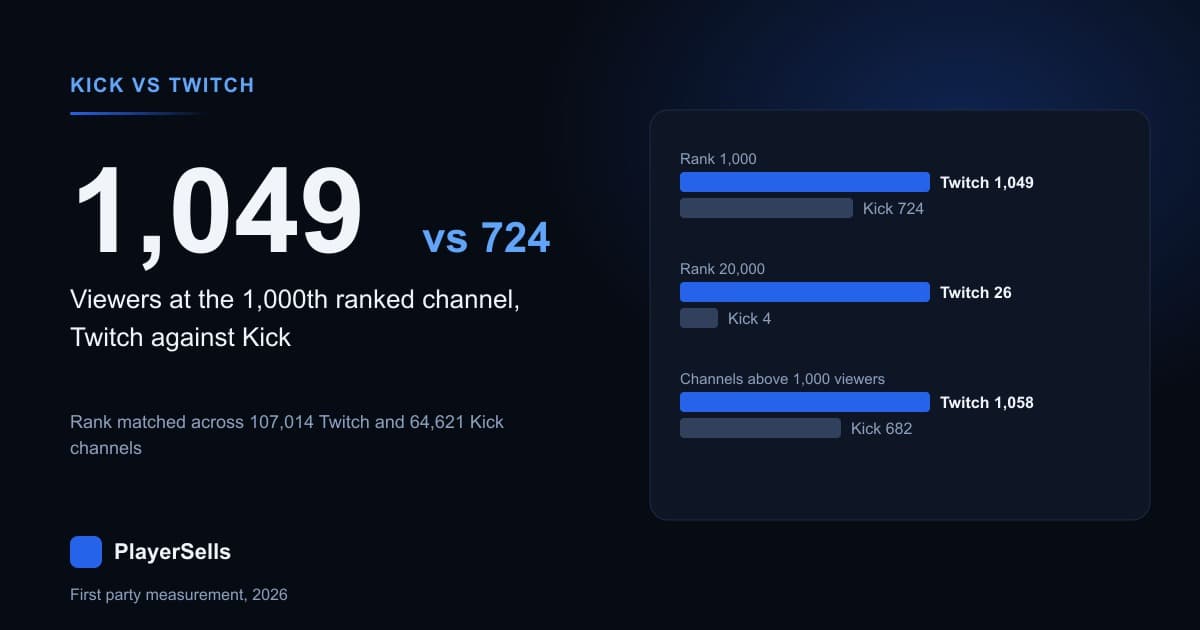
Twitch has the viewers. We measured 107,014 Twitch channels and 64,621 Kick channels that carried a concurrent-viewer reading between 2026-09-01 and 2026-09-02, sampling both platforms every 15 minutes with one method, and at every matched rank except the single largest channel the Twitch channel is bigger. The 1,000th ranked Twitch channel averaged 1,049 concurrent viewers in that window; the 1,000th ranked Kick channel averaged 724. At rank 20,000 the gap widens to 26 viewers against 4.
The comparison that looks obvious says the opposite, which is why this article exists. Kick's 90th percentile channel averages 78 concurrent viewers against Twitch's 69, and Kick's 99th percentile averages 1,033 against Twitch's 988. Both figures are correct. Both are useless. A percentile is a position inside one platform's own measured population, and our Kick directory holds 64,621 channels with a viewer reading against Twitch's 107,014. Kick's 90th percentile is its 6,463rd channel from the top. Twitch's 90th percentile is its 10,701st. Those are not the same seat.
Which platform actually has more viewers, Kick or Twitch?
Twitch, at almost every level of the ladder. Counting channels rather than percentiles, our directory holds 8,268 Twitch channels averaging 100 or more concurrent viewers against 5,591 on Kick, and 1,058 Twitch channels above 1,000 CCV against 682 on Kick. That is a 1.5x advantage which stays remarkably flat from 50 viewers all the way to 5,000. The one place Kick wins is the very top: its largest channel averaged 103,337 concurrent viewers across 4.5 observed hours, above Twitch's largest at 85,044 across 5.0 hours.
One channel is not a platform. Over a two-day window an average-viewer metric rewards whoever happened to run a large stream inside it, so we treat the rank-one result as trivia and not as evidence. The structural result is the one that repeats across thousands of rows: Kick's audience is thinner at every tier a buyer would realistically shop in.
How we measured both platforms with one method
Our Kick and Twitch engines both went live on 2026-09-01, so every number here comes from a two-day observation window ending 2026-09-02. That is short enough to forbid any growth, churn or trend claim, and we make none. Cross-sectional shape is what a two-day window measures well, and shape is the whole question.
Both engines sample live channels roughly every 15 minutes and write one viewer reading per channel per sweep. The headline metric, average concurrent viewers, is computed identically on both sides: total hours watched divided by total hours live, time weighted, so that a 20 minute stream cannot count as much as an eight hour one. The result is rounded to a whole viewer, which means a channel averaging under half a viewer records zero and drops out of the measured population.
Observed airtime is the control that makes the comparison fair, and it lands in the same place on both platforms. The median measured channel streamed 1.75 hours on Twitch and 1.75 hours on Kick over the window, with means of 2.55 and 2.72 hours. Whatever separates these two distributions, it is not that one engine watched its channels for longer.
Is Kick really more top heavy than Twitch?
This is the claim the raw percentile ladder appears to support, and it does not survive contact with the denominator. Below is the naive comparison, computed across the 107,014 Twitch and 64,621 Kick channels in our directories that carried a positive viewer average between 2026-09-01 and 2026-09-02.
| Percentile | Twitch avg CCV | Kick avg CCV |
|---|---|---|
| 25th | 2 | 2 |
| 50th (median) | 5 | 2 |
| 75th | 16 | 7 |
| 90th | 69 | 78 |
| 95th | 174 | 205 |
| 99th | 988 | 1,033 |
| Largest channel | 85,044 | 103,337 |
Read down that table and Kick looks like a platform of extremes: a lower middle, a higher top, a sharper split. Read it as an engineer and the crossover between the 75th and 90th percentile is a warning sign, not a finding. Two distributions measured over populations of different sizes cross wherever the size ratio says they will. Our Kick population is 60.4 percent the size of our Twitch population, so Kick's percentile marks sit at correspondingly shallower absolute ranks, and shallower ranks hold bigger channels.
What changes when you compare channels at the same rank?
Everything. Instead of asking what the 90th percentile channel looks like on each platform, we asked what the 6,463rd largest channel looks like on each, which is the rank Kick's 90th percentile actually occupies. We ran that test at each of Kick's own percentile ranks against the Twitch channel sitting at the identical position from the top.
| Kick percentile | Absolute rank from top | Kick avg CCV | Twitch avg CCV at same rank | Twitch multiple |
|---|---|---|---|---|
| 99th | 647 | 1,033 | 1,503 | 1.45x |
| 95th | 3,232 | 205 | 320 | 1.56x |
| 90th | 6,463 | 78 | 136 | 1.74x |
| 75th | 16,156 | 7 | 36 | 5.14x |
| 50th | 32,311 | 2 | 12 | 6.00x |
The crossover disappears completely. At Kick's 90th percentile rank a Twitch channel averages 136 concurrent viewers against Kick's 78, and the advantage grows as you descend. Kick is not more top heavy than Twitch. Kick's directory is smaller, and every percentile mark on a smaller population sits nearer the top of the list. That is arithmetic rather than platform shape, and it is the most common error in published streaming comparisons.
The full rank ladder makes the same point without any percentile arithmetic at all, which is why we consider it the load-bearing evidence in this comparison. Ranked purely by position from the largest channel down, across the same 107,014 Twitch and 64,621 Kick channels that carried a positive viewer average between 2026-09-01 and 2026-09-02, our two directories look like this, and the Twitch column leads from rank 10 onwards without a single reversal.
| Rank from top | Twitch avg CCV | Kick avg CCV | Twitch multiple |
|---|---|---|---|
| 1 | 85,044 | 103,337 | 0.82x |
| 10 | 28,267 | 25,981 | 1.09x |
| 50 | 10,966 | 7,167 | 1.53x |
| 100 | 5,806 | 4,308 | 1.35x |
| 500 | 1,816 | 1,240 | 1.46x |
| 1,000 | 1,049 | 724 | 1.45x |
| 5,000 | 190 | 116 | 1.64x |
| 10,000 | 77 | 24 | 3.21x |
| 20,000 | 26 | 4 | 6.50x |
| 40,000 | 8 | 2 | 4.00x |
How many large channels does each platform actually have?
Absolute counts are the version of this comparison that no denominator can distort, so they are the ones worth memorising. Across our directory of 127,117 Twitch channels and 78,168 Kick channels as of 2026-09-02, the count above each viewer threshold looks like this.
| Average CCV at least | Twitch channels | Kick channels | Ratio |
|---|---|---|---|
| 10 | 36,237 | 13,861 | 2.61x |
| 50 | 13,379 | 7,914 | 1.69x |
| 100 | 8,268 | 5,591 | 1.48x |
| 500 | 2,140 | 1,414 | 1.51x |
| 1,000 | 1,058 | 682 | 1.55x |
| 5,000 | 128 | 84 | 1.52x |
| 10,000 | 55 | 31 | 1.77x |
Two things stand out. The ratio settles at roughly 1.5x from 50 viewers upward and stays there for two orders of magnitude, which is a stable, boring, trustworthy result. And the ratio at the 10 viewer line, 2.61x, is much larger than the ratio anywhere above it, which says Twitch's real advantage sits in the small and mid tier rather than at the top. Anyone browsing the Twitch channel directory against the Kick channel directory is looking at two very differently shaped middles.
Could this be our crawler rather than the platforms?
It could, and one part of it is. The two engines discover channels differently, and we went looking for the damage before publishing rather than after. Twitch's public interface exposes only the top 30 streams of any category without a gated cursor, so our sweep walks 2,000 categories every cadence and can go wider but never deeper than rank 30 inside one. Kick's live directory paginates all the way down, and a full walk returned between 6,970 and 8,197 live channels per sweep on 2026-09-02, with no page cap ever reached.
That shelf is real and we can see it in our own samples. Of the Twitch category sweeps on 2026-09-02 which returned 25 or more channels, 8,252 returned exactly 30 and effectively none returned more. Every Twitch channel ranked 31st or lower in its category at that moment is invisible to us. The effect biases Twitch's measured middle upward, and it is the reason we do not trust the median gap.
What the shelf costs is measurable. Across 8,272 truncated Twitch shelves the median 30th-place channel held 2 viewers, the 90th percentile shelf floor was 17 viewers, and only 136 shelves out of 8,272, or 1.6 percent, had a floor above 100. Inside our raw sample readings, untruncated category shelves, where we saw every live channel, produced a median of 4 viewers per reading against 11 in the truncated ones. Twitch's true channel-level median is therefore below the 5 we measure, plausibly nearer 3, and the honest statement is that Twitch's median beats Kick's 2 by less than the raw figures suggest.
The direction of that bias is what rescues the main finding. Missing channels are small channels, and adding them back can only increase the count of Twitch channels above any threshold while leaving the value at rank 1,000 or rank 20,000 untouched. Every correction for our own crawl makes Twitch look deeper, not shallower. The rank ladder above is therefore a floor on the Twitch advantage, and the percentile crossover it kills was never real to begin with.
Do the badges mean the same thing on both platforms?
No, and this is where a buyer loses money fastest. Twitch splits channels into partner, affiliate and none; Kick uses a verified flag and a separate affiliate flag. The tier shares are almost identical across the two platforms, which invites the assumption that the tiers are equivalent. We measured what each badge is actually attached to across our full directory on 2026-09-02.
| Tier | Channels | Share of directory | Median avg CCV | Median followers |
|---|---|---|---|---|
| Twitch partner | 13,171 | 10.4% | 119 | 21,857 |
| Twitch affiliate | 66,797 | 52.5% | 7 | 490 |
| Twitch none | 47,149 | 37.1% | 2 | 25 |
| Kick verified | 9,277 | 11.9% | 89 | 3,172 |
| Kick affiliate | 40,385 | 51.7% | 3 | not published |
| Kick not affiliate | 37,703 | 48.3% | 2 | not published |
The top tiers are broadly comparable: Twitch partner at a median of 119 concurrent viewers, Kick verified at 89. The affiliate tiers are not. A Twitch affiliate badge separates its holder from an unbadged channel by 3.5x on median viewers, 7 against 2. A Kick affiliate badge separates its holder by 1.5x, 3 against 2, which is close to no information at all. Where a listing leans on affiliate status as proof of audience, that proof is worth something on Twitch and almost nothing on Kick. The reasoning behind what verification is actually worth when you buy an account applies here in sharper form.
One caveat belongs on the follower column. Kick follower counts are populated on 49,509 of 78,168 rows against all 127,117 on Twitch, because Kick's live-directory endpoint returns a partial channel object without them. That coverage is not spread evenly, which is why the Kick affiliate rows are blank. Coverage inside Kick's verified tier is 100.0 percent across 9,352 rows, so the 3,172 median there is real, while the affiliate tier sits at 67.8 percent of 40,412 rows. A median over the second would describe whichever channels our crawler completed, not Kick affiliates.
The language split is the largest real difference between them
Distribution shape was a denominator artifact. Language is not, and it is the finding a buyer should act on. We took the broadcast language recorded on every channel averaging at least 10 concurrent viewers, a tier where the Twitch shelf barely bites, and the two platforms are visibly running different businesses.
| Language | Twitch share | Kick share | Skew |
|---|---|---|---|
| English | 54.6% | 34.1% | Twitch 1.6x |
| Turkish | 0.3% | 9.3% | Kick 30x |
| Spanish | 7.1% | 17.7% | Kick 2.5x |
| Portuguese | 4.9% | 12.5% | Kick 2.6x |
| Arabic | 0.5% | 7.1% | Kick 13.6x |
| Russian | 8.7% | 4.1% | Twitch 2.1x |
| German | 6.6% | 0.8% | Twitch 8.2x |
| French | 5.9% | 1.0% | Twitch 5.8x |
| Japanese | 4.5% | 1.2% | Twitch 3.9x |
Turkish accounts for 9.3 percent of Kick channels above 10 CCV and 0.3 percent of Twitch's, a 30x share difference measured across 13,861 Kick and 36,237 Twitch channels. Arabic runs 7.1 percent against 0.5 percent. Run the same query across the full CCV-positive population instead of the 10-plus tier and the pattern is unchanged, with Turkish at 9.5 percent of Kick and 0.2 percent of Twitch. Kick is a Turkish, Spanish, Portuguese and Arabic platform with an English minority. Twitch is an English platform with strong German, French, Japanese and Russian wings.
That is the practical answer for anyone weighing whether to buy a Kick channel or buy a Twitch channel. A channel's audience language decides who can be sold to afterwards, and these two platforms are not competing for the same rooms. Our broadcast-language field comes from each platform's own declared stream language where it supplies one and is inferred from the channel bio otherwise, which is a real limitation to hold in mind, though it applies symmetrically across both engines.
Why we are not publishing an NSFW comparison
The directories say 3,724 of 127,117 Twitch channels carry our adult-content flag, 2.93 percent, against 178 of 78,168 on Kick, 0.23 percent. That is a 12.9x difference and we are throwing it away, because the two engines feed different text to the same classifier. Our Twitch crawler scores display name plus channel description plus category plus the live stream title. Our Kick crawler scores username plus bio plus category, with no stream title at all, because the Kick channel object does not carry one.
Stream titles are exactly where adult-adjacent language shows up, so the Twitch side gets an extra high-signal field the Kick side never sees. We tested the size of that hole by running one identical adult-term pattern against the bio field alone on both platforms: 768 of 105,592 populated Twitch bios matched, 0.73 percent, against 227 of 46,924 Kick bios, 0.48 percent. Same field, same pattern, and the gap collapses from 12.9x to 1.5x. Roughly nine tenths of the apparent NSFW difference between these platforms is our own instrumentation, and printing that is more useful than printing a number.
What this means if you are buying or selling a streaming channel
Price on measured concurrent viewers, never on percentile rank. A seller who says a channel sits in the top 10 percent of Kick is telling you it clears 78 average viewers; the same claim on Twitch means 69. Those sound alike and they are separated by 1.74x once you compare at the same absolute rank. Run the number through the Kick channel value calculator or the Twitch channel value calculator and price the audience rather than the ranking language.
Treat follower counts on the two platforms as different units. Our Twitch partner tier carries a median of 21,857 followers for a median 119 concurrent viewers, while Kick verified channels carry 3,172 followers for 89 viewers. A Kick channel with a seventh of the followers can deliver a comparable live audience, which cuts both ways: it makes Kick follower counts a poor price anchor, and it makes large Twitch follower counts a poor proxy for who actually shows up. Live listings for both platforms sit in the PlayerSells marketplace next to the account types we have been selling for longer.
Buy into the language you can serve. The largest measurable difference between these two platforms is not viewers per channel, it is who is watching and in what language, and that is the one variable a new owner cannot change after the transfer completes.
Common questions about Kick versus Twitch viewer numbers
Does Kick have more viewers than Twitch?
No. Across our two-day measurement window ending 2026-09-02, our directory held 8,268 Twitch channels averaging 100 or more concurrent viewers against 5,591 on Kick, and 1,058 Twitch channels above 1,000 CCV against 682 on Kick. Twitch leads by roughly 1.5x at every threshold from 50 viewers upward. The only measure Kick won was its single largest channel, at 103,337 average concurrent viewers against Twitch's 85,044.
Why do Kick's 90th and 99th percentiles look higher than Twitch's?
Because a percentile is a position inside one platform's own population and the populations differ in size. Our Kick directory holds 64,621 channels with a viewer reading against Twitch's 107,014, so Kick's 90th percentile sits at absolute rank 6,463 while Twitch's sits at rank 10,701. Compare the same absolute rank and the Twitch channel averages 136 viewers against Kick's 78.
Is Kick's viewer distribution more polarised than Twitch's?
Our data does not support that claim. The apparent polarisation comes from the smaller denominator on Kick. Measured at matched absolute ranks between 647 and 32,311, Twitch is ahead at every position by between 1.45x and 6.00x, and the gap widens as you move down the ladder rather than narrowing. We rejected the polarisation reading after running that rank-matched test.
What is the median Kick channel worth in viewers?
The median Kick channel with a positive viewer reading averaged 2 concurrent viewers over 2026-09-01 to 2026-09-02, measured across 64,621 channels. 57.1 percent of measured Kick channels averaged under 3 concurrent viewers and 78.6 percent averaged under 10. On Twitch the comparable figures are 33.5 percent under 3 and 66.1 percent under 10, though the Twitch numbers understate the small tail for the crawl reasons described above.
Which platform has more non-English streamers?
Kick, by a wide margin in specific languages. Among channels averaging at least 10 concurrent viewers, English was 34.1 percent of Kick against 54.6 percent of Twitch. Turkish was 9.3 percent of Kick against 0.3 percent of Twitch, and Arabic 7.1 percent against 0.5 percent. Twitch led on German at 6.6 percent against 0.8 percent, French at 5.9 against 1.0, and Japanese at 4.5 against 1.2.
Is a Kick affiliate badge equivalent to a Twitch affiliate badge?
No. A Twitch affiliate badge is attached to a median of 7 average concurrent viewers against 2 for an unbadged Twitch channel, a 3.5x separation across 66,797 affiliate rows. A Kick affiliate badge is attached to a median of 3 against 2, a 1.5x separation across 40,385 rows. Kick's affiliate flag carries close to no information about audience size and should not be priced as though it does.
How reliable are two days of streaming data?
Reliable for cross-sectional shape, useless for anything else. Both engines went live on 2026-09-01, so the tables hold two days and we make no growth, churn or trend claim from them. Average concurrent viewers over a two-day window also rewards whoever streamed a large event inside it, which is why we treat single-channel records as trivia and rely on rank ladders built from tens of thousands of rows.
Can you compare Kick and Twitch follower counts directly?
Not safely, for two reasons. Our Twitch follower counts are populated on all 127,117 directory rows while Kick's are populated on 49,509 of 78,168, because Kick's live endpoint returns partial channel objects, and that coverage runs from 100.0 percent in the verified tier down to 67.8 percent across affiliates. The units also differ: Twitch partners carry a median 21,857 followers for a median 119 concurrent viewers, while Kick verified channels carry 3,172 followers for 89 viewers. Price the viewers.
Related Articles
Continue learning with these related guides.
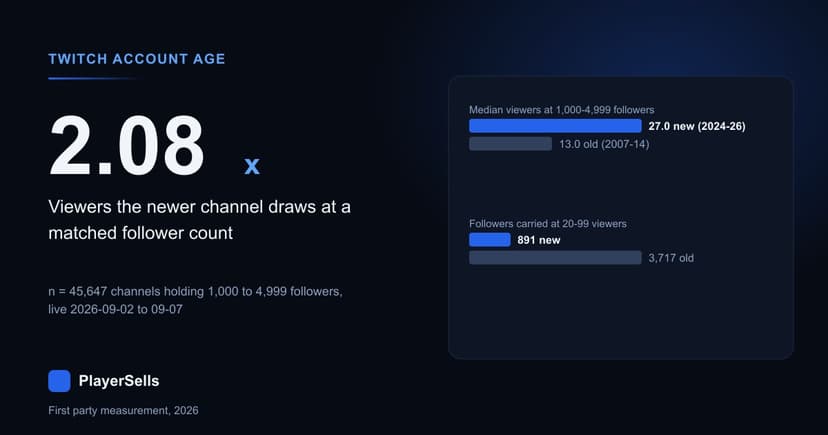
Does Twitch Account Age Still Matter? We Measured 432,192
Across 432,192 Twitch channels read on 2026-09-08, account age is almost pure accumulation, and at a matched follower count the newer channel wins.
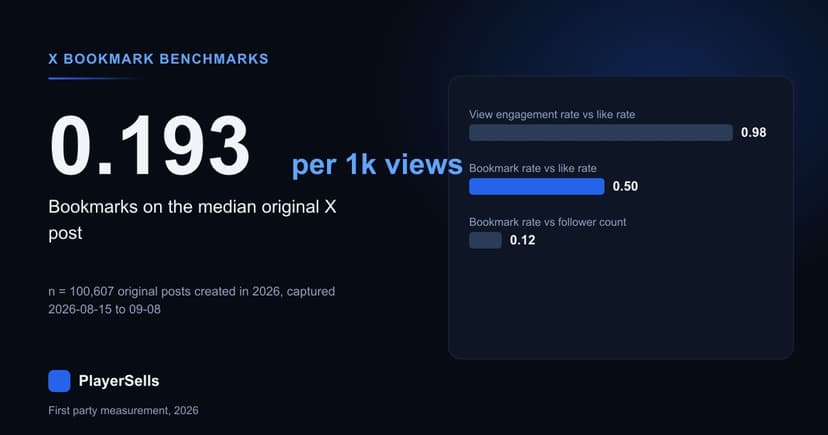
X Bookmark Rate Benchmarks From 94,318 Scored Accounts
Half the X accounts we scored on ten or more posts bookmark under 0.0273% of their views, and a third of original posts get no bookmarks at all.