
How Much Does YouTube Pay for 1 Million Views? RPM by Niche
YouTube pays by RPM, not per view. See what 1M long-form vs Shorts views earns by niche and country, the 2027 Shorts rule, and how RPM sets channel value.
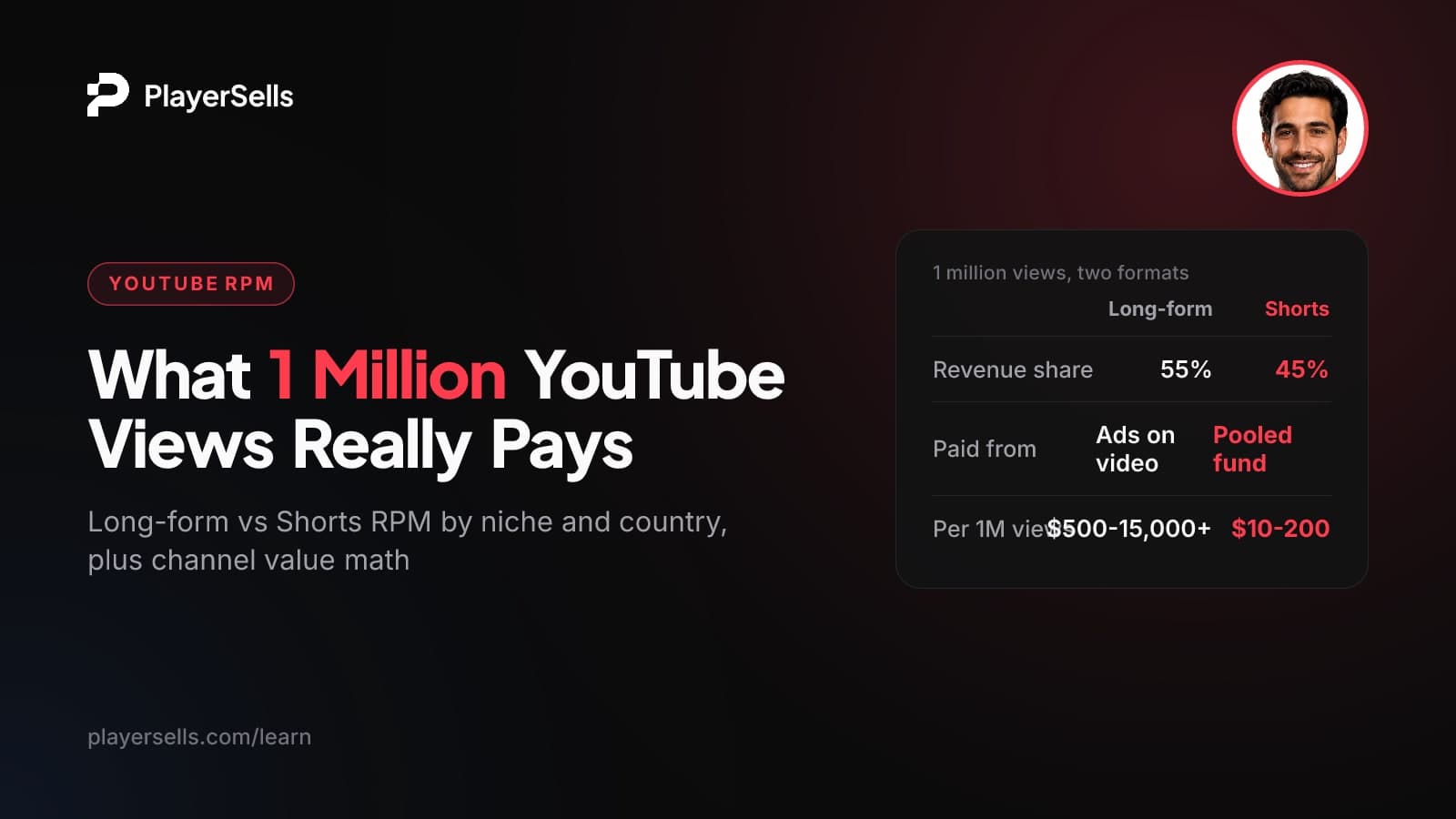
YouTube doesn't pay a fixed rate per view. What 1 million views earns is your RPM (revenue per 1,000 views, after YouTube's share) multiplied by 1,000. Industry estimates put 1 million long-form views at roughly $500 to $15,000 or more. One million Shorts views usually pays about $10 to $200 for a channel that qualifies for Shorts revenue sharing, because Shorts are paid from a shared pool.
This guide is for creators estimating income and for anyone buying or selling a monetized channel. It covers how YouTube's revenue share works, why RPM is lower than CPM, worked examples for long-form and Shorts, how niche and audience country move the number, the Shorts rule that starts February 1, 2027, and how to turn RPM into a channel valuation.
Key takeaways
- YouTube pays creators a share of revenue, not a per-view rate, so the payout for 1 million views is your RPM multiplied by 1,000.
- As of October 2026, YouTube Partner Program creators keep 55% of ad revenue on long-form videos and 45% of their allocation from the pooled Shorts fund.
- RPM is usually lower than CPM because it is counted after YouTube's share and includes views that showed no ads.
- Starting February 1, 2027, a channel needs 10 million qualified Shorts views in the last 90 days to earn Shorts ad and subscription revenue, though it keeps earning on long-form.
- Niche, audience country and season can move RPM several times over, with finance-style topics at the top of creator-reported ranges and broad entertainment near the bottom.
- One practical way to estimate channel value is trailing average monthly profit times a multiple, and Shorts-heavy or seasonal revenue deserves a lower multiple.
How does YouTube actually pay creators?
YouTube pays creators a percentage of the revenue their content generates. According to YouTube's August 2026 Partner Program update, the standard revenue share is 55% for long-form videos and 45% for Shorts. The same split applies to creators' cut of the YouTube Premium subscription pool, which is distributed based on member watch time and views.
The number you see in YouTube Studio is RPM. YouTube's ad revenue analytics help page defines RPM (revenue per mille) as how much you have earned per 1,000 video views. It is calculated per 1,000 engaged views, and it is not ad-only: it counts revenue from ads, channel memberships, YouTube Premium, Super Chat and Super Stickers.
That last point matters more than most guides admit. A channel with an active membership base can show a healthy RPM even when its ad revenue is modest. If you are valuing a channel, you want to know which slice of RPM comes from where.
What is the difference between RPM and CPM on YouTube?
CPM is what advertisers pay per 1,000 ad impressions, before YouTube takes its share. RPM is what you keep per 1,000 views, after the share. YouTube gives two reasons RPM is lower: it is counted after the revenue split, and it includes every view, even views where no ad ran.
Here is the correct path from CPM to RPM, using hypothetical round numbers so the arithmetic is easy to follow:
- Step 1: Start with the advertiser CPM. Say advertisers pay $10 per 1,000 ad impressions on your videos.
- Step 2: Work out how many ad impressions your views produced. Some views show no ads and some show several. Suppose 1 million views produced 600,000 ad impressions.
- Step 3: Calculate gross ad revenue: 600,000 impressions ÷ 1,000 × $10 equals $6,000.
- Step 4: Apply the creator share once: 55% of $6,000 is $3,300.
- Step 5: Divide by views in thousands: $3,300 ÷ 1,000 (for 1 million views) gives an ad RPM of $3.30.
Two mistakes show up in popular online guides. One applies YouTube's cut twice, which understates earnings. The other treats CPM as revenue per 1,000 views instead of per 1,000 ad impressions, which distorts them because views and ad impressions are not the same count. Apply the share once and keep impressions and views separate.
How much do 1 million views pay at different RPMs?
The formula is simple: earnings = views ÷ 1,000 × RPM. For 1 million views, that is RPM times 1,000. The hard part is knowing your RPM, which only YouTube Studio Analytics shows accurately for your channel.
The table below uses illustrative RPMs drawn from the ranges creators and industry sites report. Treat them as scenarios, not promises. The Shorts columns assume the channel qualifies for Shorts revenue sharing, and every figure moves with season and audience country.
| Scenario | Long-form RPM | 1M long-form views | Per year at 1M views/month | Shorts RPM | 1M Shorts views |
|---|---|---|---|---|---|
| Low (broad entertainment, lower-paying regions) | $0.50 | $500 | $6,000 | $0.01 | $10 |
| Middle | $3 | $3,000 | $36,000 | $0.05 | $50 |
| High (finance-style topics, high-paying regions) | $15 | $15,000 | $180,000 | $0.20 | $200 |
Even at the low end, 1 million long-form views pays more than 1 million Shorts views at the high end. To run your own numbers, plug your views and niche into the YouTube money calculator, then compare the result with the RPM in your Studio revenue report.
Why do 1 million Shorts views pay so much less?
Shorts revenue isn't tied to the ads around your own videos. Per YouTube's Shorts monetization policies, revenue from ads that run between videos in the Shorts Feed is added together each month. That pool pays creators and also covers music licensing costs. What is left is split into a Creator Pool based on engaged views and music usage across Shorts from monetizing creators.
Each monetizing creator is credited with 100% of the engaged views on their Shorts, whether or not the Short uses music. YouTube says using music doesn't change your allocation or your revenue share rate. You then keep 45% of what is allocated to you.
Premium works the same way. YouTube pays creators 45% of the net Premium revenue (including Premium Lite) allocated to Shorts, based on each creator's share of subscriber Shorts views within each country. You also have to accept the Shorts Monetization Module before any of this applies.
The result: secondary sources quote Shorts RPM anywhere from a few cents to about $0.20 per 1,000 views. The figure moves with the size of that month's pool, music usage across the platform and where your viewers are.
The February 1, 2027 Shorts rule
Starting February 1, 2027, only channels with at least 10 million qualified Shorts views over the last 90 days will get ads and subscription revenue sharing on Shorts. Channels below that line stay in the Partner Program and keep earning on long-form.
YouTube's help page already lists the 10 million views per 90 days requirement, and its August 2026 blog post sets the start date. Shorts revenue sharing resumes automatically once a channel crosses 10 million again. YouTube says creators who already earn significant revenue from Shorts are unlikely to be affected.
Do the math on a mid-sized Shorts channel. One million Shorts views a month is only 3 million over 90 days, so after February 1, 2027 that channel would earn nothing from Shorts ads. To qualify, you need to average roughly 3.4 million qualified Shorts views per month. Most competing guides still quote Shorts earnings without this rule, so treat any "per 1 million Shorts views" figure as conditional on clearing it.
Which niches and audience countries earn the highest RPM?
Topics that attract high-value advertisers, like personal finance, tend to report the highest RPMs, and broad entertainment reports among the lowest. YouTube publishes no official RPM by niche or country, so every niche figure online is a creator-reported or industry estimate. They disagree widely.
RPM by niche: what the estimates say
| Niche or segment | Reported RPM range | How much to trust it |
|---|---|---|
| Finance (long-form, mostly US audience) | $8-45 across sources (individual sites quote $8-15, $10-25+, $12-45 and $20-40) | Low: sources conflict by a factor of three or more |
| Broad entertainment (long-form) | $0.50-3 | Moderate: consistently near the bottom |
| Hindi-language gaming (India) | Roughly $0.30-0.70 | Case-study level, single niche and market |
| Shorts (any niche) | A few cents to about $0.20 | Moderate on direction, low on exact figure |
The pattern behind the numbers is consistent even when the figures aren't. Advertisers pay more to reach viewers close to an expensive decision (a credit card, a brokerage account, business software) than viewers who are simply being entertained. If you want a real benchmark, look for RPM screenshots that creators in your niche have published themselves, and note the date.
How audience geography changes RPM
The same video in the same niche can earn very different RPMs depending on where viewers live, because advertiser demand differs by country. The Hindi gaming case study above, at roughly $0.30-0.70, sits near the bottom of every long-form range in the table. Geography also feeds Shorts directly: YouTube splits Shorts Premium revenue by each creator's share of subscriber Shorts views within each country.
Check the geography report in YouTube Studio Analytics before trusting any niche benchmark. A finance channel with mostly lower-paying-market viewers can have a lower RPM than an entertainment channel with a mostly US and UK audience.
Seasonality
RPM runs higher in Q4, when advertisers spend heavily ahead of the holiday season. A single strong December can make a channel look far more profitable than it is. Use trailing 12-month figures whenever you can.
When does YouTube start paying you?
You start earning ad revenue once you join the YouTube Partner Program at the 1,000-subscriber level. The YouTube Partner Programme eligibility page lists two paths, as of October 2026:
- 1,000 subscribers plus 4,000 valid public watch hours in the last 12 months, or
- 1,000 subscribers plus 10 million valid public Shorts views in the last 90 days.
Watch hours from Shorts views in the Shorts Feed don't count toward the 4,000 hours. Per YouTube's Partner Program explainer, a lower tier opens at 500 subscribers with 3,000 long-form watch hours or 3 million Shorts views. It unlocks fan funding and promoting your own products, but not ad revenue sharing.
YouTube's August 2026 announcement also covered changes to Partner Program thresholds. Confirm the current numbers on the help page before planning around them. You can check where a channel stands with the YouTube monetization checker, and our guide to YouTube monetization requirements and what happens after a sale covers the details.
How do you turn RPM into a channel valuation?
One practical way to value a channel is trailing average monthly profit multiplied by a number that reflects risk. RPM is the input that converts views into that profit figure. Here is a practical process:
- Step 1: Pull at least 12 months of revenue from YouTube Studio and split it into long-form ads, Shorts, and other streams (memberships, Premium, Super Chat, Super Stickers).
- Step 2: Subtract running costs such as editors, voiceover, scripts and thumbnails to get monthly profit.
- Step 3: Average the last 6-12 months instead of quoting the best month, so Q4 spikes don't inflate the result.
- Step 4: Discount any stream that may not survive a change of owner, such as memberships tied to the original creator's face or voice.
- Step 5: Apply a range of multiples rather than one number, and see how sensitive the price is to your assumptions.
The table below shows that sensitivity for a channel getting 1 million views a month. The multiples are illustrative inputs, not a market standard, and the profit figures assume zero running costs for simplicity.
| 1M views/month at | Monthly profit | 15x | 25x | 35x |
|---|---|---|---|---|
| $1 long-form RPM | $1,000 | $15,000 | $25,000 | $35,000 |
| $3 long-form RPM | $3,000 | $45,000 | $75,000 | $105,000 |
| $8 long-form RPM | $8,000 | $120,000 | $200,000 | $280,000 |
| $0.05 Shorts RPM | $50 (and $0 from Shorts ads after Feb 1, 2027, below 10M views per 90 days) | $750 | $1,250 | $1,750 |
At the same view count, moving from a $1 to an $8 RPM raises the price eightfold. Try your own inputs in the YouTube channel value tool, and see what 35,000 channels reveal about YouTube channel prices for broader context.
What lowers or raises the multiple?
- Shorts dependence: Shorts income comes from a shared monthly pool and, from February 2027, depends on staying above 10 million qualified views per 90 days. Revenue that can switch off at a threshold deserves a lower multiple.
- Seasonality: Channels whose income clusters in Q4 are riskier than channels with steady monthly revenue.
- Niche: High-RPM niches earn more per view, but check that the RPM comes from ads, not from personality-driven memberships.
- Geography: An audience concentrated in high-paying countries supports a higher RPM, provided it is stable rather than one viral spike.
- Transferable revenue: Super Chat and memberships often follow the person, not the channel. Evergreen long-form videos that keep pulling search traffic are the most transferable asset.
- Concentration: If a handful of videos produce most of the views, one algorithm change can cut income sharply.
Buying or selling a monetized channel on PlayerSells
Revenue claims are the easiest part of a channel listing to exaggerate, so verify them before money moves. Ask for the Studio revenue report covering 12 months, the RPM split by format, and the geography report. Then check how ownership and AdSense payments change hands, which our guide on transferring a YouTube channel and what survives the handover explains. Review YouTube's own terms on channel ownership too, since a transfer carries platform risk that no marketplace can remove.
On PlayerSells, every listing is reviewed by a person before it goes live. Payment runs through escrow: the buyer pays PlayerSells, the money is held, and the seller is paid only after the buyer confirms the channel was delivered as described. Each deal follows a fixed sequence (offer sent, accepted, payment pending, paid, delivered, buyer confirmed, completed), and either side can open a dispute before completion. A human moderator reviews disputes while the money stays held. Sellers receive funds in an on-platform wallet and can withdraw after a clearing period.
You can browse monetized YouTube channels and check current fees on the pricing page.
Frequently asked questions
How much does YouTube pay per 1,000 views?
Long-form videos commonly earn about $0.50 to $15 per 1,000 views in industry estimates, with some finance channels reporting more. That figure is your RPM. Shorts usually pay a few cents to about $0.20 per 1,000 views. Your own figure appears in the revenue section of YouTube Studio Analytics.
Why is my YouTube RPM so low?
The most common reasons are a low-paying niche, an audience concentrated in lower-paying countries, a high share of Shorts views, or many views that showed no ads. RPM also dips outside Q4. Check your traffic mix and geography report before changing content strategy.
How many views do you need to make $1,000 on YouTube?
Divide $1,000 by your RPM and multiply by 1,000. At a $2 long-form RPM you need about 500,000 views, and at $0.05 Shorts RPM you would need about 20 million Shorts views. Your channel also has to be in the Partner Program first.
How much does YouTube take from creators' ad revenue?
On long-form videos, YouTube keeps 45% and the creator keeps 55%. On Shorts, the monthly pool first covers music licensing costs, then creators keep 45% of the revenue allocated to them. These are the standard rates as of October 2026.
How many subscribers do you need to get paid on YouTube?
As of October 2026, you need 1,000 subscribers for ad revenue sharing, plus either 4,000 valid watch hours in 12 months or 10 million valid Shorts views in 90 days. A lower tier at 500 subscribers unlocks fan funding and product promotion but not ad revenue, according to YouTube.
How much is a YouTube channel with 1 million views per month worth?
It depends almost entirely on RPM, costs and how stable the views are. At a $3 RPM, 1 million monthly long-form views produces about $3,000 a month, which at illustrative multiples of 15x-35x points to roughly $45,000-105,000 before costs and risk adjustments. A Shorts-only channel with the same views is worth a small fraction of that.
Bottom line
Stop asking what YouTube pays per view and start asking what your RPM is, which format earns it, and where your viewers live. Long-form views in a high-paying niche with a US or UK audience are worth many times more than Shorts views, and from February 1, 2027, small Shorts channels may earn nothing from Shorts ads at all.
If you are pricing a channel to buy or sell, take 12 months of real Studio data, separate long-form, Shorts and non-ad revenue, and run it through the YouTube channel value calculator at a range of multiples before you name a number.
Free tools for this topic

Published by the PlayerSells editorial team. Data comes from PlayerSells marketplace records and our own crawlers. About PlayerSells · Editorial policy
Related Articles
Continue learning with these related guides.
How Much Is My Steam Account Worth? List vs Resale Value
SteamDB shows what your Steam library cost, not what anyone would pay. Learn the three numbers, what really moves resale value, and Valve's rules.

How much it costs to buy a Twitter account: real 2026 bands
How much does it cost to buy a Twitter account? Real 2026 price bands from 111 sold X listings, and why the asking price is not the market price.

Buy a Twitter account with 10k followers, or a smaller tier?
Buy a Twitter account with 10k followers or go smaller? Closed-deal data on sell-through, price per 1K and negotiation shows which tier fits.