
YouTube Monetization Requirements in 2026 (and After a Sale)
YouTube monetization requirements for 2026: 500 vs 1,000 subscribers, 4,000 watch hours or 10M Shorts views, the 2027 increase, and what survives a sale.
To earn money on YouTube in 2026, most channels need 1,000 subscribers plus either 4,000 valid public watch hours in the past 12 months or 10 million valid public Shorts views in the past 90 days to share ad revenue. In countries with the expanded program, 500 subscribers, 3 recent uploads and 3,000 watch hours (or 3 million Shorts views) unlock fan funding and Shopping.
This guide is for creators working toward the YouTube Partner Program (YPP) and for anyone buying or selling a monetized channel. It covers both tiers, the Shorts route, the higher bar for new applicants from February 1, 2027, how the review works, why channels get rejected or demonetized, how long reapplying takes, and the question most guides skip: what happens to monetization when a channel changes owner.
Key takeaways
- As of October 2026, YouTube ad revenue sharing requires 1,000 subscribers plus either 4,000 valid public watch hours in 12 months or 10 million valid public Shorts views in 90 days.
- In countries with the expanded YouTube Partner Program, 500 subscribers, 3 public uploads in 90 days and 3,000 watch hours or 3 million Shorts views unlock fan funding and Shopping, but not ad revenue.
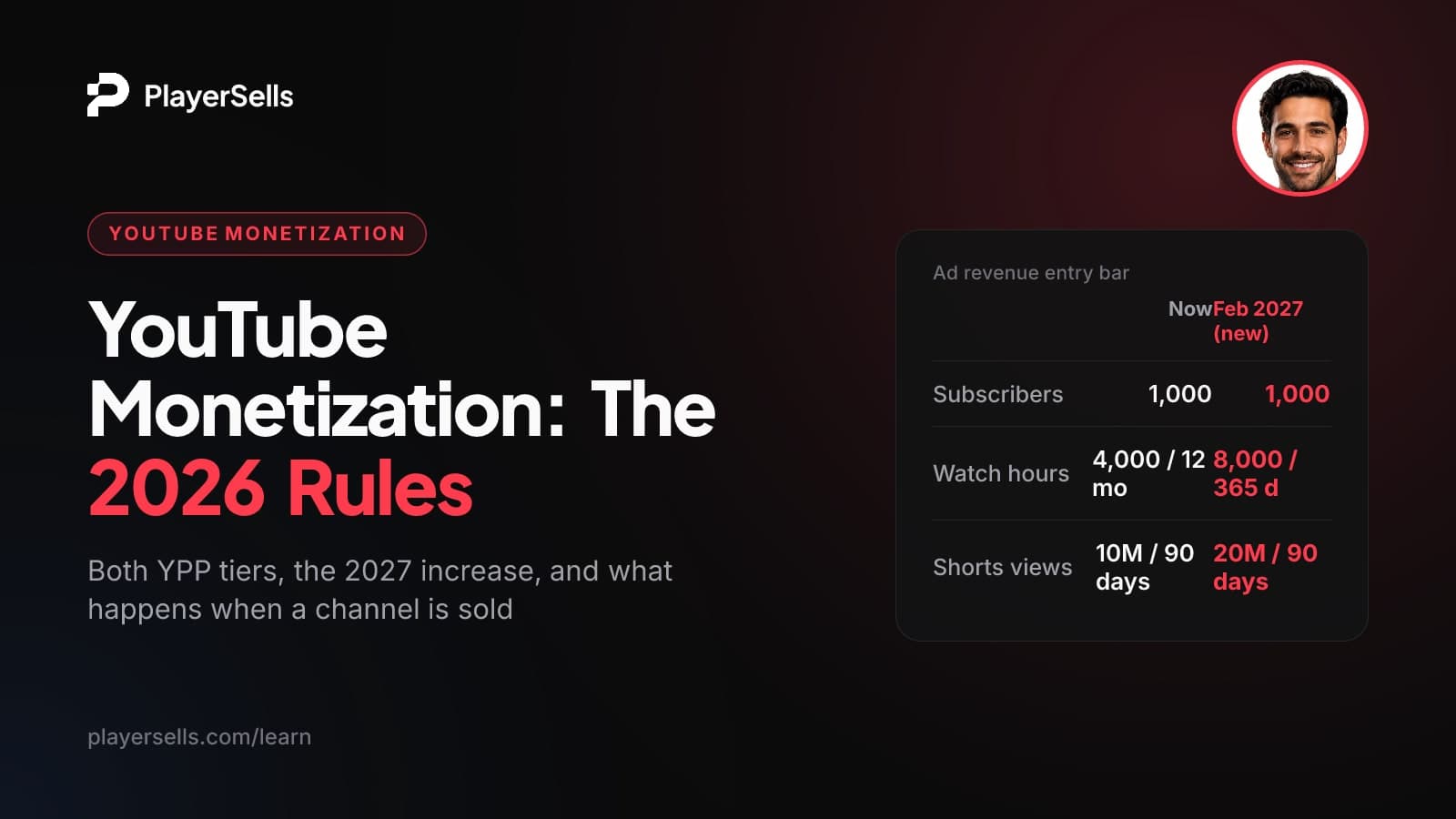
- From February 1, 2027, new applicants will need 8,000 watch hours or 20 million Shorts views for ad revenue, while channels already in YPP keep their status.
- Hitting the numbers only makes a channel eligible to apply, because human reviewers judge the whole channel against YouTube's monetization policies.
- After a first YPP rejection a channel can reapply in 30 days, and after a later rejection or a previous reapplication the wait is 90 days.
- AdSense accounts do not transfer with a YouTube channel, so a new owner must link their own AdSense account, and YouTube may re-review the channel.
What are the YouTube monetization requirements in 2026?
YouTube runs two entry tiers. The lower tier unlocks fan funding and selling your own products. The higher tier adds a share of ad revenue. Both share a set of baseline rules that have nothing to do with subscriber counts.
| Tier | Subscribers | Long-form route | Shorts route | Extra condition | What it unlocks |
|---|---|---|---|---|---|
| Fan funding tier (expanded YPP countries only) | 500 | 3,000 watch hours in last 12 months | 3 million Shorts views in last 90 days | 3 public uploads in last 90 days | Fan funding, YouTube Shopping, Creator Partnerships, promoting your own products |
| Ad revenue tier (all YPP countries) | 1,000 | 4,000 valid public watch hours in last 12 months | 10 million valid public Shorts views in last 90 days | None beyond the baseline rules | Ad revenue sharing, plus everything in the lower tier |
Tier 1: fan funding and Shopping at 500 subscribers
According to the YouTube Official Blog's YPP explainer, a channel with 500 subscribers and either 3,000 long-form watch hours or 3 million Shorts views gets fan funding features and can promote its own products. YouTube Help adds the third condition: 3 valid public uploads in the last 90 days.
The catch is geography. The 500-subscriber tier only exists in eligible countries, and YouTube says creators outside those countries see no change to the program. For them, 1,000 subscribers is the only way in. The country lists change, so check current availability on YouTube's expanded YPP overview rather than trusting a list in a blog post.
Tier 2: ad revenue at 1,000 subscribers
Per YouTube's YPP overview and eligibility page, ad revenue requires 1,000 subscribers and either 4,000 valid public watch hours in the past 12 months or 10 million valid public Shorts views in the past 90 days.
The two routes are separate. Watch hours from Shorts viewed in the Shorts Feed do not count toward the 4,000 hours, and you cannot add half the hours to half the Shorts views. A channel with 2,500 long-form hours and 7 million Shorts views qualifies on neither route.
The rules every channel must meet, regardless of numbers
YouTube lists several baseline conditions on the same eligibility page. Miss any one of them and the subscriber count does not matter.
- Follow YouTube's Channel Monetization Policies.
- Live in a country where YPP is available.
- Have no active Community Guidelines strikes.
- Turn on two-step verification for the Google Account.
- Have access to advanced features.
- Have one active AdSense for YouTube account linked, or set one up in YouTube Studio.
If you want a quick read on where a channel stands against these thresholds, the free YouTube monetization checker compares a channel's public stats to the current bars.
How many views do you need to make money on YouTube?
For long-form videos, there is no view requirement at all. YouTube measures long-form eligibility in watch hours, not views. Only the Shorts route uses a view count: 3 million Shorts views in 90 days for the fan funding tier and 10 million for ad revenue.
This trips people up because "views" is the number everyone watches. A channel with 400,000 views on short clips might have fewer watch hours than a channel with 60,000 views on 40-minute videos. If you are planning content to reach YPP, pick a route and track the metric that route actually uses.
YouTube Shorts monetization requirements, and the ongoing 10 million test
Getting into YPP through Shorts takes 1,000 subscribers and 10 million valid public Shorts views in 90 days. But that number is turning into more than an entry ticket.
On its Changes to the YouTube Partner Program page, YouTube says creators will need to maintain 10 million qualified Shorts views over the last 90 days to earn from the Shorts Creator Pool each month. In practice, a channel that drops below that level could stay in YPP and still lose its Shorts earnings for that month. The page does not give a separate start date for this rule, so check YouTube's Shorts monetization policies for when it applies to your channel.
For buyers, this matters a lot. A Shorts channel that cleared 10 million views last spring and now pulls 4 million per quarter may be "monetized" on paper while earning little from Shorts. Ask for the last 90 days, not the best 90 days.
What changes on February 1, 2027?
Starting February 1, 2027, the entry bar for ad and Premium revenue roughly doubles for new applicants. YouTube says channels already in YPP are not affected. The 1,000-subscriber requirement stays the same, and fan funding, Creator Partnerships and Shopping continue to open at 500 subscribers.
| Requirement | Ad revenue today (as of October 2026) | New applicants from February 1, 2027 | Channels already in YPP |
|---|---|---|---|
| Subscribers | 1,000 | 1,000 | No change |
| Long-form route | 4,000 watch hours in 12 months | 8,000 qualified watch hours in last 365 days | No change |
| Shorts route | 10 million Shorts views in 90 days | 20 million qualified Shorts views in 90 days | No change to membership |
| Fan funding and Shopping tier | 500 subscribers | 500 subscribers (unchanged) | No change |
Some recent guides present 8,000 watch hours or 20 million Shorts views as the current requirement. That is wrong. As of October 2026, the bar is 4,000 hours or 10 million views, and the higher figures apply only to new applicants starting February 1, 2027.
There is a quieter consequence here. The protection covers channels that are in YPP. A channel that gets removed after February 1, 2027 and then reapplies would likely be judged as a new applicant, facing the 8,000-hour or 20 million-view bar. That makes a channel's current YPP standing worth more after the change than before it, and it makes anything that risks removal (a policy problem, a messy handover) more expensive.
If you are close to 4,000 hours today, the practical move is to apply well before February 1, 2027. Reviews can take weeks and a first rejection adds a 30-day wait, so leave room.
How does the YPP review work, and why do channels get rejected or demonetized?
Crossing the thresholds only lets you apply. After that, human reviewers look at the channel as a whole and decide whether it meets YouTube's policies. According to YouTube's rejection FAQ, a rejection means reviewers believe a significant portion of the channel does not meet its policies and guidelines.
On timing, none of the YouTube pages reviewed for this guide promise a fixed review time. Third-party creator blogs estimate anything from a few days to about a month, so treat any number you see as an estimate and plan around the longer end.
Inauthentic and mass-produced content
A channel can meet every number and still be rejected because of the content itself. On July 15, 2025, YouTube updated its YPP guidelines to better identify mass-produced and repetitious content, which it now calls "inauthentic" content.
The change was smaller than the headlines suggested. YouTube renamed the old "repetitious content" policy without changing its definition, and a TeamYouTube community manager called it a minor update to a longstanding guideline. YouTube also confirmed it does not affect the separate reused content policy. It is not a ban on AI or reaction content.
What matters is how it is enforced: the inauthentic content policy applies at the channel level, not video by video. Channels that keep posting mass-produced or repetitive content may be removed from YPP. One bad upload is not the issue; a pattern is.
Community Guidelines strikes
Strikes affect new applications and existing members differently. A channel with active Community Guidelines strikes cannot apply until the strikes expire or an appeal removes them. But YouTube says channels already in YPP are not removed just for receiving strikes.
When you vet a channel, a strike on a monetized channel is not automatically fatal. It does mean that if the channel ever lost YPP, it could not reapply until the strike cleared.
How long do you have to wait to reapply after a rejection?
After a first rejection, a channel can reapply 30 days after the rejection email. After any later rejection, or if it has already reapplied once, the wait is 90 days. That is the current policy per YouTube Help as of October 2026.
The 90-day rule for repeat cases took effect on June 5, 2023, as 9to5Google reported at the time, and rejected creators can appeal within 21 days. An appeal is worth considering if you believe the reviewer misjudged the channel. If the problem is real (a large share of repetitive uploads, for example), fix the channel first, because a second rejection pushes you into the 90-day cycle.
| Situation | What you can do | Timing |
|---|---|---|
| Rejected, disagree with the decision | Appeal | Within 21 days |
| First rejection | Reapply | 30 days after the rejection email |
| Second or later rejection, or already reapplied | Reapply | 90 days |
| Active Community Guidelines strike | Apply | After the strike expires or is removed on appeal |
Combine this with the 2027 change and the stakes rise. A channel rejected in late 2026 that waits 90 days could end up reapplying after February 1, 2027, likely under the higher bar.
Does YPP status survive a channel sale?
Nobody can promise that it does. No official YouTube page reviewed for this guide addresses ownership changes directly, and secondary sources disagree. What is clear: AdSense accounts do not transfer; the new owner must link their own, and YouTube may re-review the channel.
Read YouTube's Terms of Service yourself before buying or selling a channel. This guide does not cover whether a transfer is permitted under them.
Three separate things change hands, or don't
It helps to split a "monetized channel" into three parts:
- The channel: the videos, subscribers and history. This is what actually moves to the buyer.
- The YPP agreement: the channel's membership in the Partner Program. Some sources say it generally stays with the channel; others say the new owner effectively has to apply again. Treat it as uncertain.
- The AdSense payee account: where the money goes. This belongs to the account holder, not the channel, and it does not move.
On the Google AdSense Community forum, a responder explained that AdSense accounts cannot be transferred. Earnings go to whichever AdSense account is linked to the channel, so a new owner has to link an AdSense account in their own name. Money already in the previous owner's AdSense account stays there. That is a peer answer on Google's official forum, not policy text, so read YouTube's help page on changing the linked AdSense account before a handover.
One marketing blog describes a case where ad revenue paused for about six days while a new AdSense account was re-verified. Plan for a gap, and do not expect revenue earned before the handover.
Verifying monetization before and after a transfer
- Step 1: Before paying, have the seller show the channel's current YPP status and earnings history live in YouTube Studio, not in screenshots.
- Step 2: Check the last 90 days of Shorts views and the last 12 months of watch hours, so you know whether the channel would still qualify if it had to reapply. After February 1, 2027, a reapplying channel would likely face the 8,000-hour or 20 million-view bar.
- Step 3: Ask about Community Guidelines strikes and past rejections. Either could block or delay a new application.
- Step 4: Scroll the upload history for patterns that could look mass-produced or repetitive under the inauthentic content policy.
- Step 5: After ownership moves, turn on two-step verification for your Google Account and link your own AdSense for YouTube account.
- Step 6: Agree in writing with the seller how earnings before the handover date are handled, since they stay in the seller's AdSense account.
For the full permission handover, see our guide on how to buy or sell a YouTube channel and what survives the handover. To sanity-check a price, the YouTube money calculator estimates earnings from views, and our YouTube channel valuation study shows what drives prices.
Buying or selling a monetized channel on PlayerSells
The monetization risks above are exactly why payment structure matters. On PlayerSells, the buyer pays PlayerSells, the money is held in escrow, and the seller is paid only after the buyer confirms the channel was delivered as described. Every listing is reviewed by a person before it goes live.
Each deal follows the same sequence: offer sent, accepted, payment pending, paid, delivered, buyer confirmed, completed. Use the gap between "delivered" and "buyer confirmed" to run the checks above: confirm ownership, see the YPP status for yourself, and verify the stats match the listing. If something does not match, either side can open a dispute before completion. A human moderator reviews it, and the money stays held while the dispute is open. A YouTube re-review or AdSense change can happen after you confirm delivery, so price that uncertainty in rather than assuming it away.
You can browse monetized YouTube channels or the wider list of YouTube channels for sale, and see how the escrow process works step by step. Fees are listed on the pricing page.
Frequently asked questions
How many subscribers do you need to get paid on YouTube?
You need 1,000 subscribers for ad revenue, plus 4,000 watch hours or 10 million Shorts views. In countries with the expanded program, 500 subscribers can unlock fan funding and Shopping if you also meet the upload and watch-hour or Shorts-view conditions. Subscribers alone never qualify a channel.
Do Shorts views count toward the 4,000 watch hours?
No. Watch hours from Shorts viewed in the Shorts Feed do not count toward the 4,000-hour long-form threshold. Shorts have their own route measured in views, and the two routes cannot be combined.
How long does the YouTube monetization review take?
There is no guaranteed time in the YouTube pages we reviewed. Third-party estimates range from a few days to about a month, so plan around the longer end. Keep uploading normally while you wait, since reviewers look at the channel as a whole.
Can you change the AdSense account linked to a monetized YouTube channel?
Yes, a channel can be linked to a different AdSense account, but the account itself cannot be transferred between people. A new owner links an AdSense account in their own name, and any balance in the old account stays with the old owner. YouTube Help has a dedicated page on changing the linked AdSense account.
Will a Community Guidelines strike remove my channel from YPP?
Not by itself. YouTube says channels already in the Partner Program are not removed just for receiving strikes. An active strike does stop a channel that is not yet in YPP from applying until the strike expires or is removed on appeal.
Is the 500-subscriber tier available in every country?
No. The expanded YouTube Partner Program with the 500-subscriber tier only runs in eligible countries, and the list changes. Outside those countries, the 1,000-subscriber ad revenue tier is the only way to join YPP.
Bottom line
If you are building a channel, the target as of October 2026 is 1,000 subscribers plus 4,000 watch hours or 10 million Shorts views, and getting into YPP before February 1, 2027 means the doubled bar for new applicants will not apply to you. Keep your content clearly original, because reviewers judge the whole channel, not just the numbers.
If you are buying, treat YPP status as something to verify and protect, not a feature that automatically comes with the channel. Plan for a new AdSense link and a possible re-review, and run a channel through the monetization checker before you make an offer.
Free tools for this topic

Published by the PlayerSells editorial team. Data comes from PlayerSells marketplace records and our own crawlers. About PlayerSells · Editorial policy
Related Articles
Continue learning with these related guides.
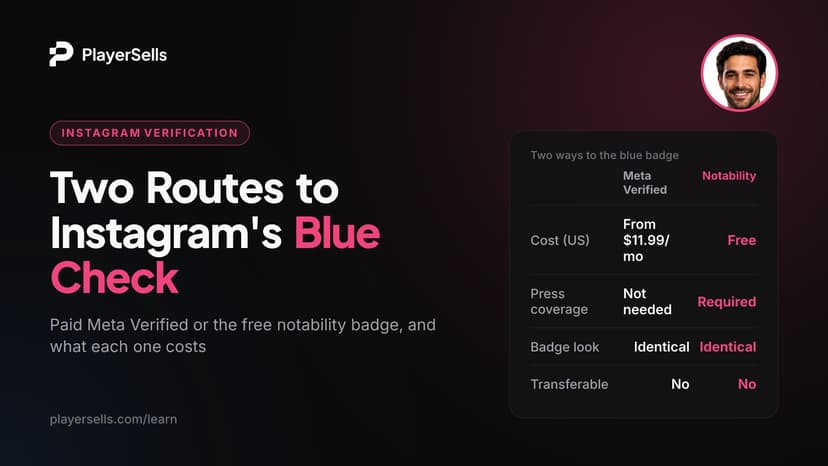
How to Get Verified on Instagram: Meta Verified vs Notability
Two routes to Instagram's blue check: pay for Meta Verified (about $11.99-$14.99/month in the US) or request the free notability badge. Rules, ID and costs.
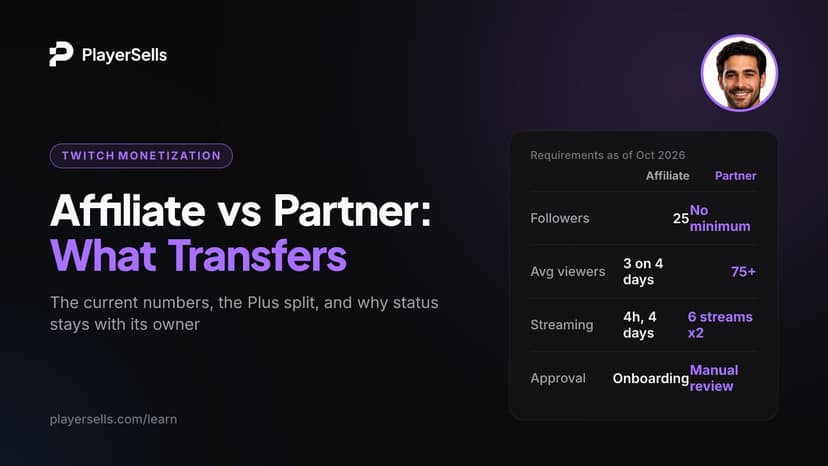
Twitch Affiliate Requirements vs Partner, and Transfers
Twitch Affiliate requirements are 25 followers, 4 hours, 4 days and 3 average viewers. Partner rules, payouts and why status won't transfer to a buyer.
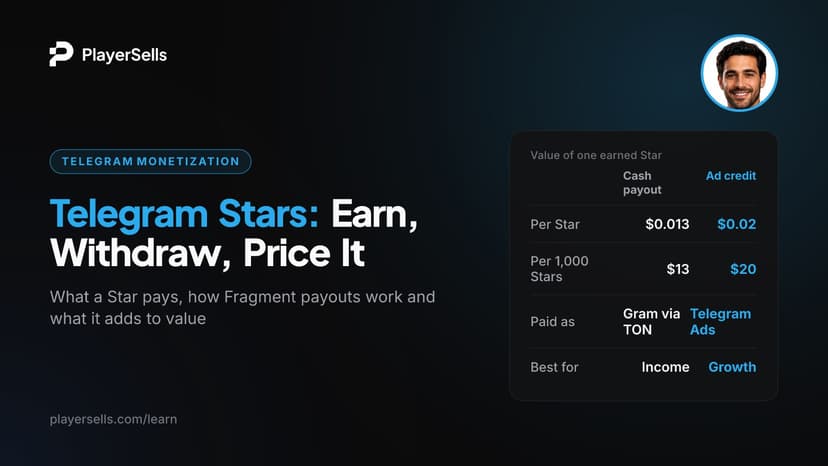
Telegram Stars Explained: How Channels Earn and Withdraw
Telegram Stars pay channel owners $0.013 each in cash or $0.02 as ad credit. Learn how to earn, withdraw via Fragment, avoid holds and price Stars income.