
How to Sell a Valorant Account: Riot Rules, Value, Handover
Selling a Valorant account breaks Riot's ToS and risks a ban. Learn what drives value, the proof buyers want, and a handover order that limits recovery risk.
Riot's Terms of Service ban selling, transferring or sharing a Riot account, and they ban offering to do so. Any Valorant account sale happens outside Riot's rules and carries a real risk of a ban. If you sell anyway, the price depends on skins, rank history, region and email access. The handover only finishes when the buyer controls the email.
This guide is for Valorant and League of Legends players who want to know where they stand before they list an account, and for buyers who want to understand what they are paying for. It covers what Riot's terms say, the risks for both sides, how value really breaks down, the proof to prepare, and a handover order that reduces the risk of either side walking off with the money or the account.
Key takeaways
- Section 1.5 of Riot's Terms of Service says players can't sell, transfer or share a Riot account or its login, and offering to do so is also against the rules.
- Riot has stated in its League of Legends enforcement FAQ that it will "almost certainly ban" an account that is sold or bought, and that account linking could spread a ban to a buyer's other accounts.
- Whoever controls the verified email can approve password and email changes, so a Valorant account isn't truly handed over until the buyer controls that email.
- Valorant account value comes mainly from the skin collection, current and peak rank, region, email access and a clean penalty history, not from any official price.
- Valorant has no skin trading feature, so the whole account is the only thing that can change hands.
- Escrow protects the payment between buyer and seller, but it can't stop Riot enforcement or a later recovery claim.
Can you sell a Valorant account under Riot's rules?
No. As of October 2026, section 1.5 of the Riot Games Terms of Service is titled "Can I share or sell my account or login credentials? (No.)" It says you can't share your account and can't sell, transfer or let anyone else access your account or login credentials. Offering to do so is banned as well, so even posting a listing is against the terms.
The ToS also limits what you own in the first place. Riot grants a limited, non-exclusive, non-transferable, revocable license to use its services for individual, non-commercial entertainment. Players have no ownership or property interest in Virtual Content they unlock, however they got it, and Riot says that content has no monetary value and can't be redeemed for real-world money. If Riot terminates an account, the license to everything on it ends immediately.
One distinction matters here. Breaking Riot's terms is a contract issue, not automatically a legal one, and whether any local law applies varies by country. What is certain is that selling breaks the agreement every player accepted, and Riot enforces that agreement with bans. This applies equally to League of Legends, because both games run on the same Riot account and the same terms.
What are the real risks of selling a Valorant account?
There are three: Riot can ban the account, a ban can spread to the buyer's other accounts, and the seller (or someone claiming to be the original owner) can try to take the account back. Each one hits a different person, which is why both sides need to understand them before money moves.
Riot says it bans sold accounts
Riot has stated, in its League of Legends Account Penalties and Enforcement FAQ (around October 2025), that it will "almost certainly ban" an account that is sold or bought. The same FAQ defines "Account Sharing" as giving or selling an account to someone other than the original creator.
It adds a detail that matters for pricing. A shared account whose MMR rose sharply within the past year has a good chance of being flagged for Ranked manipulation, and Riot says it will stand by those penalties. An account that someone else climbed for you is the riskiest kind to sell or buy, and that history should be disclosed, not hidden.
Account linking can spread a ban
Riot defines "Account Linking" as connecting multiple accounts when it is extremely certain one person uses them all. Its FAQ warns that once its linking changes roll out, all of a buyer's linked accounts could be banned along with a bought one. For a buyer, the downside isn't only losing the purchase but possibly their main account too.
The FAQ also says Riot doesn't want to punish players in good standing who once bought or shared an account that later became their main and who have followed the rules since. That is a statement about leniency for past behavior, not permission to buy or sell.
Recovery claims can reverse a sale
Riot's account recovery exists to give accounts back to people who lost access. That protects players from hackers, but it also means a sold account can be pulled back after payment if the handover was incomplete. The next section explains why email is the deciding factor.
Why does email access decide who controls a Riot account?
Because the verified email is the master key. According to Riot's Email Verification FAQ, a verified email lets its holder approve email and password changes and recover forgotten passwords and usernames, and it helps stop unauthorized changes to both. An older Riot support article adds that once an email is verified, Riot asks for a code sent to that email whenever someone opens the account settings on the web.
Riot's Account Support page sends players to account recovery if they no longer have access to the account's email, if the account may have been hacked, or if details were changed without permission. In practice, recovery tends to favor whoever controls the verified email and can show they own the account. If the seller keeps the email, the buyer has effectively rented the account until the seller decides otherwise.
That is what listing tags like "original email" and "full access" mean. Either the buyer receives the email account the Riot account was created with, or the email on file is changed to one the buyer owns, with nothing left that ties control back to the seller. Accounts sold this way are worth more because the buyer's position is far stronger. Even then, no handover removes the risk of a later recovery claim by the original creator completely.
How much is my Valorant account worth?
There is no official or neutral price list, so value comes down to a handful of drivers: the skin collection, current and peak rank, region, email access and penalty history. Public asking prices are a weak signal. As of October 2026, public forum listings run from around $25 for fresh smurf accounts to thousands for Radiant accounts with full Champions collections, and one eBay listing asked EUR 99,999 for a Diamond account. Those are asking prices, not completed sales.
The same gap between list price and real resale value shows up with other gaming accounts, as explained in our guide to how much a Steam account is worth. Use the table below to judge your own account honestly.
| Value driver | Raises value | Lowers value | Proof buyers expect |
|---|---|---|---|
| Skin collection | Knives, Champions and limited bundles, popular Vandal and Phantom lines | Few skins, mostly common or free items | Timestamped locker screenshots showing a note or the Riot ID |
| Current and peak rank | High rank backed by steady match history | Decayed rank, or a sudden recent MMR jump | Rank, match history and peak-rank screenshots |
| Region and shard | Region where many buyers actually live | Region most buyers can't legitimately use | Region shown under Personal Information in account settings |
| Email access | Original email or full access included | No email access, or seller keeps the email | Written email-access statement |
| Account history | No penalties, one consistent owner | Past penalties, shared or boosted play | Honest written disclosure |
Skins: why your inventory can't be split off
Valorant has no skin trading feature. As of October 2026, Riot only allows gifting skins or bundles bought fresh from the store, not items already in your inventory, and third-party sources report that Riot support won't move existing skins between accounts even when both belong to the same person. So a knife or a Champions bundle can't be sold on its own. The whole account is the unit of value.
That is a big difference from Steam games, where CS2 and Rust skins are tradable items you can sell individually. With Valorant, buyers pay for the locker as a package, so a few standout items on an otherwise thin account may not lift the price as much as sellers hope.
Rank, peak rank and MMR history
Buyers look at three things: the current rank, the peak rank, and whether the history in between makes sense. A Diamond account that has sat in Diamond for several seasons reads very differently from one that jumped two tiers in a month. Given Riot's warning about sharp MMR rises on shared accounts, a recent spike is a risk factor that a careful buyer will price in.
Region and shard limit your buyer pool
Region matters because buyers can't move an account freely. Per Riot's VALORANT Account Transfer FAQ (around June 2026), an account's Region of Residence and shard are set by the player's physical location when it was created, and Riot only allows changes that match where the player actually lives. Changing Region of Residence erases the current ranked season's progress, match history and purchase history, and the account can't be transferred again for 90 days.
There are exceptions. Transfers between the North America, LATAM and Brazil shards keep all data. South Korea accounts can't move to Japan, non-Korean players who want a Korean region must create a new account there, a Vietnam region requires permanent residence in Vietnam, and changes to China aren't available. The practical result is that your realistic buyers are people who live in your region.
Email access and account history
Full email access is one of the biggest swing factors, for the reasons covered above. Penalty history works the other way: any past ban or restriction, or a history of shared play, makes a buyer more nervous about future enforcement. Account age and level matter to some buyers, but there is no reliable data on how much, so treat them as minor compared with skins, rank and access.
What proof should you prepare before listing?
Prepare proof that a stranger can verify without logging in. Good evidence lets the buyer check the account before any credentials change hands, which protects you as much as them. Never send a login to "prove" anything before payment is secured.
- Locker screenshots with a handwritten note showing today's date and your Riot ID visible on screen, so the images can't be recycled from another account.
- Rank and match history screenshots covering recent games, plus a peak-rank screenshot.
- Region as shown under Personal Information at account.riotgames.com.
- A clear email-access statement: whether you are handing over the original email account, or changing the email to the buyer's.
- A plain disclosure of any penalties, periods of shared play or boosting, and which games (Valorant, League or both) have history on the account.
For more on spotting fake proof and common scam patterns, see our safety guide.
What is the safest handover order?
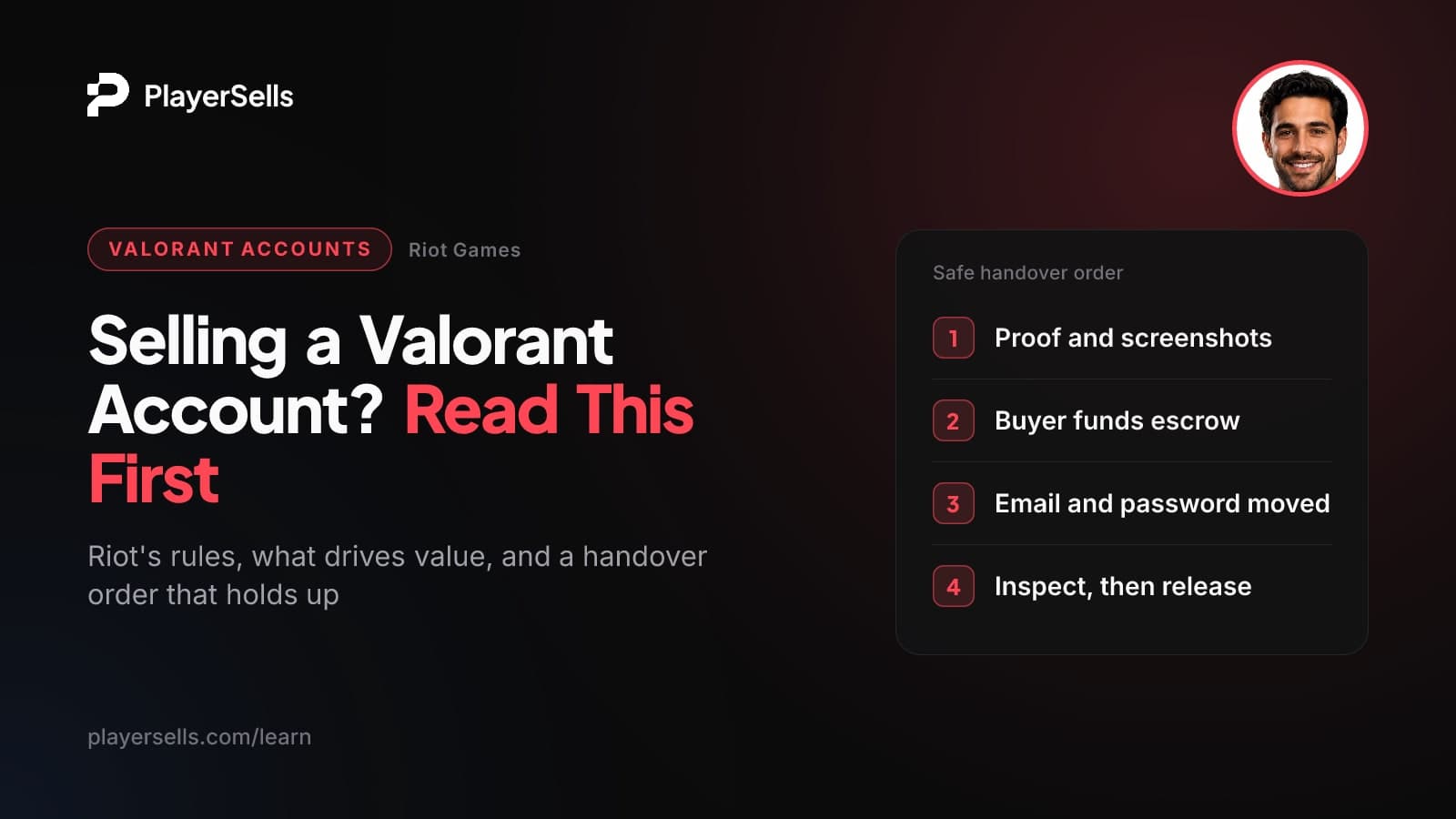
Money should be secured before credentials move, and credentials should fully move before money is released. That order protects the buyer from paying for an account they never control and protects the seller from handing over an account and never getting paid.
- Step 1: The seller shares proof, and both sides agree in writing what is included: skins, rank, region, email access and any disclosed history.
- Step 2: The buyer funds escrow. The seller does not send anything until the payment is confirmed as held.
- Step 3: The seller delivers the Riot login and, where agreed, access to the original email account.
- Step 4: The buyer changes the Riot account password and moves the email to an address only they control, or secures the original email account by changing its password and recovery options.
- Step 5: The buyer reviews the account's security settings and turns on any extra login verification available.
- Step 6: The buyer checks the account against the listing: skins, rank, match history and the region shown in account settings.
- Step 7: The seller signs out of any saved sessions and confirms they keep no recovery details.
- Step 8: The buyer confirms delivery, and only then is the money released to the seller.
Escrow protects the payment, not the account. It can't stop Riot from banning a sold account, and it can't stop a recovery claim filed after the deal is closed.
A note on Riot IDs: buyers can change the in-game name in account settings, with a cooldown currently reported as 90 days (check Riot Support for the latest rule). A new name is a cosmetic change only. The account's history stays attached to it. Region changes are only allowed to match where you actually live, so buyers should never plan a purchase around moving an account somewhere they don't reside.
Is selling a League of Legends account the same?
Mostly, yes. League and Valorant share one Riot account and one set of terms, so section 1.5 of the current Riot Terms of Service applies to League sales just the same. Older League-specific Terms of Use from around 2012 with their own "Account Sales" clause are outdated and shouldn't be relied on. Riot's enforcement FAQ, including the "almost certainly ban" and account-linking warnings, was in fact written for League.
The value logic carries over: skins and champions owned, current and peak rank, a believable match history, email access and penalty history. Server transfer rules for League differ from Valorant's and weren't covered here, so check Riot Support for the current League process. Also remember that one login carries both games. If your Riot account has history in League and Valorant, selling it hands over both. Buyers comparing options can browse League of Legends accounts for sale to see how listings describe these details.
Buying or selling a Valorant account on PlayerSells
If you decide to go ahead despite Riot's terms, the main thing a marketplace can do is reduce the risk between buyer and seller. On PlayerSells, the buyer pays PlayerSells, the money is held in escrow, and the seller is paid only after the buyer confirms the account was delivered as described. Every listing is reviewed by a person before it goes live.
Each deal follows a fixed sequence: offer sent, accepted, payment pending, paid, delivered, buyer confirmed, completed. Either side can open a dispute before completion. A human moderator reviews it, and the money stays held while the dispute is open. Sellers receive funds in an on-platform wallet and can withdraw after a clearing period. The full flow is explained on how it works, and fees are listed on the pricing page.
Buyers can browse Valorant accounts for sale or narrow the search to Valorant accounts with skins. None of this changes Riot's position or protects an account from enforcement. It protects the money and gives you a referee if delivery doesn't match the listing.
Frequently asked questions
Can you get banned for selling a Valorant account?
Yes. Riot's Terms of Service ban selling an account and even offering to sell one, and Riot has stated in its League enforcement FAQ that it will "almost certainly ban" an account that is sold or bought. The buyer carries the bigger exposure, since account linking could extend a ban to their other accounts.
Is it legal to sell a Valorant account?
It is against Riot's Terms of Service, which is a contract between you and Riot. Whether any law applies depends on your country, so "against Riot's rules" is the accurate description rather than "illegal". The practical consequence is enforcement by Riot, not a guarantee of legal trouble.
Can the original owner recover a sold Valorant account?
They can try. Riot's recovery process exists for people who have lost email access or believe their account was taken, and it favors whoever controls the verified email and can show ownership. Moving the email and password to the buyer during the handover greatly reduces the risk, but it doesn't remove it entirely.
Can I transfer my Valorant skins to another account?
No. Valorant has no skin trading feature, and Riot only allows gifting skins or bundles bought new from the store. Skins already in an inventory stay on that account, which is why sellers can only sell the whole account.
Can a Valorant account be transferred to another region?
Only to match where the player actually lives. As of June 2026, Riot's transfer FAQ says changing Region of Residence wipes the current ranked season's progress, match history and purchase history, followed by a 90-day cooldown, except between the North America, LATAM and Brazil shards, which keep all data. Korea, Vietnam and China have extra restrictions.
How do I sell a Valorant account without getting scammed?
Never hand over credentials before the payment is held by a neutral escrow. Share timestamped proof instead of logins, agree the terms in writing, and release access only after funds are secured. Be wary of buyers who ask for a "test login" or push you to deal outside a protected payment.
Bottom line
Selling a Valorant account breaks Riot's Terms of Service, and Riot has said in its League enforcement FAQ that it will almost certainly ban sold accounts. Decide with that risk in plain view. If the account was boosted, has penalties, or you can't hand over the email, the honest answer is probably not to sell.
If you still go ahead, price on skins, rank history, region and email access, prepare verifiable proof, and only hand over credentials once payment is held. When you're ready, you can create a listing through the PlayerSells sell page, where a person reviews it before it goes live.

Published by the PlayerSells editorial team. Data comes from PlayerSells marketplace records and our own crawlers. About PlayerSells · Editorial policy
Related Articles
Continue learning with these related guides.
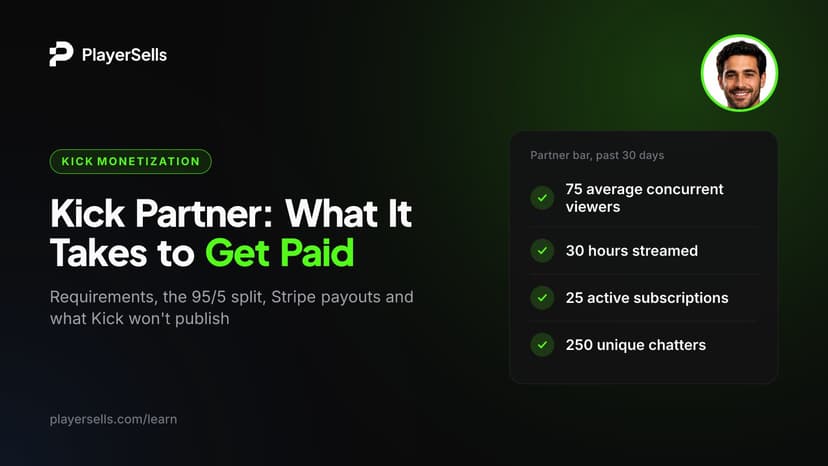
Kick Creator Incentive Program: Requirements, Pay, Payouts
Kick Creator Incentive Program requirements as of 2026: 75 CCV, 30 hours, 25 subs, plus verification, the 95/5 split and how Stripe payouts arrive.
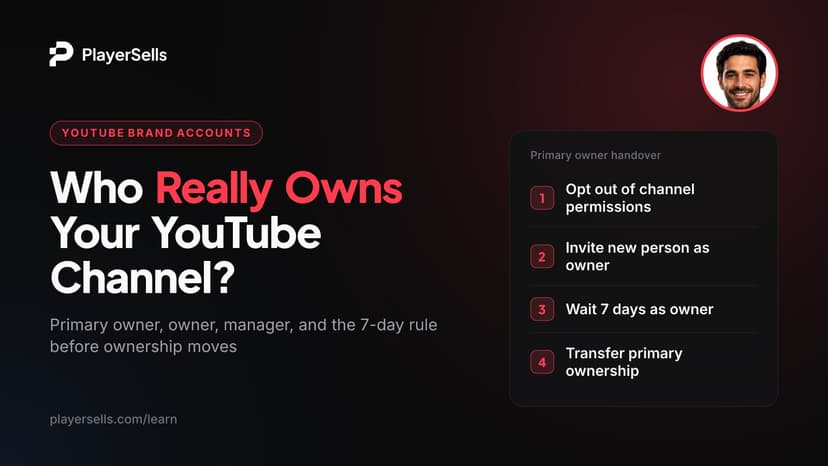
YouTube Brand Account: Owners, Managers and Primary Owner
A YouTube Brand Account lets several people run one channel. Learn the primary owner, owner and manager roles, the 7-day transfer rule and pre-buy checks.
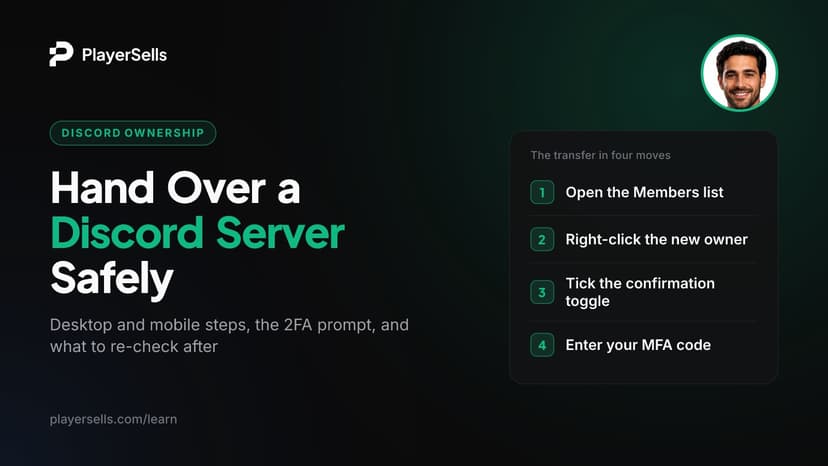
How to Transfer Discord Server Ownership Safely
Transfer Discord server ownership on desktop or mobile: the 2FA prompt, what to check after, Server Subscription payouts, and whether selling is allowed.