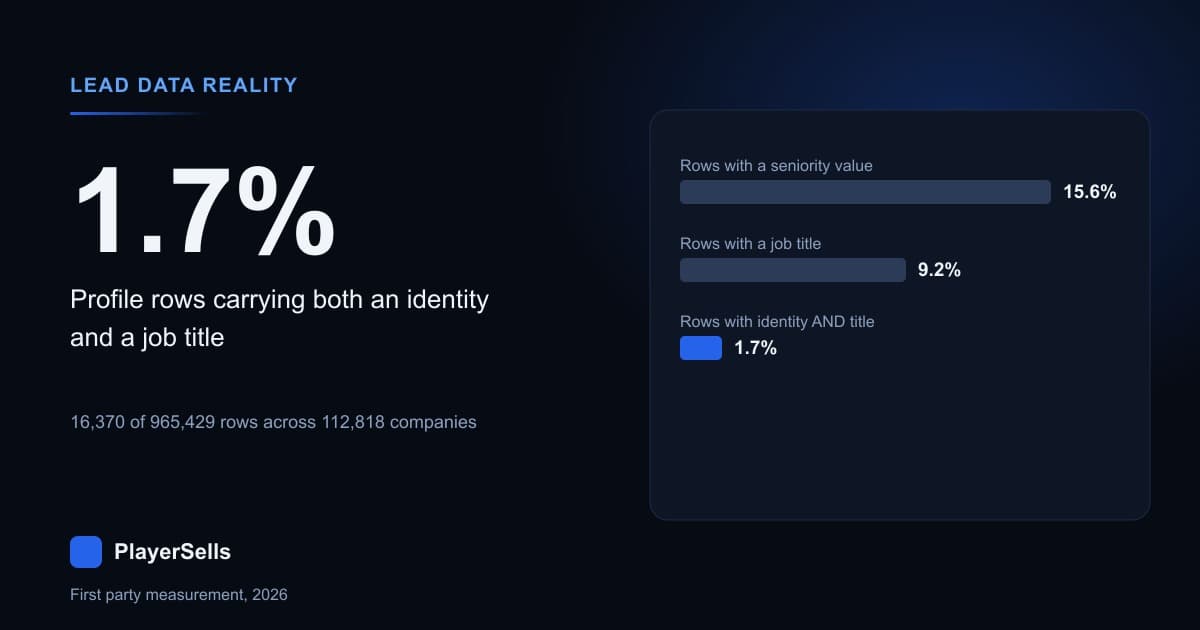
Our LinkedIn directory holds 965,429 profile rows covering 108,571 companies, crawled between 2026-08-22 and 2026-09-02, and only 16,370 of those rows (1.70%) carry both a LinkedIn profile identity and a job title. That is the real ceiling of public LinkedIn profile data at scale in 2026. A person's name and their employer are cheap to collect. Role, seniority, location and education are not, and three of those four fields are populated on exactly zero of our 965,429 rows.
We ran this crawl to answer a narrow question: how much of a company's team can you verify from public sources before you deal with them. The answer is less than the lead-data market implies. Across the 112,818 companies in our directory, 3,100 (2.7%) yield even one person with a LinkedIn identity, a stated job title and an employment relationship at the same time. Everything else is a name attached to a logo.
What 965,429 LinkedIn Profile Rows Actually Contain
Field population is the first thing to measure and the last thing anyone publishes. We counted non-null, non-empty values on every column of the people table across all 965,429 rows on 2026-09-02, then re-ran the counts with a different formulation. The two agreed exactly, which is the check we run before publishing any fill rate.
The table below shows what share of our 965,429 LinkedIn profile rows carried each field on 2026-09-02. Read it as a census rather than a sample, because these are every row in the directory, which makes the zeros on the last four lines absolute.
| Field | Rows populated | Share of 965,429 |
|---|---|---|
| Company link | 965,429 | 100% |
| Relation type (mentioned, employee, author) | 965,429 | 100% |
| Full name | 963,985 | 99.85% |
| LinkedIn profile slug | 841,096 | 87.12% |
| Seniority (derived) | 150,856 | 15.62% |
| Job title | 89,123 | 9.23% |
| Headline | 0 | 0% |
| Location | 0 | 0% |
| Education | 0 | 0% |
| Profile photo | 0 | 0% |
Four columns are structurally empty. Headline, location, education and photo are provisioned in the schema and hold nothing on any of the 965,429 rows. A vendor selling a file with those columns filled is either fetching something we are not, or inferring them. Both are worth knowing before you pay per record.
Why Is Most of a Profile Table Empty?
Because of what we fetch, not because LinkedIn hides it. That distinction separates a measurement from an accusation. Our engine reads two public surfaces: a company's LinkedIn page, and the company's own website. It never opens an individual member profile, and the proof is in the table itself, where the last-fetched timestamp is populated on 0 of 965,429 rows.
So the correct reading is not that LinkedIn conceals employee locations. A company-level public crawl, the cheapest and most scalable way to build a people database, yields names and employers and almost nothing else. The wall is the economics of fetching a million individual pages, not a policy. When a vendor quotes a per-record price with seniority and location included, ask which surface produced those fields, because neither a company page nor a website team section carries them.
Where Does the Job Title Data Actually Come From?
Not from LinkedIn. We tagged every row with its source, and the split is stark. Of 817,649 rows sourced from a LinkedIn company page, 3,076 carry a job title, a fill rate of 0.38%. Of 147,780 rows sourced from the company's own website, 86,047 carry a title, a fill rate of 58.2%.
Put differently: a company's own website is more than 150 times more likely to tell you what someone does than that company's LinkedIn page is. The trade runs the other way for identity. Every LinkedIn-sourced row has a profile slug you can open and check, while only 23,447 of 147,780 website-sourced rows (15.9%) have one.
The table below breaks all 965,429 rows down by the surface we read them from and the relationship each row claims, with title and identity fill rates for every combination. The two right-hand columns are the trade-off itself, and they move in opposite directions.
| Source and relation | Rows | Share with a job title | Share with a LinkedIn slug |
|---|---|---|---|
| LinkedIn page, mentioned | 524,692 | 0.03% | 100% |
| LinkedIn page, employee | 260,639 | 1.10% | 100% |
| Website, employee | 137,249 | 55.0% | 15.7% |
| LinkedIn page, author | 32,318 | 0.08% | 100% |
| Website, mentioned | 10,530 | 100% | 17.9% |
A second finding sits inside that table. Only 397,888 of 965,429 rows (41.2%) are an actual employment claim. The largest bucket, 535,222 rows or 55.4%, is tagged as a mention: a name appeared in association with the company with no statement that the person works there. Board members, investors, press contacts and speakers all land there. Treating every row as an employee would overstate identified headcount by 2.4 times.
Is Seniority a Measured Field or a Guess?
A guess, and a checkable one. Our seniority column is populated on 150,856 of 965,429 rows (15.62%), which looks respectable until you read the values. Of those, 61,733 resolve to the literal string "unknown", leaving 89,123 rows with a real band. That is the same 89,123 as the job title count, and the match is not a coincidence.
We tested the dependency three ways. Rows with a title but no seniority: 0. Rows with a title where seniority resolved to "unknown": 0. Rows with a real band but no title: 0. Seniority here is a classifier running over the title string, so it carries no information the title does not. We report it as derived, not observed.
Among the 89,123 rows carrying a classified band on 2026-09-02, the distribution is heavily top-weighted toward senior roles. The table below gives the row count and the share for each of the six bands our classifier assigns, measured across those 89,123 rows and no others.
| Seniority band | Rows | Share of classified rows |
|---|---|---|
| C-level | 26,322 | 29.53% |
| Director | 18,255 | 20.48% |
| Manager | 14,896 | 16.71% |
| VP | 10,294 | 11.55% |
| Founder | 10,001 | 11.22% |
| Individual contributor | 9,355 | 10.50% |
Which Employees Are Visible in Public Data?
The senior ones. C-level and founder rows together account for 40.75% of the 89,123 people whose role we can identify, while individual contributors account for 10.50%. No company on earth has that org chart. The shape is a property of where titles come from: a website team page publishes leadership, and most people below director level are absent from the public surface entirely.
Job titles are also fragmented. We counted 39,780 distinct lowercase title strings across those 89,123 rows. The most common title in the database is "partner" at 1,402 rows, or 1.57% of titled rows. Any product promising to filter a million profiles by role is filtering a long tail of free text, not a controlled vocabulary.
Call this what it is: a survivor filter. It does not mean junior staff are unreachable. It means the cheap public surface over-represents executives, so a team roster built from public data is a picture of a leadership page rather than a company.
How Many People Can You Name at a Company?
Across 108,571 companies with at least one profile row, the median company yields 5 named people. The 25th percentile is 2, the 75th is 11, the 90th is 21, the 99th is 56, and the best-covered single company yields 368 names. The mean is 8.89, higher than the median in the way every heavy-tailed distribution is.
Nearly a fifth of companies yield exactly one person, which is the most common single outcome in the directory. The table below gives the full shape of team coverage across all 108,571 companies that returned at least one profile row when we measured on 2026-09-02.
| Named people found | Companies | Share |
|---|---|---|
| 1 | 21,406 | 19.7% |
| 2 | 7,081 | 6.5% |
| 3 to 5 | 31,682 | 29.2% |
| 6 to 10 | 20,773 | 19.1% |
| 11 to 25 | 19,870 | 18.3% |
| 26 to 50 | 6,272 | 5.8% |
| 51 or more | 1,487 | 1.4% |
A further 4,247 companies in our directory returned no people at all, so the 108,571 figure is already conditioned on getting at least one name. Read any claim of full team coverage against that median of 5 named people, on a directory of 112,818 companies.
Coverage Collapses as Companies Get Bigger
The result we did not expect is that the number of people we can name barely moves with company size. We joined profile counts to self-reported headcount for the 103,476 companies where a staff count exists. Median named people is 4 or 5 in every band, from one-person firms to companies reporting more than 10,000 employees, while median reported headcount rises from 7 to 6,463.
Coverage is that ratio, and it falls off a cliff. The table below pairs median reported headcount with the median count of people we could actually name, across the 103,476 companies where both exist, taking the median of the per-company ratio rather than a ratio of medians.
| Company size band | Companies | Median staff reported | Median people named | Median coverage |
|---|---|---|---|---|
| 2 to 10 employees | 16,244 | 7 | 4 | 57.14% |
| 11 to 50 | 25,385 | 24 | 5 | 25.00% |
| 51 to 200 | 22,921 | 87 | 5 | 7.69% |
| 201 to 500 | 11,833 | 243 | 5 | 2.80% |
| 501 to 1,000 | 7,328 | 509 | 5 | 1.34% |
| 1,001 to 5,000 | 10,463 | 1,181 | 5 | 0.54% |
| 5,001 to 10,000 | 2,783 | 2,917 | 5 | 0.22% |
| 10,001 or more | 4,881 | 6,463 | 4 | 0.08% |
We checked whether that flatness was our own fetch limit rather than the public surface. Mean named people ranges only from 7.50 to 9.83 across those bands, and the per-band maximum lands on unround numbers such as 326, 347 and 368 rather than a clean cap. A hard crawl limit would spike at a round value, and none appears. Part of the flatness is still ours, since a public company page shows a bounded set of employees, but the ceiling is real for anyone reading the same surface.
One more number from that join deserves attention. The median count of named people who also have a job title is 0 in every size band. For more than half of companies at every scale, public data gives you names with no roles attached.
How Many Companies Yield a Contactable Human?
This is where the profile table meets the contact table. Ours holds 291,644 rows across 56,599 company slugs, split between 149,393 phone numbers and 142,251 email addresses, collected in the same 2026-08-22 to 2026-09-02 window. Both are read from public web pages and mailto links rather than from LinkedIn.
The role-account question only makes sense for email, and we had to restrict it before the numbers meant anything: all 149,393 phone rows carry the role-account flag set to true, a labelling artifact rather than a fact about phones. Restricted to the 142,251 emails, 46,475 (32.7%) are role addresses and 95,776 (67.3%) are not. But "not a role address" is a heuristic on the local part, not evidence a human was identified. Only 47,904 emails (33.7%) carry a person name, and 15,087 (10.6%) a name plus a title.
Rolled up across all 112,818 companies in the directory, the result is a funnel rather than a single coverage figure. Each line below counts the companies for which we hold at least one record of that kind, ordered from the cheapest fact to the most expensive.
| What you can get for a company | Companies | Share of 112,818 |
|---|---|---|
| At least one named person | 108,571 | 96.2% |
| At least one employee-relation person | 107,357 | 95.2% |
| At least one email address of any kind | 45,771 | 40.6% |
| At least one phone number | 38,962 | 34.5% |
| At least one role email such as info@ or hello@ | 32,936 | 29.2% |
| At least one person with a job title | 15,821 | 14.0% |
| At least one C-level or founder | 10,059 | 8.9% |
| At least one email bound to a person's name | 9,661 | 8.6% |
| An employee with both a title and a LinkedIn identity | 3,100 | 2.7% |
| An email with both a name and a title | 2,161 | 1.9% |
| No contact of any kind | 56,219 | 49.8% |
Half the companies we crawled produce no email and no phone. The most common role address is info@, on 19,175 rows, then hello@ on 4,003 and contact@ on 3,955. That is the real base rate of the lead-generation surface: a shared inbox for three companies in ten, a named human for fewer than one in ten.
What Does a Verified Email Actually Mean Here?
In our table, nothing yet, and we would rather say so than quote a column we have not earned. The verification-status field holds the single value "unknown" on all 291,644 contact rows, and the verified-at timestamp is populated on 0 of them. No address in this table has been through a mailbox check.
What we do have is a DNS-level signal. MX records resolve for 131,632 of 142,251 email addresses (92.5%), which confirms the domain can receive mail. It says nothing about whether the mailbox exists, whether the person still works there, or whether the address came off an old PDF. A 92.5% MX pass rate is often marketed as a 92.5% deliverability rate, and those are different measurements.
One structural detail is worth flagging. The contacts table has a person-id column intended to join a contact to a profile, and it is populated on 0 of 291,644 rows. Emails and people sit in the same database and are not linked. Joining them by name is guesswork, and that guesswork is what a per-record price often buys.
The Same Person, Two Employers
Attribution error is measurable here, so we measured it. Across the 841,096 rows carrying a LinkedIn profile slug there are 753,321 distinct profiles. Of those, 694,631 (92.2%) attach to exactly one company, 44,546 (5.9%) to two, and 14,144 (1.9%) to three or more. One profile appears against 82 different companies.
Restricting to employment claims cleans it up considerably. Among the 270,129 distinct profiles with at least one employee-relation row, 262,342 (97.1%) map to a single company and 7,787 (2.9%) map to two or more, with a maximum of 30. The multi-company tail is mostly the mention relation recurring across company pages.
Email carries a smaller version of the same problem. Of 138,793 distinct email addresses, 2,464 (1.8%) appear against more than one domain. That is a floor rather than an estimate, because it counts exact string matches only, with no normalisation applied first.
What This Means If You Are Buying an Audience
The transferable lesson is about what public data can and cannot prove, and it is the lesson we apply on the marketplace side of this business. A follower count is directly countable, which is why a public ranking such as our directory of the largest X accounts can be re-checked by anyone. Employment is not countable that way, so a team roster assembled from public sources is an inference wearing the clothes of a fact.
Apply that standard in both directions. Before accepting a claim about an audience, ask which surface produced it and what its fill rate was. Our follower audit tool exists for the reason this article does: a number you can reproduce beats a number handed to you. The same logic drives the audience finder, which reads directory data you can inspect rather than a vendor survey.
If you are evaluating a counterparty, the checklist is short. Confirm the person has a profile identity you can open, not just a name in a file. Check whether their stated role appears anywhere they do not control. Treat a shared inbox as an organisation, not a person, because 29.2% of the companies we measured offer nothing else.
And when money moves, do not rely on identity data at all. Deals on our marketplace listings run through escrow precisely because identity verification from public sources tops out around the numbers above. Sellers preparing to list an account for sale meet the mirror image of the problem, which is why we ask for evidence rather than claims. A record you can count, such as the completed-deal history behind our ranked seller leaderboard, beats any profile field here.
For the company-level view of the same directory, our measurement of LinkedIn company page benchmarks across 29,742 pages covers the organisation layer, which is far richer than the people layer. The account-side equivalent is our guide to checking whether an X account has real followers, and what a badge proves is covered in what verification is actually worth.
Questions About LinkedIn Profile Data, Answered From Our Own Measurements
These are the questions buyers, sellers and data teams ask us about this dataset. Every answer below uses numbers we ran ourselves on 2026-09-02, across 965,429 profile rows, 291,644 contact rows and 112,818 companies, in a crawl window of 2026-08-22 to 2026-09-02.
How much LinkedIn profile data is actually available at scale?
Names and employers are near-complete: a full name is populated on 963,985 of 965,429 rows (99.85%) and a company link on 100%. Job titles reach 9.23%. Headline, location, education and profile photo sit at zero rows in our crawl. If you need role or geography on a million profiles, a company-level crawl will not get you there.
Can you get a job title for most LinkedIn profiles?
No. We have a title on 89,123 of 965,429 rows, or 9.23%. The rate depends entirely on source: 58.2% of the 147,780 rows read from company websites carry a title, against 0.38% of the 817,649 rows read from LinkedIn company pages. A company's own site is the productive surface for roles, and LinkedIn is the productive surface for identity.
What share of companies have a findable named contact?
Of 112,818 companies measured, 9,661 (8.6%) yield at least one email bound to a person's name, and 2,161 (1.9%) yield an email with both a name and a job title. A further 32,936 (29.2%) yield only a role address such as info@ or hello@, and 56,219 (49.8%) yield no email and no phone at all.
Is LinkedIn seniority data reliable?
In our directory it is derived, not observed. Seniority is populated on 150,856 rows, of which 61,733 resolve to "unknown", leaving 89,123 classified rows that match the job title count exactly. Zero rows have a title without a band and zero have a band without a title, so the field is a classifier over the title string and adds no independent information.
How many employees can you identify at a large company from public data?
Roughly the same number as at a small one. Median named people is 5 for companies reporting 51 to 200 staff and still 4 for companies reporting more than 10,000, measured across 103,476 companies with a reported headcount. Median coverage therefore falls from 57.14% in the 2 to 10 band to 0.08% in the 10,001-plus band.
Does a verified email mean the address works?
Not in this dataset. Our verification-status column holds the single value "unknown" across all 291,644 contact rows and the verified-at timestamp is populated on none of them. MX records resolve for 131,632 of 142,251 email addresses (92.5%), which proves the domain accepts mail and proves nothing about the individual mailbox.
Why is so much public people data made up of mentions rather than employees?
Because company pages name people for many reasons. Of 965,429 rows, 535,222 (55.4%) are tagged as mentions, 397,888 (41.2%) are employment claims and 32,319 (3.3%) are content authors. Board members, investors, speakers and press contacts appear without working there, so treating every row as staff overstates identified headcount by 2.4 times.
Related Articles
Continue learning with these related guides.
Does Twitch Account Age Still Matter? We Measured 432,192
Across 432,192 Twitch channels read on 2026-09-08, account age is almost pure accumulation, and at a matched follower count the newer channel wins.
X Bookmark Rate Benchmarks From 94,318 Scored Accounts
Half the X accounts we scored on ten or more posts bookmark under 0.0273% of their views, and a third of original posts get no bookmarks at all.