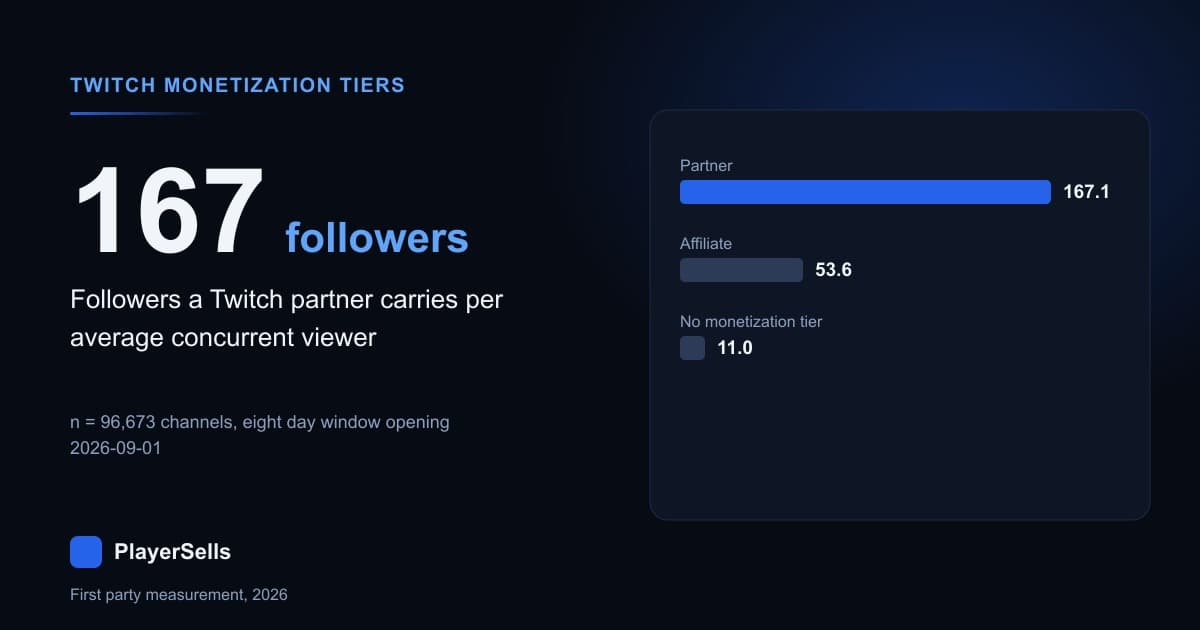
A Twitch partner channel carries a median 167.1 followers for every average concurrent viewer it draws. A channel sitting on the same platform with no monetization tier at all carries 11.0. We measured that across 96,673 channels in our own Twitch crawl on 2026-09-08, across the eight-day window our streaming engines have written so far, 2026-09-01 to 2026-09-08. The gap is 15.2x, and it is the single most useful thing the partner flag tells a buyer.
So what is a monetization tier worth? Not much as a feature you inherit, and a great deal as a filter you can read for free. Of 434,686 Twitch channels in our directory at 13:21 UTC on 2026-09-08, 25,842 carry the partner flag (5.94%), 216,344 carry affiliate (49.77%) and 192,500 carry nothing (44.28%). The tier is not a follower threshold. It is a signal about whether the viewer count is attached to a real audience, and it is the cheapest due diligence available on either platform.
How many Twitch channels are partners, affiliates, or neither?
The census below is every channel our Twitch engine recorded between 2026-09-01 and 2026-09-08, with the follower median for each tier. Follower counts were present on 434,676 of 434,686 rows, so the denominator is effectively complete. The three medians sit an order of magnitude apart, which is the shape everyone expects. The percentiles beside them are where the expectation starts to fail.
| Tier | Channels | Share | Median followers | P25 | P75 | P90 |
|---|---|---|---|---|---|---|
| partner | 25,842 | 5.94% | 18,059 | 7,418 | 54,389 | 169,845 |
| affiliate | 216,344 | 49.77% | 424 | 177 | 1,133 | 2,779 |
| none | 192,500 | 44.28% | 19 | 6 | 54 | 140 |
That 5.94% figure needs its denominator said out loud. Our directory is built from channels the live sampler surfaced, so the population is channels that went live during the window, not every account Twitch has ever created. Conditioning on activity moves the number a lot: among the 387,030 channels we observed live at least once, 6.03% are partners; among the 55,739 live on four or more separate days, 16.77%; among the 8,500 live on seven or more of the eight days, 24.88%. Pick the denominator that matches your question.
| Population | Channels | Partners | Partner share |
|---|---|---|---|
| All channels in the directory | 434,686 | 25,842 | 5.94% |
| Observed live on 1 or more days | 387,030 | 23,321 | 6.03% |
| Observed live on 4 or more days | 55,739 | 9,347 | 16.77% |
| Observed live on 7 or more days | 8,500 | 2,115 | 24.88% |
At what follower count do you actually get affiliate?
Twitch publishes a floor, not a distribution. Its Monetization for All announcement of 13 May 2026 lowered the affiliate bar from early June 2026: 25 followers instead of 50, four streaming hours instead of eight, four separate streaming days instead of seven, and a minimum of three average concurrent viewers on four different days. The same post opens Bits, subs, emotes, badges and Channel Points to every streamer while keeping payout eligibility behind affiliate or partner status.
What the floor does not tell you is how many channels at a given size have actually cleared it. Our reverse cut does. Read a row as: of every channel we observed in this follower band, this is the share holding each tier.
| Follower band | Channels | None | Affiliate | Partner |
|---|---|---|---|---|
| 0 to 9 | 65,352 | 99.96% | 0.03% | 0.01% |
| 10 to 49 | 82,407 | 91.92% | 8.07% | 0.02% |
| 50 to 99 | 43,211 | 55.64% | 44.32% | 0.04% |
| 100 to 249 | 65,216 | 25.17% | 74.72% | 0.11% |
| 250 to 499 | 48,358 | 9.88% | 89.99% | 0.13% |
| 500 to 999 | 40,624 | 6.05% | 93.59% | 0.36% |
| 1,000 to 2,499 | 38,750 | 4.70% | 92.52% | 2.78% |
| 2,500 to 4,999 | 17,198 | 3.69% | 80.60% | 15.71% |
| 5,000 to 9,999 | 11,354 | 3.43% | 57.01% | 39.56% |
| 10,000 to 24,999 | 9,936 | 4.37% | 29.69% | 65.94% |
| 25,000 to 49,999 | 4,684 | 5.06% | 12.89% | 82.05% |
| 50,000 to 99,999 | 3,189 | 3.57% | 9.09% | 87.33% |
| 100,000 to 499,999 | 3,446 | 2.58% | 5.80% | 91.61% |
| 500,000 or more | 951 | 0.53% | 2.63% | 96.85% |
Two crossings matter. Affiliate passes half the band at 80 to 89 followers, where 53.89% of 7,500 channels hold it, against 45.99% of 8,572 in the 70 to 79 band. Partner passes half between 7,500 and 12,499: 48.75% of 4,174 channels in the 7,500 to 9,999 band, 56.38% of 3,026 in the 10,000 to 12,499 band. Twitch's published affiliate minimum is 25 followers, and in our sample the 21,419 channels in the 20 to 29 band are 3.64% affiliate. The published floor and the size at which half of channels actually hold the flag are 3.4x apart.
Where do the tiers overlap, and what does that prove?
If the gate were a follower threshold, the three distributions would not touch. They touch heavily. Measured on the same 2026-09-08 snapshot, 155 partner channels hold fewer followers than the median affiliate (424), 314 partners sit under 1,000 followers, and 4,092 partners, 15.8% of all of them, sit under 5,000. In the other direction, 1,742 affiliates and 588 untiered channels are larger than the median partner (18,059). Ninety-four channels above 100,000 followers carry no tier at all.
Some of that overlap looks like status a channel kept while shrinking. An eight-day window cannot observe removals, so we can only say the small partners exist, not how they got there. Some of it is the discretionary route Twitch names on its Partner Program page, which says an applicant can qualify by completing the Path to Partner achievement or by demonstrating a large, engaged following on other services, and states plainly that completing the criteria "does not guarantee Partnership".
Either way, the practical reading for a buyer is the same. You cannot infer the tier from the size, and you should not pay for the tier as if size and tier were the same purchase. Both belong in the valuation separately, which is why our Twitch channel value estimator takes them as two inputs rather than one.
What is a monetization tier actually worth to a buyer?
Here is the measurement that changed how we read these channels. For every channel averaging five or more concurrent viewers, with a non-zero follower count and observed live on at least two separate days, we divided followers by average concurrent viewers. That ratio answers a question the raw viewer count cannot: is anybody watching this channel because they follow it?
| Tier | Channels | P25 followers per viewer | Median | P75 |
|---|---|---|---|---|
| partner | 18,910 | 74.8 | 167.1 | 404.6 |
| affiliate | 69,863 | 25.9 | 53.6 | 111.1 |
| none | 7,900 | 4.5 | 11.0 | 29.6 |
We ran the same question a second way to check it. Taking channels averaging ten or more concurrent viewers under the same filters, the share holding fewer than ten followers per average viewer is 0.96% of 18,683 partners, 6.30% of 42,025 affiliates and 40.07% of 3,272 untiered channels. That is a 42x spread on a threshold we picked before looking. The geometric means over the identical channel sets agree with the medians as well: 179.2 for partners, 54.4 for affiliates and 11.7 for untiered channels. Three formulations, one answer.
A concurrent viewer number is easy to buy and hard to audit from outside. A follower base attached to that viewer number is not. The tier flag is Twitch's own verdict on whether the channel cleared a viewership bar under its review, which is why it separates these populations so cleanly. If you are pricing a channel on watch hours, our Twitch revenue calculator is only as good as the audience underneath those hours.
Why does an untiered channel sometimes outdraw a partner the same size?
Matching on follower count exposes something odd. Within the 10,000 to 24,999 follower band, the 294 channels with no tier posted a median 144 average concurrent viewers, above the 5,890 partners at the same size on 88. In the 25,000 to 99,999 band, 279 untiered channels reached 318 against 161 for 5,933 partners. At 100,000 followers and up the ordering reverts.
| Follower band | None (n) | None median CCV | Affiliate (n) | Affiliate median CCV | Partner (n) | Partner median CCV |
|---|---|---|---|---|---|---|
| 100 to 999 | 20,341 | 2 | 115,117 | 5 | 232 | 32 |
| 1,000 to 4,999 | 1,810 | 7 | 42,855 | 15 | 3,421 | 65 |
| 5,000 to 9,999 | 287 | 38 | 5,531 | 26 | 4,051 | 75 |
| 10,000 to 24,999 | 294 | 144 | 2,435 | 35 | 5,890 | 88 |
| 25,000 to 99,999 | 279 | 318 | 730 | 142 | 5,933 | 161 |
| 100,000 or more | 74 | 369 | 193 | 597 | 3,764 | 581 |
The untiered high-viewer group is a different animal, and its composition says so. Of 1,831 channels averaging 100 or more concurrent viewers with no tier, 809 (44.2%) are flagged Russian-language against 6.07% of the directory overall, their median follower count is 223, and 1,088 of them sit under 1,000 followers. Slots is the most common last category at 359 channels, ahead of Dota 2 at 246.
We are describing an association measured on one eight-day window, not accusing any channel of anything, and we did not audit individual streams. As a buying signal it is still the clearest one on either platform. Large viewer numbers with no tier and almost no followers behind them are worth less than the same viewer numbers with a tier, and the discount should be steep.
Are Kick's affiliate and subscription flags the same gate?
No. Our Kick directory held 199,711 channels on the same 2026-09-08 snapshot. The API exposes an affiliate flag and a subscription-enabled flag, and they agree on 187,493 channels, 93.88% of the total. The 12,177 channels where they disagree are the interesting ones, and they disagree in one direction almost exclusively.
| Affiliate flag | Subscriptions enabled | Channels | Median followers | P75 followers |
|---|---|---|---|---|
| false | false | 102,037 | 2 | 11 |
| true | true | 84,709 | 61 | 267 |
| false | true | 12,168 | 738 | 3,120 |
| true | false | 41 | 12 | 50 |
Channels with subscriptions on but no affiliate flag have a median 738 followers, twelve times the median flagged affiliate. They are also the cleanest cohort on Kick by the follower-to-viewer test: 12.30% of 4,925 of them hold fewer than ten followers per average viewer, against 36.86% of 17,446 flagged affiliates and 79.50% of 3,737 channels with neither flag. Their median followers per viewer is 61.3, against 18.5 for flagged affiliates and 2.2 for unmonetized channels.
Kick's own documentation explains the split. Its help center article on enabling subscriptions, updated 26 June 2026 and titled How to become a KICK Partner and how KICK streaming works, now uses the word Partner for what the API still calls affiliate, and sets the bar at five cumulative streaming hours to unlock the Enable Subscriptions button, with a 95/5 revenue split.
A second article, How to join the KICK partner program dated 7 July 2026, describes a separate application-gated tier that requires a verified channel plus 75 average concurrent viewers, 30 hours streamed, 25 active subscriptions, 250 unique chatters, 3 VODs and 250 followers over the past 30 days, and offers a Fast Track for creators with an audience elsewhere. Two ladders, one word.
What does Kick's tier ladder look like by size?
The reverse cut on Kick behaves differently from Twitch, and the difference is the finding. Subscriptions-enabled and verified both climb monotonically with size and reach 100% above 100,000 followers. The affiliate flag does not: it peaks at 71.85% in the 50 to 249 band and then falls away.
| Follower band | Channels | Affiliate flag | Subscriptions on | Verified |
|---|---|---|---|---|
| 0 to 9 | 88,685 | 16.25% | 16.24% | 0.34% |
| 10 to 49 | 43,425 | 56.63% | 56.64% | 1.44% |
| 50 to 249 | 33,133 | 71.85% | 80.04% | 4.08% |
| 250 to 999 | 17,129 | 67.46% | 91.32% | 15.66% |
| 1,000 to 4,999 | 10,924 | 66.03% | 93.84% | 49.42% |
| 5,000 to 24,999 | 4,262 | 58.59% | 95.71% | 86.98% |
| 25,000 to 99,999 | 1,063 | 49.58% | 99.25% | 97.93% |
| 100,000 or more | 334 | 43.41% | 100.00% | 100.00% |
Below 50 followers the two flags are indistinguishable, at 16.25% against 16.24% and 56.63% against 56.64%. They separate from there and never rejoin. Verification is the rung that actually tracks size on Kick, crossing half the band between 2,000 and 2,499 followers at 53.47% of 1,526 channels. If you are shopping a Kick channel, read the verified badge and the subscription state, and treat the affiliate flag as the historical artifact it now looks like. Our Kick channel directory and the equivalent Twitch channel directory publish these fields per channel.
What actually transfers when you buy a monetized channel?
Less than sellers imply, and we will not invent a policy here. What Twitch documents on its Partner Program page is what partner status entitles a channel to: subscription price tiers at 5.99, 9.99 and 24.99 US dollars, up to 50 channel emotes, one cent per Bit cheered, 60-day VOD storage against 14 days for affiliates, and a broadcast delay of up to 15 minutes. Those are channel entitlements, not transferable assets, and the account-level rules that govern whether a handover is permitted at all are a separate question covered in our guide to platform transfer rules, cooldowns and locks.
What our data says is narrower and more useful. A tier is evidence that the channel passed a viewership bar under the platform's own review at some point. It is not evidence the audience is still there, because 155 partners in this snapshot have fewer followers than the median affiliate. Check the tier, then check the follower-to-viewer ratio, then check whether the channel streamed in the last week. Three free reads, in that order.
What this means if you are buying or selling one
Sellers over-price the badge and under-price the ratio. A partner channel with 20,000 followers and 30 average viewers is 667 to 1, comfortably above the partner median of 167.1, and that is a real audience with soft recent activity. An untiered channel with 3,000 followers and 400 average viewers is 7.5 to 1, inside the band where 40.07% of untiered channels sit, and the viewer number is the part to discount.
Our own marketplace is small and we will say so: 436 active listings across six platforms on 2026-09-08, of which exactly one is a Kick channel and none are Twitch. The category pages for partner Twitch channels, affiliate Twitch accounts and affiliate Kick channels exist and describe what we escrow, but live streaming supply is thin right now. Posting a buy request on the wanted board is the faster route while that is true.
How we measured this, and what it does not cover
Everything above comes from our own crawl of Twitch and Kick, snapshotted at 13:21 UTC on 2026-09-08. Both engines began writing on 2026-09-01, so every time-based figure here covers eight days, and 2026-09-08 is a partial day. Two columns in our schema are named avg_ccv_30d and hours_streamed_30d; we verified that they currently hold the eight days that exist, by reproducing hours_streamed_30d exactly from the summed daily live minutes. Anyone reading the column name rather than the data would overstate the window by nearly four times.
Three limits worth naming. First, our channel population comes from what the live sampler surfaced, so it over-represents channels that actually streamed and under-represents dormant accounts, which is the right bias for a buyer question and the wrong one for a platform-wide census. Second, concurrent viewer figures are means over our own sampling cadence, not platform-reported averages. Third, we discarded one earlier headline.
A group of 518 untiered channels read exactly zero followers while averaging 100 or more concurrent viewers, which looked dramatic until we checked it. Five hundred of them appeared on a single day, and 313 of their daily rows carried a null follower reading, so a first-sighting fetch gap could not be ruled out. Every ratio figure in this article therefore excludes zero-follower rows and requires two or more observed days, which costs us the drama and keeps the finding. For the related question of how followers and live viewers track each other across both platforms, see our measurement of follower count against concurrent viewers on Twitch and Kick.
Common questions about Twitch and Kick monetization tiers
What percentage of Twitch streamers are partners?
5.94% of the 434,686 channels in our Twitch directory on 2026-09-08 carry the partner flag, but that denominator includes barely-active channels. Among the 55,739 channels we observed live on four or more separate days in the 2026-09-01 to 2026-09-08 window, 16.77% are partners. Among the 8,500 live on seven or more days, 24.88%. The honest answer depends entirely on what you count as a streamer.
How many followers do you need for Twitch affiliate?
Twitch's published minimum has been 25 followers since early June 2026, alongside four streaming hours across four separate days and three average concurrent viewers on four of them. In practice, adoption lags eligibility: in our 2026-09-08 sample only 3.64% of the 21,419 channels in the 20 to 29 follower band hold affiliate, 44.32% of the 43,211 channels at 50 to 99 followers hold it, and the flag passes half the band at 80 to 89 followers.
How many followers do you need to be a Twitch partner?
There is no published follower threshold, and our data shows why. Partner share crosses 50% between 7,500 and 12,499 followers: 48.75% of 4,174 channels at 7,500 to 9,999 and 56.38% of 3,026 at 10,000 to 12,499. But 314 partners in the same snapshot hold under 1,000 followers, so size is a strong correlate and not a gate.
Is a Kick affiliate the same as a Kick partner?
Not any more. Kick's help center article on unlocking subscriptions, updated 26 June 2026, calls that rung Partner and sets it at five cumulative streaming hours, while its separate KICK Partner Program article of 7 July 2026 describes an application tier requiring verification plus 75 average concurrent viewers, 30 streamed hours, 25 active subscriptions, 250 unique chatters, 3 VODs and 250 followers over 30 days. The API affiliate flag is the older name for the lower rung.
Does the affiliate flag mean a Kick channel can take subscriptions?
Usually but not always. On our 2026-09-08 snapshot of 199,711 Kick channels, 12,177 had subscriptions enabled without the affiliate flag and only 41 had the flag without subscriptions. Above 100,000 followers, 100% of the 334 channels we hold have subscriptions on while 43.41% carry the affiliate flag, so on large channels the flag is the less reliable of the two fields.
Does buying a partner channel guarantee monetization?
We measured tiers, not outcomes, so treat this as what the data supports and nothing more. Twitch's Partner Program page states that meeting the criteria does not guarantee partnership, and its May 2026 monetization announcement opened subs, Bits and Channel Points to all streamers while keeping payout eligibility tied to affiliate or partner status. The tier is evidence of a past review, not a promise about a future account.
What is the fastest tier check before you pay?
Divide followers by average concurrent viewers. Across 96,673 Twitch channels measured on 2026-09-08, the median is 167.1 for partners, 53.6 for affiliates and 11.0 for untiered channels. Anything under 10 puts a channel in the band where 40.07% of untiered channels sit and under 1% of partners do. It takes ten seconds and it catches more than a badge does.
Related Articles
Continue learning with these related guides.
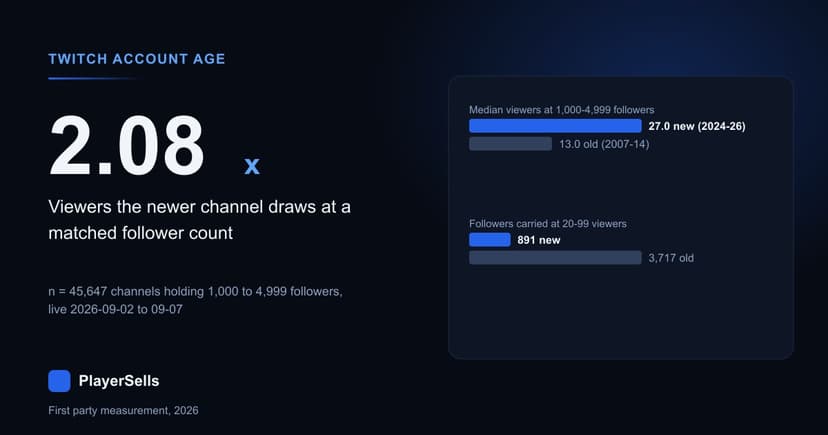
Does Twitch Account Age Still Matter? We Measured 432,192
Across 432,192 Twitch channels read on 2026-09-08, account age is almost pure accumulation, and at a matched follower count the newer channel wins.
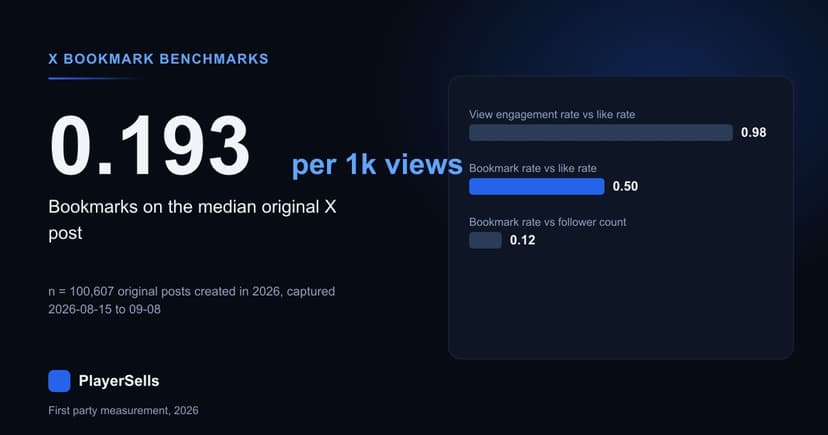
X Bookmark Rate Benchmarks From 94,318 Scored Accounts
Half the X accounts we scored on ten or more posts bookmark under 0.0273% of their views, and a third of original posts get no bookmarks at all.