Do Twitch Followers Matter? We Measured 145,714 Channels
Follower count explains 62.3% of Twitch viewer variance, yet channels with matched follower counts still differ 16.8x in concurrent viewers.

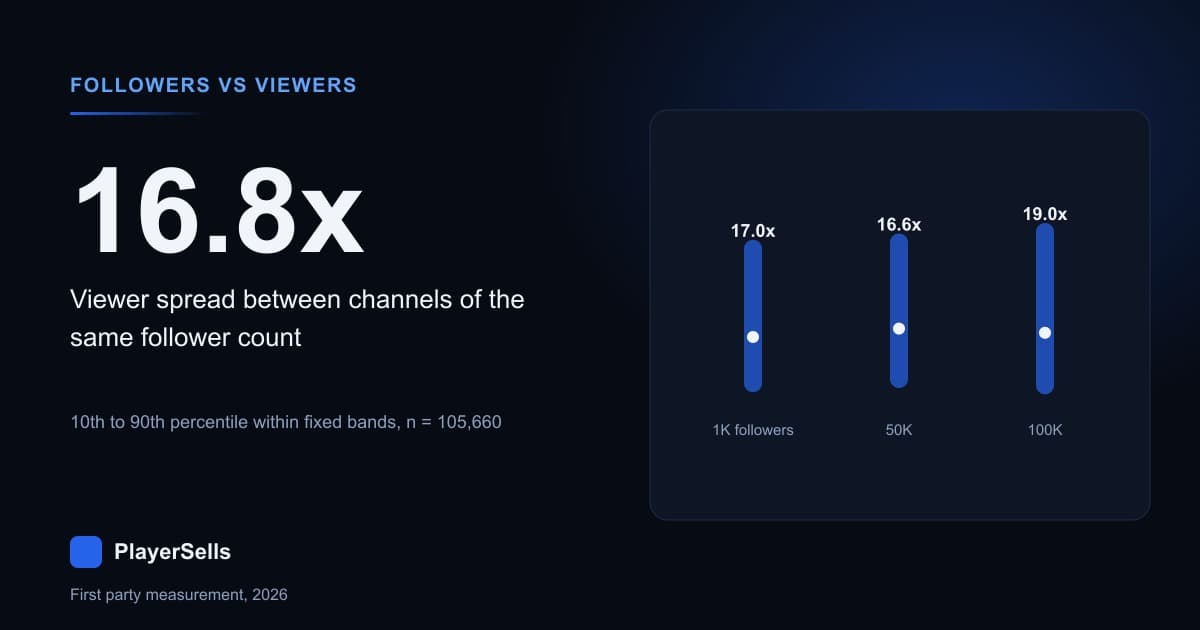
Follower count explains 62.3% of the variance in average concurrent viewers on Twitch, measured across 105,660 channels in our own directory on 2026-09-02, and 52.6% across 40,054 Kick channels. That sounds decisive until you hold followers still. Split the Twitch channels that have at least 1,000 followers into 40 narrow follower bins, each spanning only about 1.11x in follower count, and the median bin still shows a 16.8x gap between the 10th and the 90th percentile of concurrent viewers. On Kick the same test gives 38.1x. Two channels with the same follower count are not two channels with the same audience.
So do Twitch followers matter? They matter as a rank and not as a price. The Spearman rank correlation between followers and average concurrent viewers is 0.755 on Twitch and 0.698 on Kick. We worked on ranks and in logs because both variables are heavy tailed: the raw Pearson figure on Twitch is 0.558. Every number here comes from our own 15 minute sampling of both live directories across two days, 2026-09-01 and 2026-09-02, the entire life of both engines. Our viewer field carries a 30d suffix but holds those two days only, so nothing here is a 30 day average and we make no growth claim.
How much does follower count actually predict?
We ran the correlation several ways per platform, because where you put the floor changes the answer. Across every Twitch channel with a positive viewer reading and a non zero follower count, the rank correlation is 0.755. Restrict to channels with at least 1,000 followers, roughly the smallest anyone bothers to list for sale, and it falls to 0.682 with 51.7% of variance explained. Kick falls harder, to 0.514 and 32.2%. The tradeable range is where followers explain least. Kick's rows also carry a selection problem we correct further down.
This table reports the rank correlation, the log to log explained variance, and the viewer multiple associated with a tenfold rise in followers, for each sample cut we measured on 2026-09-02.
| Platform and cut | Channels | Spearman rho | Log-log R-squared | Viewers per 10x followers |
|---|---|---|---|---|
| Twitch, all with followers above 0 | 105,660 | 0.755 | 62.3% | 3.2x |
| Twitch, 100+ followers | 69,458 | 0.701 | 59.8% | 4.7x |
| Twitch, 1,000+ followers | 30,388 | 0.682 | 51.7% | 5.3x |
| Kick, all with followers above 0 | 40,054 | 0.698 | 52.6% | 3.4x |
| Kick, 100+ followers | 21,063 | 0.661 | 47.8% | 7.1x |
| Kick, 1,000+ followers | 9,282 | 0.514 | 32.2% | 7.0x |
| Twitch, 11+ average viewers, selection free | 34,186 | 0.697 | 53.5% | 2.9x |
| Kick, 11+ average viewers, selection free | 13,292 | 0.495 | 26.4% | 2.3x |
The slope moves in the opposite direction to the correlation, which is a warning about the full sample figure. Over the whole range, ten times the followers is associated with 3.2x the viewers on Twitch. Above 1,000 followers it is 5.3x. The full range slope is flattened by channels under 100 followers, where our viewer average is stored as an integer and cannot sit below 1. We rejected 3.2x as the headline for that reason and use the restricted slope for anything a buyer would act on.
The final two rows are the fair fight. Restricting both platforms to channels averaging 11 or more viewers, the only range where our Kick follower coverage is complete, follower count explains 53.5% of the variance on Twitch across 34,186 channels and 26.4% on Kick across 13,292. A Kick follower count carries about half the information.
What happens when you hold follower count still?
Correlation is the wrong tool for a purchase decision. A buyer is not choosing between a 1,000 follower channel and a 500,000 follower channel. A buyer has one channel with a stated follower count and wants to know what audience that number buys. So we pinned follower count to within 5% of five round levels and measured the spread inside each window.
These are average concurrent viewers for channels whose follower counts sit within 5% of the stated level, measured on 2026-09-02.
| Platform and follower level | Channels | 10th pct CCV | Median CCV | 90th pct CCV | P90 over P10 |
|---|---|---|---|---|---|
| Twitch, 1,000 | 1,485 | 2 | 11 | 34 | 17.0x |
| Twitch, 5,000 | 666 | 7 | 35 | 115 | 16.4x |
| Twitch, 10,000 | 496 | 12 | 57 | 200 | 16.7x |
| Twitch, 50,000 | 230 | 37 | 184 | 614 | 16.6x |
| Twitch, 100,000 | 187 | 55 | 249 | 1,043 | 19.0x |
| Kick, 1,000 | 445 | 2 | 16 | 199 | 99.5x |
| Kick, 5,000 | 308 | 16 | 109 | 659 | 41.2x |
| Kick, 10,000 | 190 | 17 | 164 | 906 | 53.3x |
| Kick, 50,000 | 50 | 105 | 583 | 2,900 | 27.6x |
The Twitch result is the striking one. The spread is almost identical at every size: 17.0x at 1,000 followers, 16.6x at 50,000, 19.0x at 100,000. Follower count does not become a better predictor as a channel grows. We re-ran the question with a different method, the 40 narrow bins above, and got 16.8x on Twitch and 38.1x on Kick. Two formulations agree, which is why we publish it.
How often does the smaller channel actually win?
The percentile spread is abstract, so we measured the head to head version. Take a Twitch channel with 1,000 to 4,999 followers and one with 10,000 to 49,999, roughly ten times more, and compare their viewers. Across all 16,673 by 5,827 pairings, computed by rank sum, the smaller channel wins 14.9% of the time. On Kick, across 5,779 by 1,633 channels, it wins 20.1%.
Paying a tenfold follower premium therefore buys the losing side of the viewer comparison once in roughly seven Twitch deals and once in five Kick deals. That is not a tail risk. It is the routine outcome of pricing a stream on accumulated clicks rather than current attention. The Twitch channel value estimator and the Kick channel value estimator both take viewers as an input for that reason.
The follower ladder and the viewer ladder are different ladders
Set out the full band structure and the mismatch is obvious. Median viewers rise steadily with followers on both platforms, but the spread inside every band swallows the gap to the next one. On Twitch the 75th percentile of the 1,000 to 4,999 follower band, at 35 viewers, sits below the median of the 5,000 to 9,999 band, at 46, and far below that band's 75th percentile of 92.
Average concurrent viewers by follower band, for the 105,660 Twitch and 40,054 Kick channels in our sample carrying both a follower count and a positive viewer reading.
| Follower band | Twitch n | Twitch median CCV | Twitch P90 CCV | Kick n | Kick median CCV | Kick P90 CCV |
|---|---|---|---|---|---|---|
| Under 100 | 36,202 | 2 | 5 | 18,991 | 2 | 6 |
| 100 to 499 | 28,199 | 4 | 14 | 8,498 | 4 | 54 |
| 500 to 999 | 10,871 | 8 | 28 | 3,283 | 13 | 155 |
| 1,000 to 4,999 | 16,673 | 17 | 70 | 5,777 | 45 | 296 |
| 5,000 to 9,999 | 4,023 | 46 | 162 | 1,476 | 123 | 687 |
| 10,000 to 49,999 | 5,827 | 96 | 385 | 1,633 | 268 | 1,332 |
| 50,000 to 99,999 | 1,519 | 221 | 837 | 211 | 810 | 3,195 |
| 100,000 to 999,999 | 2,140 | 524 | 2,360 | 177 | 2,697 | 12,725 |
| 1,000,000 and above | 206 | 2,524 | 15,677 | 8 | n too small | n too small |
Kick's median viewer count runs 1.6 to 5.1 times above Twitch's in every follower band from 500 upward, which reads at first like Kick channels being stronger. Read it the other way. A Kick follower is a younger, less accumulated unit, so it takes fewer of them to produce one viewer. Set our ranked Twitch channel directory beside our ranked Kick channel directory and the same channel size means different things.
Why does a follower buy fewer viewers as a channel grows?
Because followers accumulate and viewers do not. Dividing one by the other gives a decay curve, steep on Twitch and nearly flat on Kick. A Twitch channel in the 100 to 999 follower band converts a median 16.89 viewers per 1,000 followers. Above one million followers it converts 1.37. That is a 12.3x collapse in what a follower is worth as a proxy for live audience, across 39,070 and 206 channels.
Median concurrent viewers per 1,000 followers, by follower band, measured 2026-09-02.
| Follower band | Twitch n | Twitch viewers per 1,000 followers | Kick n | Kick viewers per 1,000 followers |
|---|---|---|---|---|
| Under 100 | 36,205 | 90.91 | 18,991 | 166.67 |
| 100 to 999 | 39,070 | 16.89 | 11,781 | 19.38 |
| 1,000 to 9,999 | 20,696 | 8.36 | 7,253 | 19.35 |
| 10,000 to 99,999 | 7,346 | 4.49 | 1,844 | 13.76 |
| 100,000 to 999,999 | 2,140 | 2.36 | 177 | 13.95 |
| 1,000,000 and above | 206 | 1.37 | 8 | n too small |
The under 100 row in both columns is an artifact of integer rounding, not a finding: one viewer on a 25 follower channel yields 40 viewers per 1,000 by arithmetic alone. Ignore it. From 100 followers upward the Twitch curve drops 12.3x while Kick's drops 1.4x, from 19.38 to 13.95. Kick's follower bases have not had time to go stale. Twitch's have.
Does an older channel's follower count mean less?
Yes, and the effect is measurable. Holding log follower count constant, the partial correlation between log account age and log viewers on Twitch is -0.228 across 105,663 channels. Older channels get fewer viewers per follower. Adding age to a model already containing follower count lifts explained variance from 62.3% to 64.2%. Twitch publishes a creation date on every channel object, so this costs a buyer nothing to check.
Our first cut used a wide 1,000 to 99,999 follower band and produced a 2.66x gap between oldest and newest cohort. That was partly a size confound: older cohorts sat higher in the band, a median 5,999 followers against 2,578. Re-run inside two narrow bands where cohort median followers match to within 7%, the effect shrinks and survives.
Median concurrent viewers per 1,000 followers by Twitch account creation cohort, inside two follower bands where the cohorts hold near identical median follower counts.
| Creation cohort | 1,000 to 4,999 followers: n | Viewers per 1,000 | 10,000 to 49,999 followers: n | Viewers per 1,000 |
|---|---|---|---|---|
| 2007 to 2015 | 4,151 | 7.19 | 1,966 | 3.89 |
| 2016 to 2018 | 4,298 | 7.92 | 1,665 | 4.73 |
| 2019 to 2021 | 4,873 | 8.96 | 1,431 | 5.26 |
| 2022 to 2026 | 3,351 | 12.84 | 765 | 7.91 |
The controlled gap is 1.79x in the smaller band and 2.03x in the larger, monotonic in both. A 20,000 follower Twitch channel created in 2023 is associated with roughly twice the viewers of a 20,000 follower channel created in 2014. Both sellers quote the same follower number. Only one sells an audience that still turns up, the streaming version of a mismatch we have measured elsewhere, where a legacy badge is priced above what it delivers.
Is the spread real, or is it our own measurement noise?
This is the objection that could have killed the article. We sample each live directory every 15 minutes, and the median channel appears in only 7 sweeps, about 1.75 hours of observed airtime. An average built from 7 readings is noisy, and noise inflates within band spread. If most of the 16.8x gap were sampling error, the conclusion would be worthless.
We tested it with a split half. For every channel observed live on both 2026-09-01 and 2026-09-02, we compared day one's average against day two's, then compared follower count against that same day two average. If our measurement were mostly noise, day one would fail to predict day two.
| Predictor of day two average CCV | Twitch n | Twitch Spearman | Twitch log R-squared | Kick n | Kick Spearman | Kick log R-squared |
|---|---|---|---|---|---|---|
| Day one average CCV | 20,095 | 0.951 | 93.0% | 13,486 | 0.888 | 88.1% |
| Follower count | 20,095 | 0.796 | 67.0% | 13,486 | 0.709 | 52.4% |
Yesterday's viewer number predicts today's at a rank correlation of 0.951 on Twitch, leaving 7.0% of log variance unexplained. Follower count leaves 33.0% on the same 20,095 channels. The measurement is stable, so the spread belongs to the channels, not our crawler. One day of viewer data beats a follower count accumulated over as much as nineteen years.
Does Kick's missing follower data break the comparison?
It bends it, upward, and the bend is measurable. Kick's live directory endpoint returns a partial channel object with no follower count, so 63.6% of our Kick directory carries a follower figure. That gap is not spread evenly. Coverage is a step function of viewer size: 52.8% of channels averaging 1 to 2 viewers have a follower count, against 100% of channels averaging 11 to 50. The missing rows are precisely the rows where last_full_fetch is null, and the match is near exact, with only 21 exceptions across 64,621 channels.
Kick follower coverage by average concurrent viewer band, across the 64,621 Kick channels with a positive viewer reading on 2026-09-02.
| Average viewers | Channels | With a follower count | Coverage |
|---|---|---|---|
| 1 to 2 | 36,877 | 19,461 | 52.8% |
| 3 to 5 | 10,034 | 5,383 | 53.6% |
| 6 to 10 | 4,368 | 3,619 | 82.9% |
| 11 to 50 | 5,486 | 5,486 | 100.0% |
| 51 to 200 | 4,570 | 4,565 | 99.9% |
| Above 200 | 3,286 | 3,266 | 99.4% |
A correlation on that subset drops the noisiest corner of the scatter, so it flatters follower count. We sized the effect using Twitch as a control, since Twitch coverage is effectively complete. Imposing Kick's band by band retention rates on the 105,663 Twitch channels leaves 76,555 and moves Spearman from 0.755 to 0.799, explained variance from 62.3% to 65.6%, and median followers from 260 to 450, an inflation of 1.73x.
Two conclusions follow. Any Kick statistic taken from the fully fetched subset alone overstates, a median follower count by roughly 1.7x. And the honest comparison is the one restricted to channels averaging 11 or more viewers, where coverage is 99.4% or better on both sides: 53.5% of variance explained on Twitch against 26.4% on Kick.
What this measurement cannot see
Two further limits. Both engines went live on 2026-09-01, so our viewer field sums two days of sampling, 2026-09-01 12:57 UTC to 2026-09-02 15:10 UTC. We verified that rather than trusting the column name: recomputing the field from our daily sample rows reproduces the stored value at a correlation of 1.0000 across all 107,014 Twitch channels carrying one, every channel within a viewer. No growth or churn claim is possible from a window this short, and we make none.
The second limit matters more. Every channel here went live during our sweep window, because that is how the directory discovers channels at all. We cannot measure a channel with 200,000 followers that has not streamed in a year, and those are exactly where followers predict viewers worst. Our correlations are a ceiling, not an estimate. The share of directory channels never seen live is fairly flat across follower bands, 12.7% to 17.3%, rising to 25.9% above one million followers.
Airtime does not explain the leftover variance. Holding follower count constant, the partial correlation between log hours streamed and log viewers is 0.053, lifting explained variance from 62.28% to 62.39%. Twitch programme status does far better. Inside a matched 1,000 to 4,999 follower band, partner channels returned a median 20.54 viewers per 1,000 followers across 1,489 channels, affiliates 8.23 across 14,580, and channels in neither 4.25 across 604. We stop short of a general rule: in the 10,000 to 49,999 band the 189 channels in neither programme invert the order at a median 188 viewers, which we cannot yet explain.
How should a buyer price a streaming channel instead?
Ask for viewers, verified over time, and treat followers as a sanity check rather than the reverse. A seller showing two weeks of consistent viewer readings has handed over the variable with a 0.951 day to day rank correlation. A seller leading with follower count has handed over one that leaves a 16.8x range on the table at every size we measured.
Three checks follow. Compare the channel's viewers per 1,000 followers against the band medians here: a Twitch channel at 20,000 followers converting 1.0 sits under a quarter of the 4.49 band median. Check the creation date, since the 2022 to 2026 cohort delivers about twice the viewers per follower of the pre 2016 cohort at matched size. Then place the follower number against the wider population with our Twitch follower rank tool.
None of that gives you a price, and this article quotes none. It tells you which number to negotiate on. Listings sit in our account marketplace, and the pages for buying a Twitch channel and buying a Kick channel set out what transfers, a separate risk from what the audience is worth.
Common questions about followers and concurrent viewers
Do Twitch followers matter at all?
They matter as a coarse rank. Across 105,660 Twitch channels measured on 2026-09-02 the Spearman correlation between followers and average concurrent viewers is 0.755, so larger follower counts do go with larger audiences. What they cannot do is price a single channel: at any fixed follower count between 1,000 and 100,000, the 10th to 90th percentile viewer range spans about 17x.
How many followers do you need for a given viewer count on Twitch?
There is no fixed ratio, but the medians are usable. In our 2026-09-02 sample the median Twitch channel with 1,000 to 4,999 followers averaged 17 concurrent viewers, with 5,000 to 9,999 followers averaged 46, and with 10,000 to 49,999 followers averaged 96. Above 1,000 followers, a tenfold rise in followers is associated with about 5.3x the viewers, not ten times.
Why do Kick channels show more viewers per follower than Twitch channels?
Kick converts a median 19.38 viewers per 1,000 followers in the 100 to 999 band and 13.95 in the 100,000 to 999,999 band, a decline of only 1.4x across 11,781 and 177 channels. Twitch falls 12.3x across the same span, from 16.89 to 1.37. Kick launched recently, so its follower bases have had far less time to accumulate accounts that no longer watch.
Is average concurrent viewers a better buying signal than follower count?
Yes, by a wide margin in our data. Among 20,095 Twitch channels observed live on both 2026-09-01 and 2026-09-02, the previous day's average viewer count predicted the next day's with a rank correlation of 0.951 and left 7.0% of log variance unexplained. Follower count left 33.0% unexplained on the same channels, so it is the weaker of the two signals.
Does channel age change what a follower is worth?
It does. Holding follower count constant across 105,663 Twitch channels, the partial correlation between account age and concurrent viewers is -0.228. Inside a matched 10,000 to 49,999 follower band, channels created between 2022 and 2026 returned a median 7.91 viewers per 1,000 followers against 3.89 for channels created before 2016, a gap of 2.03x on 765 and 1,966 channels.
Can you trust Kick follower statistics?
Only with a correction. We hold a follower count for 63.6% of our Kick directory, and coverage is a step function of channel size: 52.8% of channels averaging 1 to 2 viewers against 100% of those averaging 11 to 50. Imposing that exact pattern on our fully covered Twitch sample inflates the median follower count by 1.73x and the rank correlation from 0.755 to 0.799, so any Kick figure taken from the covered subset alone reads too high.
How were these correlations calculated?
On ranks and in logs, never on raw values. Both follower count and concurrent viewers are heavy tailed, topping out at 85,044 average viewers on Twitch and 103,337 on Kick, so a raw Pearson correlation is dominated by a handful of channels. We report tie corrected Spearman rank correlations and ordinary least squares fits on natural logs, computed on 2026-09-02 across the samples named beside every figure.
Related Articles
Continue learning with these related guides.
Does Twitch Account Age Still Matter? We Measured 432,192
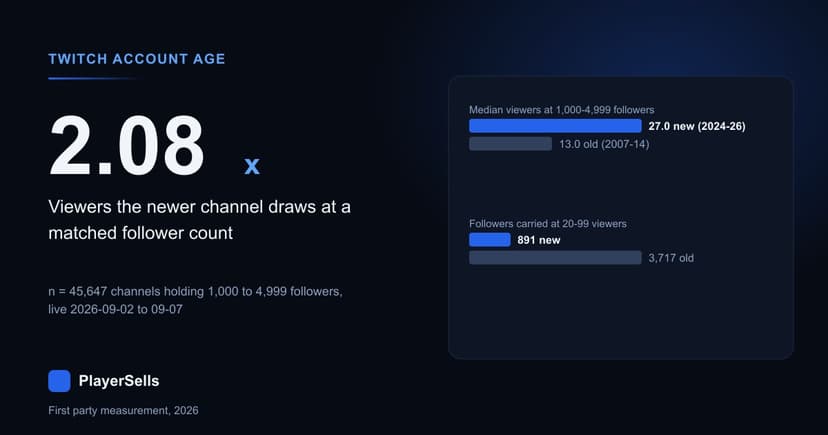
Across 432,192 Twitch channels read on 2026-09-08, account age is almost pure accumulation, and at a matched follower count the newer channel wins.
X Bookmark Rate Benchmarks From 94,318 Scored Accounts
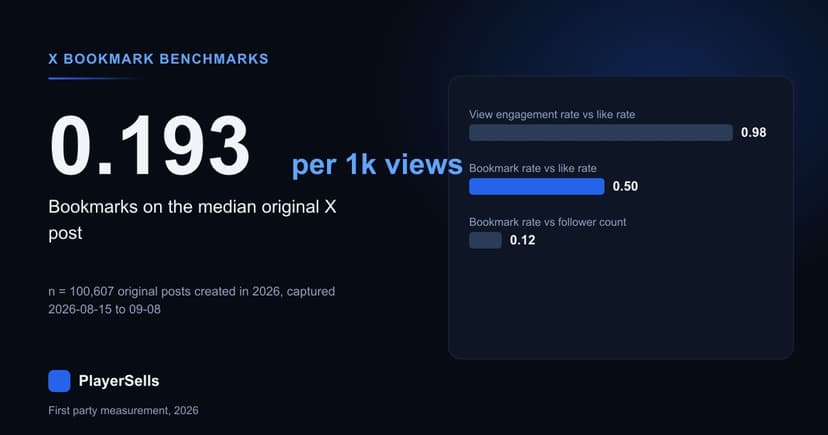
Half the X accounts we scored on ten or more posts bookmark under 0.0273% of their views, and a third of original posts get no bookmarks at all.