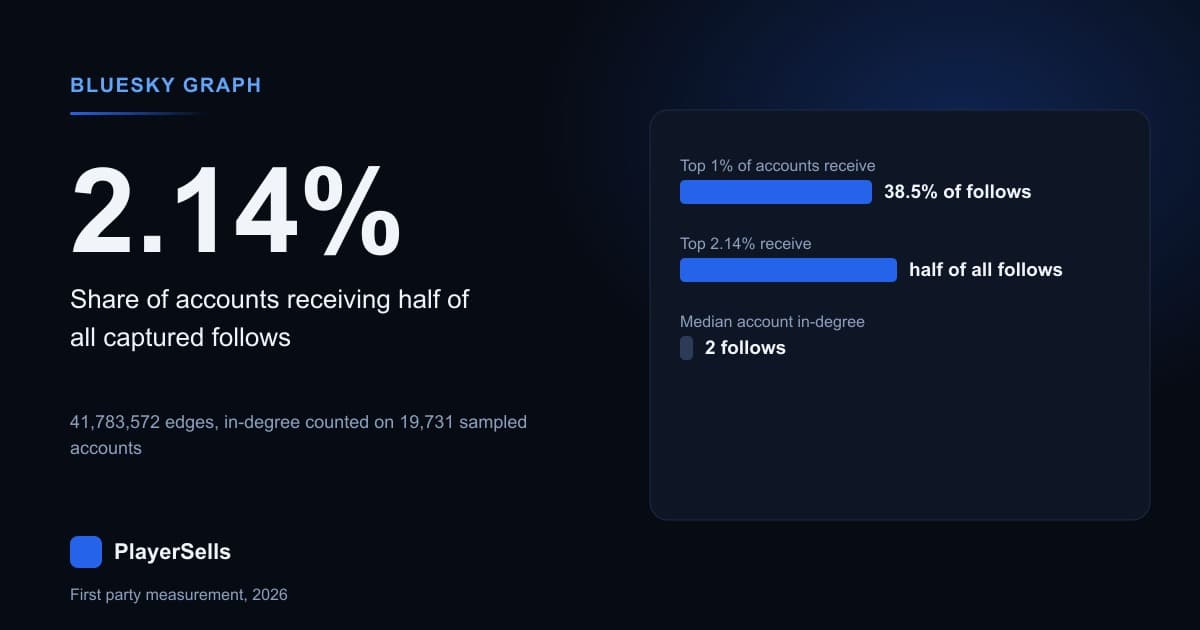
Our own crawl of Bluesky has stored 41,783,572 follow edges captured between 2026-06-10 and 2026-09-02, pointing at roughly 4.13 million discovered accounts, and the 2026 shape of that graph is severely top heavy: 2.14 percent of accounts receive half of every follow we captured, and the top 1 percent receive 38.45 percent of them. We measured that on a random sample of 19,731 accounts whose exact in-degree we counted one at a time against the edge table. The median account receives 2 captured follows. The 90th percentile receives 18.
The caveat arrives with the answer. This is not Bluesky's true follow graph, and no crawled graph ever is. It is a panel: we read the follow lists of roughly 459,000 accounts, we store at most 200 follows from each, and every edge in the table starts at one of them. Concentration measured on a panel can be the panel's shape rather than the network's. Most of the work below is testing that. The concentration survived. The out-degree side did not, so we do not report it as a finding at all.
What a network analysis of Bluesky can establish, and what it cannot
The table is bdir_account_edges. A 0.25 percent block sample returned 108,418 rows on the first pass and 108,411 minutes later, because the engine is still writing. Every row carries a single edge type, "follows". There is no reply graph, no like graph, no block graph. The weight column runs 1 to 4 and counts re-observations of the same pair, not tie strength: 78.88 percent of sampled edges have weight 1. The primary key is the source and target pair, so counting rows gives the correct in-degree and summing weight would not.
Two structural facts define the sampling frame, and they bound what any network analysis built on this table can establish. First, an account enters our directory only because somebody we crawled follows it. In two independent samples of 19,731 and 19,358 accounts, not one had an in-degree of zero and not one had a real follower count of zero. Second, we store a truncated slice of each crawled account's follow list, and the truncation is hard: across 19,731 sampled accounts the maximum stored out-degree is exactly 200, confirmed again on a second seed and on a third sample of 78,789 records.
Stored out-degree equals the smaller of the real following count and 200. Stephen King's account follows 3 accounts and we hold 3; Mark Hamill's follows 3,245 and we hold 200. For 94.6 percent of crawled accounts that ceiling binds, and the median crawled account has 10.2 percent of its real follow list in our table. Any claim we made from this table about how many accounts Bluesky users follow would be a claim about our crawler, so this analysis measures the inbound side only.
How concentrated is the Bluesky follow graph?
We counted exact in-degree for every account in a 0.5 percent sample, 19,731 accounts holding 217,456 captured in-edges between them, then repeated the procedure on a second independent sample of 19,358. The two runs agree to within four hundredths of a percentage point on the headline. This is the in-degree ladder, with the directory's real follower distribution beside it for scale.
| Percentile | Captured in-degree | Real followers at the same percentile |
|---|---|---|
| 50th | 2 | 135 |
| 75th | 5 | 412 |
| 90th | 18 | 1,232 |
| 99th | 154 | 9,404 |
| 99.9th | 806 | not measured |
| Maximum | 4,413 | 34,755,101 |
That right hand column comes from a separate 2 percent account sample of 79,023 records, not from a conversion of the middle one. The maximum belongs to the platform's own account, which new users are offered at signup, so read that row as infrastructure rather than as an audience. Turned into shares, the distribution is the familiar heavy tail, but the exact numbers are the point.
| Slice of accounts | Share of captured follows | Second sample, n=19,358 |
|---|---|---|
| Top 0.1% | 13.26% | 15.12% |
| Top 1% | 38.45% | 38.49% |
| Top 5% | 63.41% | 62.46% |
| Top 10% | 74.70% | 73.83% |
| Bottom 50% | 5.08% | 5.15% |
Half of all captured follows land on the top 2.14 percent of accounts, roughly one in 47. Eighty percent land on the top 13.93 percent. At the other end, 58.87 percent of accounts have a captured in-degree of 2 or less and share 6.63 percent of the follows. We re-ran the question as a threshold rather than a rank, the check that catches a broken percentile: accounts with in-degree of 154 or more are 1.008 percent of the sample and take 39.07 percent of edges, against 38.45 percent from the rank method. The formulations agree.
Could our own crawler have manufactured this concentration?
This is the question that should kill most crawled-graph findings, so we tested it three ways before keeping the number. The first test is whether our capture rate drifts with account size. If we captured a larger slice of big accounts' follower lists than of small ones, the concentration would be manufactured. It does not drift.
| Real follower band | Accounts sampled | Median captured share of followers | Median captured in-degree |
|---|---|---|---|
| Under 100 | 7,002 | 3.85% | 1 |
| 100 to 999 | 7,259 | 1.11% | 3 |
| 1,000 to 9,999 | 1,712 | 1.05% | 21 |
| 10,000 to 99,999 | 145 | 1.15% | 225 |
| 100,000 and above | 4 | 1.28% | 1,806 |
Between 100 and 100,000 real followers, measured across 16,122 sampled accounts, our panel holds 1.05 to 1.15 percent of a follower list regardless of size. The 3.85 percent in the smallest band is arithmetic, not bias: one captured follow against a median of 37 real followers cannot land lower. A proportional sample is what makes a ranking by captured in-degree a fair proxy for a ranking by real followers. The second test is internal consistency, and across those 16,122 accounts captured in-degree never once exceeds the real follower count.
The third test is the one a panel is genuinely vulnerable to. Our crawl frontier is prominence driven: crawled accounts hold a median of 2,098 real followers against 105 for accounts we have only seen as a target, and in a random draw of 400 crawled accounts not one had fewer than 500 followers. If large accounts feed the edge table and large accounts follow large accounts, the concentration could be theirs rather than the network's. So we split the sources by size.
| Source account size | Sources | Edges | Follows sent to 10,000+ accounts | Follows sent to sub-1,000 accounts |
|---|---|---|---|---|
| 500 to 5,000 followers | 334 | 29,313 | 28.64% | 31.98% |
| 5,000 followers and above | 66 | 7,469 | 37.85% | 19.41% |
Larger sources do point further up, by about nine percentage points, so part of the tilt is ours. But the smaller half of the panel still sends 28.64 percent of its follows to accounts holding 10,000 or more followers, and those are 0.93 percent of the directory: roughly a 31x over-representation, produced by the least prominence-biased accounts we can observe. The concentration is attenuated by the panel, not created by it. We cannot observe sources under 500 followers at all, so the true network figure is most likely somewhat below 38.45 percent.
How big is the account a typical Bluesky follow points at?
Sampled from 400 randomly drawn crawled accounts and the 38,087 follows they made, the median captured follow points at an account with 3,404 real followers. The median account in our directory of 4.13 million Bluesky records has 135. A follow on Bluesky travels about 25 times up the size ladder from the typical account, which is the concentration table restated in a form a seller can price.
| Target of a captured follow | Share of the 38,087 follows | Share of directory accounts |
|---|---|---|
| Under 1,000 followers | 29.44% | 87.85% |
| 10,000 or more followers | 31.69% | 0.93% |
| 100,000 or more followers | 4.36% | 0.02% |
| Flagged verified | 7.66% | 0.23% |
The verified row is the sharpest of the four. Accounts flagged verified are 0.227 percent of a 78,789 record sample, carry a median captured in-degree of 124 against 2 for the directory, and absorb 7.66 percent of captured follows. Two independent estimates, one edge weighted and one account weighted, put that share at 7.66 and 8.17 percent. The flag is associated with an order-of-magnitude difference in inbound attention, though nothing here establishes which came first. Our write-up on what verification is actually worth when you buy an account takes that apart, and the Bluesky follower rank tool places a handle against the directory.
Does anyone actually follow back on Bluesky?
Reciprocity is the hardest thing to measure on a crawled graph. A reverse edge can appear only if the target is itself a crawled account, true for 72.38 percent of captured follows, and only if the follow back sits inside the 200 rows we captured from that target. Both conditions push any observed rate down, so every figure below is a floor rather than an estimate of Bluesky.
| Measurement condition | Edges examined | Reciprocated |
|---|---|---|
| All captured follows | 11,742 | 5.90% |
| Target is itself a crawled account | 8,499 | 8.10% |
| Target's complete follow list is held | 4,903 | 8.71% |
The third row has no truncation in it: those 4,903 follows point at accounts following fewer than 200 others, so we hold their complete lists and see every follow back they made. Only 8.71 percent came back. Those targets follow a median of 64 accounts, which is the mechanical explanation. An account that follows 64 people cannot reciprocate the several hundred follows it receives, however willing it is. We are not publishing a reciprocity rate for Bluesky, because we cannot measure one. We publish three conditioned floors and the reason each is a floor.
Is a Bluesky follower worth more or less than an X follower?
Not in reach terms, because reach is not in this dataset. A follow graph records who subscribed, never who saw a post, and converting one into the other without impression data is guesswork. What we can compare honestly is scarcity, using the follower distribution measured across 79,023 sampled Bluesky accounts on 2026-09-02 against the figures published in our X follower count benchmarks measured across 17.6 million accounts on 2026-07-31.
| Threshold | Share of Bluesky directory | Share of X directory | Rarer on Bluesky by |
|---|---|---|---|
| Under 1,000 followers | 87.85% | 61.1% | more common |
| 10,000 or more | 0.93% | 8.05% | 8.7x |
| 100,000 or more | 0.024% | 0.90% | 37.5x |
| 1,000,000 or more | 0.0025% | 0.07% | 28x |
A 10,000 follower Bluesky account sits in the top 0.93 percent of our Bluesky directory. The same count on X sits in the top 8.05 percent of our X directory. Those two directories are built by different discovery methods and are not the same instrument, so read the direction rather than the ratio. The direction is conservative: our Bluesky frame requires an account to have been followed by somebody we crawled, which should bias it toward larger accounts, and it still shows far more small accounts than the X index does.
Size on Bluesky is therefore scarcer while the ceiling is much lower, and the network is young: account creation dates in our sample run from 2023-01-24 to 2026-08-31. Whether the platform is worth buying into at all is answered separately in our measurement of whether Bluesky is dead, taken on accounts rather than app sessions.
What our X follow graph can and cannot be compared against
We set out to say whether Bluesky's network is more or less concentrated than the X follow graph we published earlier, and the honest answer is that the published work does not support that comparison yet. Our article on audience overlap measured across 81 million follows reports 81,731,840 stored X follow relationships captured between 2026-06-09 and 2026-08-29, and it measures overlap between pairs of target audiences. It publishes no in-degree concentration figure, and deriving one here would mean a fresh full pass over an 83 million row table.
What the two datasets do share is architecture, which changes how both should be read. The X article describes its data as a fixed panel of roughly a hundred thousand accounts, and reports that captured follows plateau at a median of roughly 203 to 217 per account no matter how many the account really follows. Our Bluesky engine hits the same wall at 200, over a nearly identical window. Two platforms, one crawler design, the same ceiling. Any concentration comparison between them needs the same estimator on both sides first.
What does this mean if you are buying or selling a Bluesky account?
Rank is the number to ask about, not follower count in isolation. Because our capture rate is flat at roughly 1.1 percent between 100 and 100,000 real followers, an account's position in our directory is a stable ranking. An account with 1,866 real followers sits at a median captured in-degree of 21; one with 15,839 sits at 225. If a listing's follower count implies a rank the account does not hold, the follower base is not distributed the way an organic one is.
The top of Bluesky is also genuinely thin. Only 0.93 percent of accounts in our directory have crossed 10,000 followers and 0.024 percent have crossed 100,000. Small supply supports price, and it means comparable sales are rare enough that one listing can move an entire tier. When a Bluesky account appears alongside the X, TikTok and Telegram inventory on our live marketplace listings, there is very little to price it against.
A stored follow is also not evidence of an active audience. Almost two thirds of the edges we hold, 62.1 percent, were last confirmed in June 2026, against 30.1 percent in August and 0.05 percent in the first days of September. A follow recorded in June and never re-verified may already have been undone.
Expect a buyer to check numbers live rather than from any directory snapshot, and if you are listing an account for sale, pull fresh figures on the day. The same discipline applies on X, where the audience overlap tool exists because raw follower counts hide who the audience is. For the commercial picture, our piece on Bluesky accounts by the numbers and whether you can sell one covers what these accounts trade for, and the Bluesky directory of top accounts shows the head of this distribution.
What we measured and refused to publish
Out-degree was the first casualty. The distribution looks like a real result, with a median of 96 and a 99th percentile of 198, and it is entirely our crawler: the ceiling is 200 and 94.6 percent of crawled accounts are truncated by it. Second, the apparent sparsity of the target side. In a 400 source slice, 30,659 of 33,559 distinct targets appeared exactly once and the top 100 targets took only 2.15 percent of edges, which reads as low concentration and is an artifact of examining 38,087 edges out of 41.8 million.
Third, the tier column, which holds A, B and C and looks like an independent quality grade. It is not. In our sample the 5 tier A accounts are exactly the 5 above 100,000 followers, and the 183 tier B accounts are exactly the 183 between 10,000 and 100,000, so tier is follower count rebinned. Fourth, a corrected reciprocity estimate: we could divide the observed 5.90 percent by an estimated observation ceiling and publish something near 39 percent, but that inversion assumes the 200 follows we capture are a random slice of each list, and they are not.
Two columns are dead, and we name them so nobody quotes them from this table: country was NULL on all 19,731 sampled accounts, and status holds the single value "active" across every sample we drew. Category is populated on 18.96 percent of accounts and language on 71.5 percent, enough to filter with and not enough to publish a distribution from.
Common questions about the Bluesky follow graph
These come up whenever we publish graph measurements. Each answer below is bounded by what this dataset can support, which on a crawled follow graph is a narrower set of questions than most readers expect, so the limits are stated alongside the numbers rather than buried under them.
How many Bluesky follow connections do you actually hold?
41,783,572 stored follow edges as of 2026-09-02, taken from the table's row estimate rather than a full count, which is not something we run on a 16 GB table on a production cluster. They point at approximately 4.13 million discovered accounts and were captured between 2026-06-10 and 2026-09-02. Every edge carries the single type "follows", so no reply, like or block data is mixed in.
Is 38.45 percent concentration high compared with other social networks?
It is high in absolute terms, since one percent of accounts taking 38.45 percent of all captured follows means half of everything lands on 2.14 percent of accounts. We are not comparing it to X here, because our published X follow graph article measures audience overlap rather than in-degree concentration, and re-deriving an X figure would need a fresh pass over 83 million rows.
Why is the median in-degree only 2?
Because we capture roughly 1.1 percent of any account's real follower list, and the median account in our directory has 135 real followers. One percent of 135 is close to 1, so a median captured in-degree of 2 is what a proportional sample of a small audience looks like. It is a scaled measurement, not a claim that the median Bluesky account has two followers.
Can I use captured in-degree to value a Bluesky account?
As a ranking, yes, because the capture rate is flat between 100 and 100,000 real followers at 1.05 to 1.15 percent across 16,122 sampled accounts. As an absolute audience number, no. Multiply it back up and you recover the follower count you already had, with sampling error added. Its real use is checking whether a listed follower count sits where an organic account of that size should sit.
Does a big Bluesky account follow back?
Rarely, on the evidence we can see. Where we hold a target's complete follow list, 8.71 percent of 4,903 captured follows were reciprocated, and those targets follow a median of 64 accounts. Across all 11,742 edges in the broader test the observed rate is 5.90 percent. All three conditioned measurements are floors, because a follow back is visible only when the target is crawled.
How current is this data?
Mixed, and that is the honest answer. 62.1 percent of sampled edges were last confirmed in June 2026, 7.7 percent in July, 30.1 percent in August and 0.05 percent in September. The graph is a June to September composite rather than a single snapshot, so a follow that has since been undone can still be sitting in the table. Verify a specific account live before you pay for it.
Related Articles
Continue learning with these related guides.
Does Twitch Account Age Still Matter? We Measured 432,192
Across 432,192 Twitch channels read on 2026-09-08, account age is almost pure accumulation, and at a matched follower count the newer channel wins.
X Bookmark Rate Benchmarks From 94,318 Scored Accounts
Half the X accounts we scored on ten or more posts bookmark under 0.0273% of their views, and a third of original posts get no bookmarks at all.