

Bluesky Account Statistics 2026: 3.9 Million Accounts, and Whether You Can Actually Sell One
Bluesky account statistics from an index of 3,927,915 accounts: follower tiers, cohort decay, custom domain handles, and whether selling one is allowed.
This article does two things. It publishes Bluesky account statistics drawn from an index of 3,927,915 accounts and 37,997,680 follow edges, which is the largest cut of Bluesky follower data we are aware of anyone releasing publicly. And it answers the question that brings most people here: can you sell a Bluesky account? The short version is that Bluesky's Community Guidelines ban account selling in named terms, more explicitly than any other major platform's rules, while the underlying AT Protocol makes one specific piece of a Bluesky identity, the custom domain handle, more genuinely transferable than any handle anywhere else. Both are true at once, and the rest of this piece is about holding them together without fooling yourself.
The headline numbers before the evidence. 3,311,696 of the accounts we index sit below 1,000 followers. Only 937 are above 100,000, which makes a six-figure Bluesky following roughly 36 times rarer, as a share of the indexed population, than a six-figure X following in our X sample. 2,095,736 indexed accounts were created in 2024, more than the 2023, 2025 and 2026 cohorts combined, and median follower count roughly halves with every successive signup year: 263 for 2023, 139 for 2024, 65 for 2025, 26 for 2026. And 165,058 accounts, 4.4 percent of the panel, use a custom domain handle rather than the default .bsky.social. Those accounts carry roughly double the median follower count and are about 13 times more likely to carry a verification badge.
Bluesky account statistics from an index of 3,927,915 accounts
Bluesky is the least measured large social network in existence. That sounds odd for a platform that publishes an open firehose of every public record, but it follows from the openness. Because anyone can crawl the network, no single crawl is authoritative, and because Bluesky publishes registered-user totals rather than a regular active-user report, the daily-active figures circulating on the open web come from third-party trackers that disagree with each other by more than a factor of two. There is no daily active user number for Bluesky anywhere in this article, because we do not have one we can defend.
What Bluesky says about itself is worth anchoring to. In its Series B announcement the company stated the network grew "from 13 million to over 43 million global users" since its October 2024 Series A, and that the wider network it calls the Atmosphere holds roughly 20 billion public records. Those are registered accounts and stored records, not people logging in daily. Treat them as the ceiling of the addressable population, not as the audience.
Against that ceiling, our index of 3,927,915 accounts is roughly 9 percent of Bluesky's stated registered base: a large panel for this kind of work and enough for stable percentile and cohort estimates, but a panel and not a census. Everything below describes what the panel shows, not what Bluesky is. It feeds the public Bluesky directory, where the same data is browsable account by account rather than in aggregate.
How we built this panel, and what it cannot tell you
The Bluesky index was assembled from two sources: the AT Protocol firehose, which streams public repository commits across the network, and follow-graph crawling, which walks outward from known accounts along their follow edges. At the 2026-07-31 snapshot the index held 3,927,915 accounts and 37,997,680 follow edges. Every figure here carries that date. Bluesky moves fast enough that a snapshot six months old would be misleading on cohort composition and badly wrong on the 2026 cohort.
Three limitations follow from the method, and you should hold all three while reading.
First, this is a crawl panel, not a random sample. Follow-graph crawling reaches accounts through their edges. An account never followed by anyone in the crawl frontier and never surfaced on the firehose is the hardest kind to reach, so the panel almost certainly under-represents the most dormant tail: accounts registered during a signup wave, never used, never followed. Since those would nearly all sit at zero or single-digit followers, their absence pushes every median in this article upward. Read every median here as an upper bound on the true platform-wide figure.
Second, the index stores follower count, follow count and post count. It does not store likes, reposts, replies, impressions or any other engagement measure. There is therefore no engagement rate anywhere in this article and there will not be one. Where we compare Bluesky to X, Telegram or TikTok, the comparison is on audience size and structure only. Anyone quoting you a Bluesky engagement rate should be asked where the denominator came from.
Third, coverage of derived fields is partial. 3,759,140 accounts carry a usable follower and following count and 3,756,940 a resolvable creation year, so the tier and cohort tables cover about 95.6 percent of the index. Category classification is thinner: 856,385 accounts, 21.8 percent of the index, carry a category label, and the category table below is a cut of that classified subset only.
Where this article compares Bluesky to X, the X figures come from a 2 percent sample of our 17,639,527-account X index, roughly 350,000 accounts. That sampling note applies to every X number in this piece. Telegram and TikTok comparisons come from full-index cuts of 2,381,241 Telegram chats and 10,317 TikTok accounts.
Bluesky follower benchmarks: being big here is 36 times rarer than on X
Here is the distribution. The share columns compare the shape of Bluesky's audience pyramid against X's directly, which is what people are actually reaching for when they ask about Bluesky follower benchmarks.
| Follower tier | Bluesky accounts | Share of Bluesky panel | Share of X sample | Bluesky median posts |
|---|---|---|---|---|
| Under 1K | 3,311,696 | 88.10% | 61.09% | 27 |
| 1K to 5K | 364,003 | 9.68% | 25.20% | 323 |
| 5K to 10K | 48,062 | 1.28% | 5.66% | 716 |
| 10K to 50K | 32,456 | 0.86% | 6.18% | 1,444 |
| 50K to 100K | 1,986 | 0.053% | 0.98% | 3,207 |
| 100K and above | 937 | 0.025% | 0.90% | 2,602 |
The scarcity ladder is the finding. At every tier above 1,000 followers Bluesky is thinner than X, and the gap widens as you climb. At 1K to 5K, X is 2.6 times more densely populated. At 5K to 10K, 4.4 times. At 10K to 50K, 7.2 times. At 50K to 100K, 18.5 times. Above 100K, 36 times. In counting terms: roughly 1 in 111 accounts in our X sample sits above 100,000 followers, against roughly 1 in 4,012 in the Bluesky panel.
Two readings are available and only one is right. The wrong one is that Bluesky audiences are worthless because they are small. The right one is that follower count means something different on each platform and cannot be compared at face value. A 20,000-follower Bluesky account sits in the top 0.9 percent of the panel; a 20,000-follower X account sits in the top 8.1 percent of the X sample. Price the first as though it were the second and you have marked a top-1-percent asset as a top-8-percent one. The reverse error, waving away Bluesky counts as small numbers, is more common and equally wrong.
The posts column carries a quieter finding. Median lifetime posts for a sub-1K Bluesky account is 27 against a comparable X figure of 941, roughly 35 times higher. Bluesky's long tail is not merely smaller, it is dramatically less written-in: most of those 3.3 million accounts posted a handful of times and stopped. That is what a signup wave looks like when you index it two years later. Note too that median posts falls from 3,207 in the 50K to 100K tier to 2,602 above 100K, so volume does not keep rising at the very top the way it does on X, where the 1M+ tier still medians above 20,000 lifetime posts. The likeliest explanation is composition, since Bluesky's largest accounts disproportionately arrived with an audience built elsewhere, but we cannot prove that from the index and flag it as interpretation rather than result.
The 2024 land rush is over, and each cohort since is worth about half the last
Cohort data is where Bluesky's short history shows up most cleanly. 3,756,940 indexed accounts carry a resolvable creation year.
| Created | Accounts | Median followers | P90 followers | Median posts |
|---|---|---|---|---|
| 2022 | 46 | 787 | 34,228 | 208 |
| 2023 | 855,317 | 263 | 2,048 | 134 |
| 2024 | 2,095,736 | 139 | 1,146 | 36 |
| 2025 | 666,772 | 65 | 561 | 11 |
| 2026 | 139,069 | 26 | 214 | 7 |
2024 accounts for 55.8 percent of all dated accounts, 1.26 times the 2023, 2025 and 2026 cohorts combined. That single year is more than half the network we can see. It is the land rush, and it is over: the 2025 cohort is 68 percent smaller, and 2026, covering seven months at snapshot date, is running well below that again.
The median column should change how you value an account. 263, 139, 65, 26. Each step is roughly a halving and the halvings accelerate: 2024 is 53 percent of 2023, 2025 is 47 percent of 2024, 2026 is 40 percent of 2025. A median 2023 account has 10.1 times the followers of a median 2026 account, and the P90 column shows the same slope, 2,048 down to 214.
That is a steeper decay than X's cohort curve, where a 2009-vintage account medians 939 followers against 231 for a 2025 account, a gap of roughly 4 times spread over sixteen years. Bluesky compressed a wider gap into three. We cover the X version in detail in our X follower benchmarks study, and the contrast is the point: on X, age is a gradual premium accumulated over a decade and a half. On Bluesky it is a cliff.
What that means for a specific account
Creation year is the most informative field on a Bluesky profile after follower count, and it is free to check. An account created in 2023 with 300 followers is a median performer for its cohort. An account created in 2026 with 300 followers sits above the 90th percentile of its cohort. Those two look identical on a screenshot and are not the same asset: the 2026 account built its audience against a much harder network, without the discovery surge that carried 2023 and 2024.
The inverse matters more for buyers. A 2023 account at 300 followers has had three years to get there and has stalled, while its cohort peers with real momentum sit in the P90 band at 2,048. Read cohort position, not raw count. The posts column reinforces it: median lifetime posts for the 2024 cohort is 36 against 134 for 2023, so the base rate for a 2024-vintage account is close to dormant, and an active one is more unusual than its follower count suggests.
Only 4.4 percent of Bluesky accounts use a custom domain handle
This is the most original finding in the dataset and the one that connects the statistics to the transfer question. Bluesky handles are DNS hostnames. Most accounts take the default subdomain the service hands out. A minority set a domain they control instead.
| Handle type | Accounts | Median followers | P90 followers | Verification badge rate |
|---|---|---|---|---|
| Custom domain | 165,058 | 253 | 2,356 | 1.77% |
| Default .bsky.social | 3,594,082 | 131 | 1,155 | 0.13% |
165,058 of 3,759,140 accounts, 4.39 percent, run a custom domain handle. They carry 1.93 times the median follower count, 2.04 times the P90, and are 13.6 times more likely to hold a verification badge. None of those gaps is small enough to be noise at this sample size.
The second-order arithmetic is worth doing. Applying those badge rates to the two populations gives roughly 2,900 verified custom-domain accounts and roughly 4,700 verified default-handle accounts, about 7,600 badges across the panel, or around 0.2 percent of it. So although a custom-domain account is 13.6 times more likely to be verified, custom-domain accounts still make up only about 38 percent of all badged accounts, because the default population is 21.8 times larger. Both facts are true and people usually quote only the first.
Bluesky's verification announcement from April 2025 reported that over 270,000 accounts had set a domain handle since the feature launched in 2023. Against a registered base then heading toward 43 million, that is well under 1 percent platform-wide, against 4.4 percent in our panel. That is not a contradiction, it is a direct measurement of the panel skew described above: a follow-graph crawl over-samples accounts that have followers, and custom-domain setters have more followers. Take the 4.4 percent as describing the visible, connected part of Bluesky rather than the whole registration table.
Be precise about the badge, because the two systems get conflated. Bluesky states it "will proactively verify authentic and notable accounts and display a blue badge next to their names", with a second tier of Trusted Verifier organisations that can issue badges themselves. It explicitly separates the domain handle from the badge, describing a domain username as something that "links your web presence to your social account" and noting that "this is different from a verification badge."
Why the custom domain gap is a correlation, not a growth tactic
The temptation is to turn that finding into advice: set a custom domain and double your followers. Do not. The causal arrow is at least partly backwards and probably mostly backwards.
Setting a domain handle requires three things a random new user lacks: a domain you own or will buy, the willingness to add a DNS TXT record, and a reason to weld your web identity to your social one. Each correlates with already being a professional, a publication, a developer, a brand, or someone who had an audience before arriving. The population that sets a domain handle is self-selected for exactly the traits that produce followers. The domain did not create the audience; the kind of person who has an audience is the kind of person who sets a domain.
We cannot separate the two effects with this data. The index holds no before-and-after on handle changes, so there is no way to measure whether an account grew faster after switching, and anyone stating the causal magnitude is guessing, us included. What we can say is that the correlation is real, large, and measured across 3.76 million accounts rather than asserted.
Why it still matters to a buyer
A correlation with self-selection baked in is not useless. It is precisely what a signal is. If an account you are evaluating runs a custom domain handle, you have learned that its operator did a deliberate, mildly technical thing most operators do not do, and that it belongs to a population with roughly double the median audience and 13 times the badge rate. That is a legitimate prior to update on, in the same way an X account's follower-to-following ratio is a legitimate prior without causing anything either. The second reason is commercial, and it gets its own section below: a custom domain handle is the only component of a Bluesky identity that is property in the ordinary sense.
The follower to following ratio sits at 1.00 and only breaks above 50K
On X, the follower-to-following ratio is the cleanest single indicator of account scale that exists. It climbs monotonically from 0.63 in the sub-1K tier to 5,971 at 1M+, and it is the first thing an experienced buyer checks. On Bluesky it behaves completely differently.
| Follower tier | Bluesky median follower:following | X median follower:following |
|---|---|---|
| Under 1K | 1.00 | 0.63 |
| 1K to 5K | 2.14 | 2.19 |
| 5K to 10K | 2.92 | 8.54 |
| 10K to 50K | 2.42 | 30.64 |
| 50K to 100K | 57.38 | 131.62 |
| 100K and above | 313.27 | 419.65 (X 100K to 500K) |
Three things jump out. The sub-1K median is exactly 1.00, so the typical small Bluesky account follows precisely as many accounts as follow it, where the equivalent X account sits at 0.63 and follows about 1.6 accounts for every one that follows back. The Bluesky ratio does not climb smoothly: 1.00, 2.14, 2.92, then a fall to 2.42 in the 10K to 50K tier, then a 23.7-fold jump in one step to 57.38 at 50K to 100K. Concretely, a median Bluesky account with 20,000 followers follows about 8,264 other accounts, where the median X account at the same size follows about 653. That is a twelvefold behavioural difference at identical audience size.
The mechanism is reciprocity. Bluesky's growth ran on mutual follows and on starter packs, shareable bundles that let one user recommend, in Bluesky's own words, "up to 150 people and up to 3 custom feeds" in a single invite. The protocol records this: the app.bsky.graph.follow schema carries an optional via field referencing the record a follow came through, which is how a follow originating from a pack stays distinguishable. A network that grows by bundling and reciprocating produces exactly the curve above, flat near parity through the middle of the distribution, then a sharp break where an account stops being a participant in a mutual graph and becomes a broadcast destination.
The practical rule this changes
On X we would tell you never to buy a 50K account with a ratio under 1, because it almost certainly means bought or churned followers. On Bluesky that rule is useless below 50K followers and would reject most of the network: an account at 8,000 followers with a ratio of 2.9 is not suspicious, it is the median. Applying X heuristics here will make you reject normal accounts and, worse, leave you falsely reassured above 50K where the real distribution is far more extreme.
The reverse test is the useful one. Above 50,000 the Bluesky median ratio is 57.38, and above 100,000 it is 313.27. An account claiming 80,000 followers while following 40,000 back has a ratio of 2, a 10K to 50K tier norm and wildly out of line for its stated size. That is the shape worth investigating. Our follower audit tool is calibrated on X, so treat its thresholds as X thresholds, but the logic of comparing an account against its own tier's median transfers.
Politics is Bluesky's largest category, crypto has its highest median audience
856,385 indexed accounts, 21.8 percent of the panel, carry a category label. The remaining 78.2 percent are unclassified, mostly for want of enough text to classify. The share column below is share of classified accounts, not share of the panel.
| Category | Accounts | Share of classified | Median followers |
|---|---|---|---|
| politics | 130,661 | 15.26% | 288 |
| education | 93,625 | 10.93% | 166 |
| news | 86,752 | 10.13% | 259 |
| music | 78,836 | 9.21% | 190 |
| science | 55,388 | 6.47% | 205 |
| gaming | 53,702 | 6.27% | 162 |
| design | 48,300 | 5.64% | 161 |
| sports | 45,811 | 5.35% | 221 |
| movies | 44,063 | 5.15% | 194 |
| tech | 36,652 | 4.28% | 155 |
| programming | 29,686 | 3.47% | 145 |
| anime | 28,228 | 3.30% | 146 |
| crypto | 25,788 | 3.01% | 440 |
| memes | 22,524 | 2.63% | 223 |
| business | 19,694 | 2.30% | 189 |
| travel | 18,190 | 2.12% | 237 |
| finance | 13,897 | 1.62% | 204 |
| ai | 12,802 | 1.49% | 234 |
| health | 10,541 | 1.23% | 215 |
| deals | 1,245 | 0.15% | 245 |
Politics is the largest classified category at 130,661 accounts, 15.26 percent of the classified panel. In our X sample politics also leads, at 11.79 percent, so Bluesky is 1.29 times more politically concentrated on the same classifier. Given the platform's origin story that is unsurprising, but it is now measured rather than assumed.
The genuinely interesting cut is crypto. It ranks 13th by account count at 3.01 percent, yet carries the highest median follower count on the platform at 440, which is 1.53 times the politics median and 3.03 times the programming median at the bottom of the table. On X, crypto is the 4th largest category at 9.06 percent of classified accounts. So crypto is three times more concentrated on X, but the crypto accounts that do exist on Bluesky are, at the median, the largest audiences on the network. A comparatively unserved category with above-average audience size is a different commercial proposition from a crowded one.
Where Bluesky over-indexes and under-indexes against X
Comparing share of classified accounts on each platform gives a clean read on what kind of network this is. Science is 6.47 percent of classified Bluesky accounts against 3.12 percent on X, a 2.07 times over-index. Programming runs 3.47 against 1.72, another 2.0 times. Gaming is 6.27 against 4.10, education 10.93 against 7.50, anime 3.30 against 1.83. The under-indexes are just as sharp: business is 2.30 percent against 7.05 on X, a 3.1 times gap; sports 5.35 against 10.72, exactly half; crypto 3.01 against 9.06. Bluesky is disproportionately a network of scientists, programmers, educators, gamers and political accounts, and disproportionately not a network of businesses, sports accounts and crypto projects.
One structural difference is worth flagging. The spread between the highest and lowest category median follower count is 3.03 times on Bluesky, crypto at 440 down to programming at 145. On X the same spread is 1.85 times, deals at 1,262 down to design at 681. Category choice carries more weight here. The category hubs under the Bluesky directory and their counterparts on the X directory let you compare the actual account lists side by side, and the English-language cut narrows it further. News is the third largest category and the one where the two platforms' shares are closest, 10.13 percent against 10.89 percent.
What a DID is, and why it changes the transfer question entirely
Everything above is market structure. From here the article is about mechanics, and Bluesky's are genuinely different from every other platform this site covers. You cannot answer the sellability question by analogy to X, because the identity model is not the same shape.
On Bluesky your account is not your handle. Your account is a DID, a Decentralised Identifier. The AT Protocol identity guide describes DIDs as "a W3C standard for providing stable and secure IDs" and states that they "should never change, to ensure that links to their content are stable." The handle you see, whether name.bsky.social or a domain, is a separate mutable pointer. The handle specification puts it bluntly: handles "are mutable and human-friendly account usernames, in the form of a DNS hostname." A DID resolves to a DID document holding three things that matter here: the claimed handle, the account's signing key, and the URL of the Personal Data Server that hosts its data. Change hosts and the server entry changes. Change your handle and the handle entry changes. The DID stays put.
did:plc versus did:web, and why a buyer should care
The DID specification blesses exactly two methods. did:plc is "a self-authenticating DID method developed specifically for use with atproto", and it is what almost every Bluesky account uses. did:web uses a hostname as the identifier and "is supported in atproto to provide an independent alternative to did:plc."
PLC stands for Public Ledger of Credentials, and control over a did:plc identity rests in a set of rotation keys listed in descending order of authority. The PLC specification states that "any key specified in rotationKeys has the ability to sign operations for the DID document", and that the directory "provides a 72hr window during which a higher authority rotation key can rewrite history, clobbering any operations (or chain of operations) signed by a lower-authority rotation key."
Read that again with a purchase in mind. If you buy an account and the seller retains a higher-authority rotation key, they can rewrite the identity's history and take it back, with a 72 hour window after any operation you perform. That is not a vulnerability, it is the documented recovery mechanism working as designed: the protocol-level twin of the seller-clawback problem described in our account recovery scams write-up, except that here it is a first-class feature rather than a support-ticket loophole.
Two more things. Every operation on a did:plc identity is publicly logged, so the full history of key rotations, handle changes and host moves for any account is readable by anyone at the directory's audit endpoint. And the directory itself is centralised: the PLC project states plainly that "some trust is required in the PLC server", and Bluesky Social PBC currently operates it. The decentralisation story is real at the protocol layer and incomplete at the directory layer. did:web has its own named limitation: it "does not provide a mechanism for migration or recovering from loss of control of the domain name."
What migrating between PDS hosts actually moves
A Personal Data Server, or PDS, is the host that stores an account's repository. The protocol overview describes it: "user data is exchanged in signed data repositories. These repositories are collections of records which include posts, comments, likes, follows, etc." Most Bluesky accounts sit on a PDS Bluesky operates, and the protocol is explicitly designed so you can leave.
The account migration guide sets out four phases. One, create a deactivated account on the new host, proving control with a service auth token signed by the current signing key. Two, move the data: export the repository as a CAR file and import it, then move blobs, meaning images and other media, one at a time, after the repository import so they link to the records referring to them and are not garbage collected. Three, update the identity by submitting a PLC operation that points the DID document at the new host, which on the reference implementation requires a confirmation token "delivered by email to the verified account email by default". Four, activate on the new host and deactivate on the old one.
What moves: repository records, blobs, and preferences stored on the PDS. What does not: the guide is explicit that preference migration "will only include private state stored in the PDS; some preferences and state may exist in external services", and that if the old host is gone with no backup, "the new account will still function with the same identity, but old content would be missing." Friction is real too. Blob uploads on the reference implementation are rate limited to 1,000 per 24 hours per IP, large repository exports "may fail on import and give unexpected errors", and aggressive identity caching elsewhere can make requests fail "for up to 24 hours" after the switch.
Followers are the interesting case, because they never move: they were never yours to move. Each follow is a record in the follower's own repository, and the app.bsky.graph.follow lexicon defines its subject field as a string with format did. Your DID does not change during migration, so every one of those edges keeps resolving to you without anyone doing anything.
Here is why this matters for the sellability question, and it is the single most misunderstood point about this platform. Migration proves the protocol can move an account between hosts. It does nothing to move an account between people. Who controls the account is determined by the DID, the rotation keys and the login credentials, and choosing a different host touches none of those. AT Protocol portability is host portability, not ownership transfer. An account that is trivially movable from one server to another is not thereby any more sellable than an X account, and anyone using the word "portable" to imply otherwise is trading on the ambiguity.
A custom domain handle is the one part of a Bluesky identity you actually own
Now the two halves of this article meet. The 165,058 custom-domain accounts in our index are the only accounts on any platform we cover where a meaningful component of the identity is property in the ordinary sense.
Setting a domain handle works one of two ways, both in Bluesky's domain handle tutorial. Either you publish a DNS TXT record on the _atproto subdomain of your domain whose value is your DID, or you serve the DID as plain text from a well-known path on the domain. The handle specification requires the link to be bidirectional: the domain must point at the DID and the DID document must claim the handle. If either side stops resolving, the protocol has a defined failure state, the value handle.invalid, signalling "that there is no bi-directionally valid handle for the given DID."
Exactly what a domain handle buyer acquires, and what they do not
Bluesky's prohibition, quoted in full in the next section, covers accounts. A domain is not an account. Domain ownership is administered by a registrar under ICANN rules, transfers through an authorisation code, and involves Bluesky at no point. The two things genuinely sit in different regimes: the account cannot change hands under Bluesky's rules, and the domain that points at it can change hands without those rules ever being engaged. That is not a loophole in the ban, it is a consequence of the ban being about the right thing.
What a domain handle buyer acquires is the domain: the registration, DNS control, whatever search and link equity the name carries, and the ability to make it resolve to their own DID by repointing the TXT record. From that moment the handle displays on their account. That is a genuine advantage over every other platform. An X handle is something X sells and licences rather than something you own, a point covered in the X handle marketplace explainer. A TikTok handle cannot be conveyed at all.
What the buyer does not acquire is everything that makes an audience an audience. The DID stays with the seller, and because follows point at DIDs rather than handles, the followers stay with the DID too. No posts, no reply history, no badge, no starter pack memberships. Bluesky also notes that when you move off a default handle, "your old .bsky.social username will be reserved for you", so the seller's account keeps working under a different name rather than going dark, still holding every follower and still free to operate.
The buyer of the domain has bought the sign, not the shop. It is a clean, legitimate transaction with genuine value for a brand consolidating its web and social identity under one name, and it has almost nothing to do with buying an audience. Conflating the two is the most common error in this subject. Anyone offering you "a Bluesky account with a premium domain handle" should be asked to state in writing which of the two they are selling.
Can you sell a Bluesky account? What the rules actually say
Bluesky is unusually direct, and the answer is not favourable. There is one trap to avoid first: the prohibition is not in the Terms of Service. Read the Terms of Service alone, which is what most people check, and you will find no clause on account transfer at all and conclude that Bluesky is silent or neutral. That conclusion is wrong. The rule lives in the Community Guidelines, which the Terms bind you to when they require your content to comply with them.
Under section 3 of the Bluesky Community Guidelines, headed "Be Authentic", the Account Authenticity subsection lists prohibited conduct under the lead-in "Do not abuse platform Trust & Safety systems by:" and the second item is, verbatim, "Selling, transferring, or sharing accounts." The guidelines were last updated on 19 September 2025. That is about as unambiguous as platform policy gets. It is not an inference from a non-transferability clause, and it is not a username rule stretched to cover accounts. It names selling, transferring and sharing in one line.
The identity churning clause is the sharpest wording on any platform
A second clause in the same document matters just as much and almost nobody quotes it. The guidelines prohibit "deceptive account practices, including identity churning (changing your account identity to keep followers), handle-squatting, coordinated deception, or other deceptive behaviors."
Read the parenthetical again: "changing your account identity to keep followers." That is not a general anti-deception principle that happens to catch account flipping. It is a definition of account flipping written into policy. The entire economic logic of buying an audience is that you acquire an account with followers, change what it is about, and retain the followers through the change. Bluesky named that exact sequence and banned it. No other major platform's rules describe the model this precisely; most rely on broader impersonation or authenticity language that takes an argument to apply.
So the resale case is caught twice, at two moments. The transaction violates the Trust and Safety clause. The rebrand that makes the purchase worth anything violates the deceptive practices clause. A buyer who acquires an account and genuinely never changes its identity has avoided the second violation and has also bought something with no commercial use, since the value of a bought audience is precisely the ability to point it at something new.
The Terms, effective 14 August 2025, are supporting rather than load-bearing. They instruct users to "not share your Account with others or use anyone else's account" and reserve the right to "suspend, restrict, or terminate your Account" for policy violations. They do confirm that "you retain ownership of your Content on the Bluesky application and website", a genuine and slightly unusual concession, but content ownership is not account ownership and creates no transfer right. Do not mistake that clause for permission.
The honest answer, in two parts
On enforceability and law: a terms prohibition is contractual between user and platform, not criminal, and the shape of that distinction is the subject of our piece on ToS versus law. Breaching it is not by itself illegal in most jurisdictions. What it means is that the platform has an explicit, dated, quotable basis to terminate the account and the buyer has no recourse when it does. Here that risk is documented rather than inferred, which makes it worse for a buyer, not better.
On practical exposure, which should be the deciding factor: because the PLC audit log is public, the evidence trail for a transfer is public too. A handle change, then a host migration, then a rotation key change, all timestamped and readable by anyone at the audit endpoint, is a legible pattern. Combine it with a rebrand of the posting identity and you have a self-documenting case that matches the identity churning clause word for word. On most platforms a transfer leaves traces only the platform can see. On Bluesky it leaves traces everyone can see.
How Bluesky compares with X, Telegram and TikTok on transferability
The useful comparison is not "is it allowed", because the answer is close to no almost everywhere. The rules split three ways. Seven platforms ban account transfer explicitly in their published rules: Instagram, Discord, Twitch, Snapchat, Reddit, TikTok and Bluesky. Two are silent, YouTube and Telegram, and Telegram's silence is best read as deliberate given that it runs a username marketplace of its own. X is sanctioned with conditions: it sells handles itself and does not let you resell yours. What actually distinguishes the platforms is not the rule but what moves when a transfer happens, how visible it is afterwards, and whether any legitimate venue exists.
Telegram is the only platform with a sanctioned resale market, and only for usernames rather than channels. Fragment describes itself as "a free platform which facilitates the transaction of collectibles between users and the purchase of services from third parties", built on the TON blockchain, trading Telegram usernames and virtual numbers alongside official Telegram Premium, Ads and Stars. Channel ownership is separate and works through the ordinary admin-rights mechanism, which is why Telegram channels change hands more smoothly than accounts anywhere else. The practicalities are in the Telegram channel selling guide, and the index behind those channels is at the Telegram directory.
X sells handles itself and does not permit you to resell yours, which puts the handle firmly in the licensed-not-owned category. Transfer is a credentials handover with no protocol support, no third-party-visible audit trail, and a well-documented recovery-based clawback risk. TikTok is the most restrictive in practice, with the tightest device and login heuristics of the four.
Bluesky is a genuine split. The protocol is the most transfer-friendly infrastructure of the four: portable identity, portable data, documented migration, and a handle layer that is literally the DNS. The policy is the least permissive in explicit wording. The deciding factor is that no sanctioned venue exists and no meaningful secondary market has formed, so there is no price discovery, no counterparty pool and no precedent. For the full cross-platform view of cooldowns, locks and mechanics, see the transfer rules reference.
What a Bluesky account is worth today, reasoned from comparables
We are not giving you a Bluesky price, because we do not have one. Our marketplace carries live listing data for X, Telegram and TikTok. It does not carry meaningful Bluesky listing volume, and inventing a number to fill that gap would be exactly the fabrication this article exists to argue against. What we can do is put the real comparables on the table and reason honestly about direction.
| Platform | Listings | Median asking price | Median price per 1,000 audience |
|---|---|---|---|
| X (Twitter) | 345 | $100 | Varies by tier, see below |
| TikTok | 45 | $200 | $12.06 |
| Telegram | 32 | $50 | $29.94 |
| Bluesky | No meaningful volume | Not measurable | Not measurable |
On X, unit price by size tier runs $45.05 per 1,000 followers at 1K to 5K, $13.94 at 5K to 10K, $13.05 at 10K to 50K and $7.05 at 50K to 100K, with a median asking price of $95 in the 5K to 10K band. Those are the numbers a Bluesky seller would anchor to, and there are three reasons to expect Bluesky to sit below them and two to expect it above.
Arguments for a discount. One, the policy position is explicit rather than inferred, so termination risk is documented and a buyer should price it. Two, there is no sanctioned venue and no liquid counterparty pool, and illiquidity is a real discount in every asset class. Three, the monetisation path is thinner: we have no verified creator-payout programme for Bluesky to model, so a buyer is acquiring reach rather than a revenue stream, which is a lower-multiple purchase.
Arguments for a premium. One, scarcity is genuinely higher at every tier: a 10,000-follower Bluesky account sits in the top 0.9 percent of our panel where the equivalent X account sits in the top 8.1 percent. Two, if the account carries a custom domain handle, part of what changes hands is an actual domain registration with independent resale value.
Which dominates depends on the specific account, and the honest summary is that the discount arguments are structural while the premium arguments are conditional. For a defensible number, start from the comparable X tier price, apply an illiquidity discount you are prepared to justify, and value any custom domain separately on its own merits as a domain. Our valuation tool is calibrated on X data, so use it for the comparable, not as a Bluesky answer.
What we do know about how deals actually close
One piece of context transfers regardless of platform. Across 609 deals ever created on our marketplace, 74 completed and 351 were cancelled. Median completed deal value is $40, median time from creation to completion is 23.1 hours, and the 90th percentile is 151.3 hours. Disputes were raised on 61 of the 550 deals that reached funding or beyond, 11.1 percent. Whatever you are trading, more than half of started deals never finish, and the ones that do tend to finish fast. That base rate is worth knowing before building a plan around a category with no established market at all.
Frequently asked questions
How many Bluesky users are there?
Bluesky's March 2026 Series B announcement states the network grew "from 13 million to over 43 million global users" since October 2024. That is registered accounts, not active ones. Our index covers 3,927,915 accounts, roughly 9 percent of that base. We deliberately do not quote a daily or monthly active figure, because the public estimates disagree by more than a factor of two and none has a published methodology we can check. If a source gives you a Bluesky DAU number without saying how it was measured, treat it as a guess.
Can you sell a Bluesky account?
Not within the rules, and check the right document. The Terms of Service say nothing about account transfer, so reading them alone leaves you thinking Bluesky is neutral. The prohibition is in the Community Guidelines, last updated 19 September 2025, which list "Selling, transferring, or sharing accounts" as a prohibited abuse of Trust and Safety systems and separately ban "identity churning (changing your account identity to keep followers)". That puts Bluesky in the explicit-ban group with Instagram, Discord, Twitch, Snapchat, Reddit and TikTok, with the most specific wording of the seven. A breach of terms is contractual rather than criminal in most jurisdictions, but it gives the platform a dated, quotable basis to remove the account and leaves the buyer without recourse.
Is a Bluesky custom domain handle transferable?
Yes, and this is the one real exception. A custom domain handle is a DNS record on a domain you own. Sell the domain through a registrar, have the new owner repoint the TXT record at their own DID, and the handle moves without Bluesky being party to it. What does not move is the account: followers are records in each follower's own repository pointing at your DID, not your handle, so a handle transfer carries no audience, no posts, no badge and no history. It is legitimate precisely because it is not an account sale.
Is Bluesky worth it compared with X?
It depends what you are optimising for, and the data points two ways at once. Audiences are much smaller: 88.1 percent of our Bluesky panel sits below 1,000 followers against 61.1 percent of our X sample. But that same scarcity means a given follower count represents a higher percentile position. Bluesky over-indexes heavily on science, programming, education, gaming and politics and under-indexes on business, sports and crypto, so fit depends on your category. We cannot compare the two on engagement, because our Bluesky index stores follower, follow and post counts only.
What happens to a Bluesky account if the custom domain expires?
The account survives, the handle does not. The handle specification requires a bidirectional link between domain and DID, and when it breaks the protocol has a defined state, the value handle.invalid, indicating "that there is no bi-directionally valid handle for the given DID." The DID, the repository and every follow edge are unaffected, because none of them reference the handle. The account keeps working and needs a new handle set. Price this into any purchase involving a domain handle: an unrenewed domain is a handle that quietly stops resolving, and whoever registers it next controls the name.
Does a verification badge transfer with an account?
There is no mechanism to transfer a badge independently, and the question is largely moot given the prohibition on account transfer. Bluesky states it "will proactively verify authentic and notable accounts", with a Trusted Verifier tier of organisations that can issue badges directly. A badge is a claim that the account is who it says it is, and an account that changes hands and rebrands is by construction no longer that. Badge rates in our panel are low either way, about 0.2 percent overall. We look at what badges are worth across platforms in the verification value study.
What is the single most useful thing to check on a Bluesky account?
Creation year, checked against its cohort. Median follower count by signup year runs 263, 139, 65 and 26 for 2023 through 2026, so the same raw number means very different things depending on when the account started. A 2026 account with 250 followers sits above the 90th percentile of its cohort. A 2023 account with 250 followers is a median performer that has been flat for three years. After that, check whether the handle is a custom domain, because that one field separates a population with roughly double the median audience and 13 times the badge rate.
Where to go from here
If you came for the numbers, the whole indexed population is browsable rather than merely aggregated: the Bluesky directory lets you filter by category and language and see the actual accounts behind every median in this article. If you came for the sellability question, the answer is that Bluesky bans account sale in explicit, recently updated terms, the protocol makes only the domain handle genuinely transferable, and no established market exists to price the rest.
If what you actually want is to acquire an audience with escrow protection and a documented transfer path, the categories where that market exists today are X, Telegram and TikTok, and those live on the marketplace. Every deal runs through escrow, funds release only after the buyer confirms the handover, and the median completed deal closes in 23 hours. That is a worse answer than "here is what a Bluesky account costs", and it is the true one.
Free tools for this topic

Published by the PlayerSells editorial team. Data comes from PlayerSells marketplace records and our own crawlers. About PlayerSells · Editorial policy
Related Articles
Continue learning with these related guides.
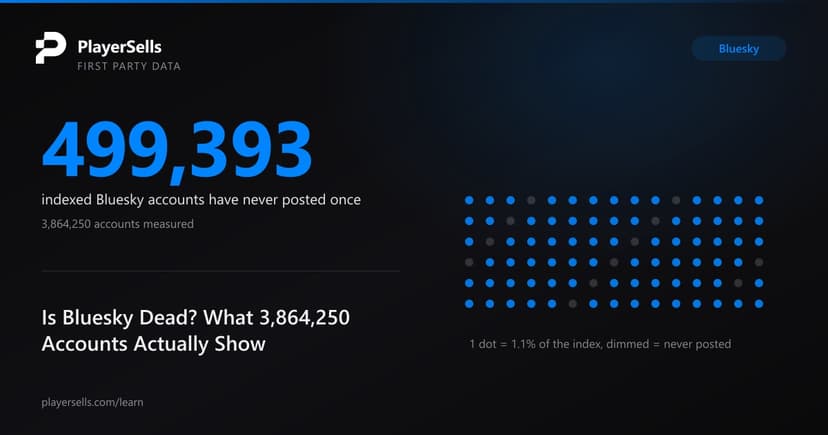
Is Bluesky Dead? What 3,864,250 Accounts Actually Show
Is Bluesky dead? We measured 3,864,250 indexed accounts: 12.9 percent have never posted, and the 29,114 we track daily grew 1.18 percent in 79 days.

LinkedIn Company Page Benchmarks From 29,742 Real Pages
We measured 29,742 LinkedIn company pages. The median engagement rate is 0.1685 percent of followers, not the 2 percent that benchmark posts quote.

Telegram Channel Benchmarks 2026: View Rates, Size, and Growth from 2.4 Million Channels
Telegram view rate benchmarks from 2.4 million indexed channels: 31.3% median at 1K-5K subscribers, 3.3% above 500K, plus 52-day growth by category.