Across 116,351 creator-declared YouTube featured channels links that we crawled between 2026-06-10 and 2026-07-01, the median featured channel is 0.695 times the size of the channel that features it. The direction is not fixed. It flips with size: in our own crawl, channels holding fewer than 100,000 subscribers feature channels a median 2.27 times larger than themselves, while channels above 10 million subscribers feature channels around one eighteenth of their own size. Every one of the 116,351 links carries a measured subscriber count on both endpoints, so we computed that ratio on the whole graph rather than a matched subset.
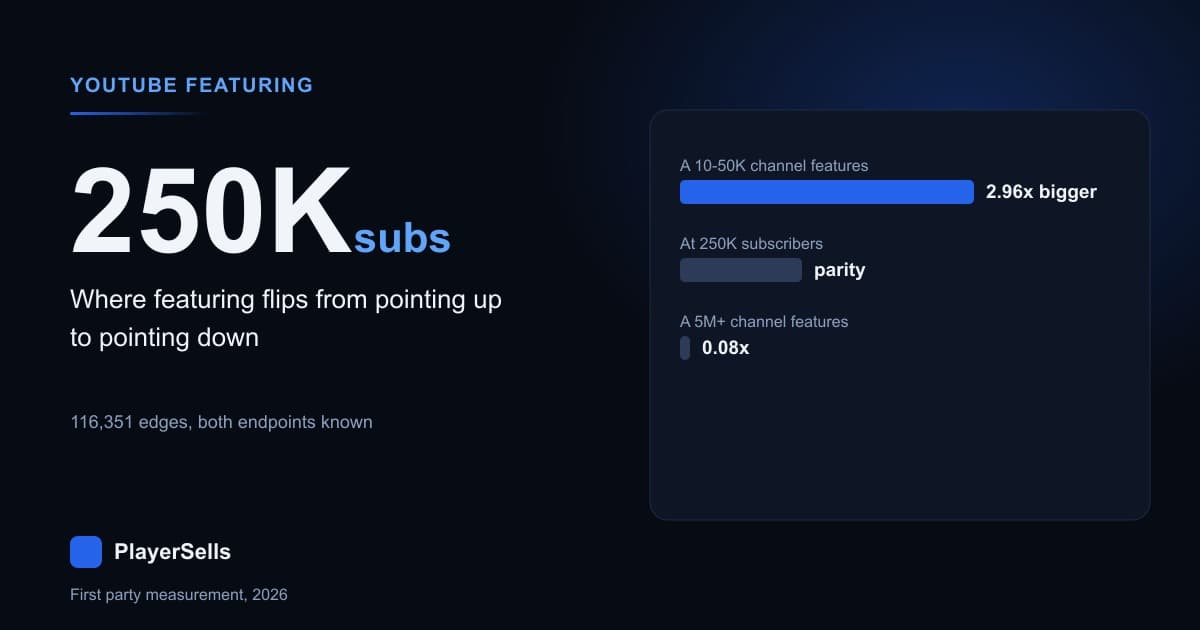
That answers the question the featured shelf is usually asked to settle. Featuring is aspirational for small channels and it is patronage for large ones. Genuine peer-to-peer featuring, defined as a link between two channels within 2x of each other in subscribers, accounts for only 25,759 of the 116,351 links, or 22.1 percent. The crossover sits at roughly 250,000 subscribers. Below that line most of a channel's featured links point up. Above it, most point down.
How we measured the featured graph
YouTube lets a channel publish a list of other channels on its own page. That list is an explicit, creator-declared endorsement, which makes it the cleanest affiliation signal we hold on any platform, because nothing is inferred into it by an algorithm. Our directory stores those links in a single edge table. Measured on 2026-09-02, it holds 116,351 rows, all carrying one edge type, with no duplicated pairs and no self-links, connecting 12,885 source channels to 34,416 distinct destinations inside a directory of 35,149 channels.
The capture window matters more than the row count. Every link in this set was last observed between 2026-06-10 and 2026-07-01, because the expansion crawl that harvests featured lists stalled on 2026-07-01 with two jobs still marked running. Channel profiles kept refreshing after that date, so the subscriber counts are current to 2026-09-02, but the link structure itself is a three-week snapshot from June 2026. Every structural claim below describes that window, not YouTube today.
How many channels actually use the featured shelf?
The naive answer from our directory is 12,885 of 35,149 channels, or 36.7 percent. We rejected that number outright. Our crawl discovered channels in four dated waves, and the share of each wave whose featured list we ever opened falls steadily: 51.7 percent of the 5,408 channels found on 2026-06-10, then 46.8 percent, then 29.7 percent, down to 24.2 percent of the 9,159 found on 2026-07-01. A channel showing zero featured links is often just a channel we never expanded.
The honest denominator is the job queue, not the directory. Our expansion worker recorded a completed featured-list fetch for 18,902 channels, and 12,885 of them, 68.2 percent, list at least one other channel. Roughly one channel in three above the size we crawl publishes an empty featured shelf. Broken out by size the rate barely moves: 69.4 percent above 10 million subscribers, 70.2 percent between 1 and 10 million, 68.8 percent between 100,000 and 1 million, and 65.6 percent below 100,000.
One boundary is hard and worth stating plainly. The smallest channel whose featured list we fetched holds 24,800 subscribers, so nothing in this article describes how a channel with 3,000 subscribers behaves. Anyone sizing up a small acquisition should first check where the channel sits in the full subscriber distribution with our YouTube subscriber rank tool, then decide whether these figures apply at all.
What does a typical featured shelf look like?
Among the 12,885 channels that feature anyone, the median shelf holds 6 channels while the mean holds 9.03, which is the usual signature of a heavy tail. The 75th percentile is 11 channels, the 90th is 20, the 99th is 48, and the longest shelf we recorded holds 362. Nearly four in ten featuring channels list fewer than five. The table below counts those 12,885 channels by how many channels each one lists.
| Channels listed on the featured shelf | Featuring channels | Share of the 12,885 |
|---|---|---|
| 1 to 4 | 4,973 | 38.6% |
| 5 to 9 | 3,835 | 29.8% |
| 10 to 24 | 3,200 | 24.8% |
| 25 to 49 | 764 | 5.9% |
| 50 to 99 | 110 | 0.9% |
| 100 or more | 3 | 0.02% |
The extreme shelves are not the ones a reader would guess. The longest, at 362 links, belongs to Henry the PaleoGuy, a New Zealand channel with 98,800 subscribers. Second is Studio71, a multi-channel network carrying 32,500 subscribers on its own brand channel and 172 outbound links. Third is White Eagle Music Promotion at 29,200 subscribers with 100 links. Those three together account for 0.54 percent of all edges, so they do not move any median quoted here.
Why does the size ratio flip at 250,000 subscribers?
Sorting all 116,351 links by the subscriber ratio between destination and source gives a distribution that is enormously wide rather than centred anywhere: the 10th percentile ratio is 0.018 and the 90th is 13.73. Splitting the links by the size of the channel doing the featuring resolves it. We tested three separate formulations of the same question, and all three put the turning point in the same subscriber band.
| Subscribers of the featuring channel | Links measured | Median size ratio, featured to featuring | Share pointing at a larger channel | Median subscribers of the featured channel |
|---|---|---|---|---|
| 10,000 to 50,000 | 13,071 | 2.96x | 65.5% | 105,000 |
| 50,000 to 100,000 | 16,596 | 1.92x | 61.7% | 139,000 |
| 100,000 to 250,000 | 24,653 | 1.15x | 52.6% | 176,000 |
| 250,000 to 500,000 | 17,386 | 0.75x | 44.7% | 261,000 |
| 500,000 to 1 million | 14,607 | 0.49x | 37.1% | 340,000 |
| 1 million to 5 million | 21,888 | 0.24x | 24.7% | 477,000 |
| 5 million and above | 8,150 | 0.08x | 10.2% | 891,000 |
The last column is the finding underneath the finding. Across a 284x range in the size of the featuring channel, from a median 55,000 subscribers in the smallest tier to a median 15.6 million in the largest, the median featured channel moves only 8.9x, from 105,000 to 891,000 subscribers. The featured shelf regresses hard toward the low six figures. A 20 million subscriber channel and a 40,000 subscriber channel are, in this sample, pointing at broadly the same stratum of YouTube.
That compression has a practical edge for pricing. A featured link from a very large channel is common and cheap in attention terms, because that channel already points downward at a mid-size stratum by default. A link from a channel in the 100,000 to 250,000 band is the scarcer one, because that band is the last one where the median link still points up. Our measurement of what 35,000 YouTube channels reveal about price covers the valuation side of the same directory.
Is featuring reciprocal?
Reciprocity is only measurable where we opened both ends of a link, and that condition holds for 90,493 of the 116,351 edges, or 77.8 percent. Within that measurable subset, 48,334 links are returned by the other channel, which is 53.4 percent. Counted naively across all 116,351 links, ignoring that 25,858 of them point at a channel whose shelf we never read, the figure drops to 41.5 percent.
Neither number is the truth on its own. The destinations we did expand have a median in-degree of 2 and a median 258,000 subscribers, while the destinations we did not expand have a median in-degree of 1 and a median 6,660 subscribers. Our sample of measurable pairs is therefore skewed toward the large, well-connected core of the graph, so 53.4 percent is an upper bound and 41.5 percent is a lower bound. The real reciprocity rate for all YouTube featured channels links sits between them.
| Size gap on the link | Measurable links | Returned by the other channel | Reciprocity rate |
|---|---|---|---|
| Featured channel 10x larger or more | 14,501 | 6,030 | 41.6% |
| Featured channel 2x to 10x larger | 22,934 | 11,461 | 50.0% |
| Within 2x, peer to peer | 24,387 | 13,352 | 54.8% |
| Featured channel 2x to 10x smaller | 18,853 | 11,461 | 60.8% |
| Featured channel 10x smaller or more | 9,818 | 6,030 | 61.4% |
The matching counts in the middle column are a correctness check rather than a coincidence, because a reciprocated pair appears once in an upward band and once in the mirrored downward band. What differs is the denominator, and that is the result. Of the 14,501 measurable links pointing at a channel at least 10x larger, 8,471 were never returned. Of the 9,818 pointing at a channel at least 10x smaller, only 3,788 were never returned. Unanswered attention flows uphill at 2.2 times the rate it flows downhill.
Who gets featured most, and why that is not a popularity ranking
Sorting the 34,416 destinations by how many distinct channels list them produces a table that looks nothing like a YouTube leaderboard. The most-featured channel in the entire crawl holds 17,700 subscribers and appears on 80 shelves, more than any channel of any size in the sample, including one with 515 million subscribers. Nine of the twelve most-featured channels are children's music or cartoon channels, and most of those are language variants of a single network cross-linking its own catalogue.
| Channel | Subscribers | Channels featuring it |
|---|---|---|
| The Supers | 17,700 | 80 |
| Plum the Super Witch | 172,000 | 72 |
| Paramount Plus | 2,290,000 | 62 |
| Farmees | 9,880,000 | 60 |
| Get Movies | 57,100,000 | 59 |
| The Voice Global | 11,600,000 | 58 |
| Junior Squad | 5,460,000 | 58 |
| Kids TV | 31,000,000 | 56 |
Statistically the same point holds across the whole set. The correlation between how often a channel is featured and the log of its subscriber count is 0.304, measured across all 34,416 destinations, which leaves roughly 91 percent of the variation in being featured unexplained by size. Median in-degree by size tier is 5 for channels above 10 million subscribers, 3 between 1 and 10 million, 2 between 100,000 and 1 million, and 1 below 100,000. A 100x difference in size buys a 5x difference in shelf appearances.
Anyone valuing a channel should read that as a warning about a metric that resembles social proof and is mostly a record of shared ownership. Feed the underlying numbers into our YouTube channel value calculator instead of treating a long list of featuring channels as evidence of independent endorsement.
How concentrated is the featured graph?
Featured links are far less concentrated than a follow graph. Of the 34,416 channels that appear on at least one shelf, 19,621, or 57.0 percent, appear on exactly one. Only 2,794, which is 8.1 percent, appear on ten or more, and not a single channel in the sample appears on 100 or more. Median in-degree is 1 and the maximum we observed is 80.
| Slice of the 34,416 featured channels | Share of all 116,351 featured links |
|---|---|
| Top 100 by times featured | 4.20% |
| Top 500 | 15.20% |
| Top 1,000 | 24.59% |
| Top 3,442, the top 10 percent | 49.72% |
Half of all featured links go to the top 10 percent of featured channels, and the other half spread across the remaining 30,974. Part of that flatness is structural, since only 12,885 channels in this snapshot published a shelf at all, which caps how many times anyone can be listed. The rest is real: the featured shelf has no equivalent of a mega-account that everyone follows. Browsing our YouTube channel directory shows the same long tail from the profile side.
Do channels feature inside their own country and language?
Strongly, and this is the one place the graph behaves like a community rather than a catalogue. We compared the observed match rate on each attribute against the chance rate implied by the actual distribution of that attribute across the same links, which is the only fair baseline in a set where one language dominates.
| Attribute | Links where both channels carry a value | Observed match rate | Chance baseline | Lift |
|---|---|---|---|---|
| Country | 89,374 of 116,351 | 59.4% | 11.1% | 5.4x |
| Language | 108,173 of 116,351 | 70.0% | 29.1% | 2.4x |
Country is the sharper signal at 5.4x chance, measured across the 76.8 percent of links where both channels carry a country value. Language runs at 2.4x chance on 93.0 percent of links. For a buyer this is the useful half of the featured shelf: it is a weak guide to size and a poor guide to popularity, but a reliable guide to which national audience a channel actually sits inside. That matters more than raw subscriber count for anyone planning to keep monetisation intact, a subject covered in our guide to what survives a YouTube channel transfer.
What we measured and refused to publish
Four results came out of this dataset and did not make the article. The share of channels that feature anyone, quoted as 36.7 percent of the directory, describes our crawler's expansion frontier rather than YouTube, so it was replaced by the 68.2 percent figure computed against completed fetch jobs. Same-category homophily measured 48.1 percent against an 11.9 percent chance baseline, a 4.0x lift, but the category label is populated on only 47.8 percent of channels and is assigned by our own classifier, which visibly mislabelled several channels inside a twelve-row sample. We dropped it.
Two columns turned out to be unusable as data. The edge weight column holds the value 1 on 116,276 of 116,351 rows and 2 on the other 75, so it carries nothing worth quoting. The adult-content flag is set on 21 of 35,149 channels, which is 0.06 percent and far too thin to support any statement. The channel status column holds a single value across all 35,149 rows. Reporting the kills matters as much as reporting the findings.
One assumption we started with turned out to be wrong in our favour. We expected the subscriber ratio to be computable only on links where both channels happened to sit in the directory, which would have been a biased subset. In fact all 116,351 links have both endpoints present with a subscriber count above zero, because featured links are how channels enter this directory in the first place. The bias sits on the source side instead: nothing below 24,800 subscribers was ever expanded.
What this changes if you are buying or selling a channel
Three practical readings follow from the measurements above. A long featured shelf on a channel you are evaluating is weak evidence of anything, since the longest shelf across 116,351 links belongs to a channel with 98,800 subscribers, and the three longest come from a solo creator, a network and a music promoter. Count who features the channel, not who it features, and then discount that too.
A channel featured by ten or more others sits in the top 8.1 percent of the 34,416 featured channels we measured, which is genuinely uncommon. Check whether those featuring channels share a country and a language with it, because 59.4 percent of links stay inside one country against an 11.1 percent chance rate, and a cluster of same-owner network channels looks identical to organic endorsement until somebody checks. Sellers preparing a channel for our marketplace of live account listings get asked this by serious buyers, and it is worth answering before you list an account for sale.
Finally, treat the featured shelf as a positioning artefact rather than an audience asset. It carries no measurable subscriber flow in this data, and we have not measured whether it survives a transfer intact. Buyers comparing platforms can start from our YouTube channel listings, and anyone who wants the growth side of the same directory should read our measurement of average YouTube channel growth without survivor filters.
Common questions about YouTube featured channels
The questions below come up most often from buyers and sellers reading this data. Every answer is measured across the same 116,351 links captured between 2026-06-10 and 2026-07-01.
What are YouTube featured channels, and where does this data come from?
A featured channel is one a creator has deliberately placed on their own channel page, so it is a declared endorsement rather than an inferred relationship. We crawled 116,351 of these links from 12,885 source channels between 2026-06-10 and 2026-07-01, pointing at 34,416 distinct destinations. All of it sits in our directory of 35,149 YouTube channels, refreshed for subscriber counts through 2026-09-02.
Do bigger channels get featured more often?
Somewhat, but far less than most people expect. The correlation between times featured and log subscriber count is 0.304 across 34,416 channels. Median appearances by size are 5 for channels above 10 million subscribers, 3 between 1 and 10 million, 2 between 100,000 and 1 million, and 1 below 100,000. The single most-featured channel in the sample holds 17,700 subscribers and appears on 80 shelves.
How often do two channels feature each other?
Between 41.5 and 53.4 percent of the time. Reciprocity is only measurable on the 90,493 links where we opened both channels, and 53.4 percent of those are returned. Because the channels we opened skew larger and better connected, with a median 258,000 subscribers against 6,660 for the ones we did not open, that 53.4 percent is an upper bound and the all-links figure of 41.5 percent is a lower bound.
Does a long featured list mean a channel is well connected?
No. The median featuring channel lists 6 channels and the 99th percentile lists 48, but the three longest shelves in the data belong to channels with 98,800, 32,500 and 29,200 subscribers, two of which are a network and a music promoter listing their own roster. A long shelf usually indicates shared ownership or a promotional arrangement rather than standing in a community.
Should a buyer treat a featured list as part of what they are buying?
Treat it as positioning evidence, not as an asset. It is a reliable guide to which national audience a channel sits inside, since 59.4 percent of the 89,374 country-labelled links stay within one country against an 11.1 percent chance rate. It is a poor guide to size, since only 22.1 percent of the 116,351 links connect channels within 2x of each other. We have not measured whether a featured list survives a channel transfer.
What share of channels feature nobody at all?
About 31.8 percent, measured on the 18,902 channels whose featured list we actually fetched. The rate is nearly flat across sizes, running from 65.6 percent of channels below 100,000 subscribers publishing a non-empty shelf up to 70.2 percent of channels between 1 and 10 million. The smallest channel we expanded held 24,800 subscribers, so this says nothing about channels below that line.
Related Articles
Continue learning with these related guides.
Does Twitch Account Age Still Matter? We Measured 432,192
Across 432,192 Twitch channels read on 2026-09-08, account age is almost pure accumulation, and at a matched follower count the newer channel wins.
X Bookmark Rate Benchmarks From 94,318 Scored Accounts
Half the X accounts we scored on ten or more posts bookmark under 0.0273% of their views, and a third of original posts get no bookmarks at all.